Five ways big data and integration enables the factory of the future

(c)iStock.com/sorbetto

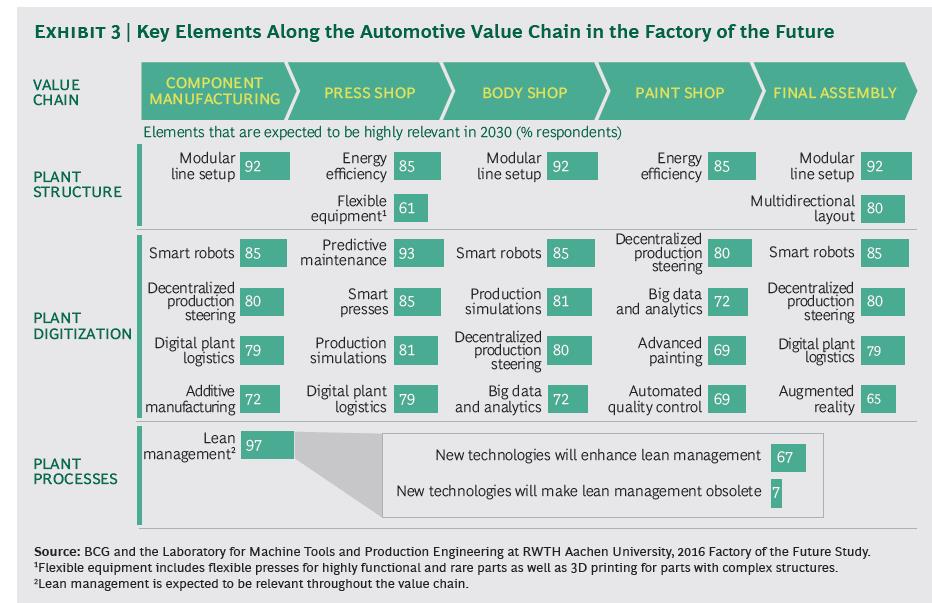
  • 93% of global product leaders say that predictive maintenance combined with real-time equipment monitoring enabled by integration is a must-have for factory planning today.
  • 75% of global product leaders plan to implement factory of the future initiatives and programs in the next five years or less, starting with Industry 4.0
  • 67% of automotive executives expect that new technologies enabled by real-time integration will enable their teams to reach and exceed lean management and continuous improvement goals starting this year and accelerating through 2030.

Boston Consulting Group’s recent article, The Factory of the Future provides insights into a recent global survey the consulting firm conducted of more than 750 manufacturing product leaders from leading companies in three industrial sectors: automotive (which includes suppliers and original equipment manufacturers, or OEMs), engineered products, and process industries.

The survey’s objective is to define the vision for the factory of the future in 2030.  Determining long-term benefits and the roadmap to implementation are also goals of the study Boston Consulting Group (BCG) and its research partner, the Laboratory for Machine Tools and Production Engineering at RWTH Aachen University, achieved. The Factory of the Future is a vision for how manufacturers should enhance production by making improvements in three dimensions: plant structure, plant digitisation, and plant processes.

Five ways integration fuels the factory of the future’s growth

Real-time integration based on intelligent objects that connect diverse enterprise systems including SAP, Salesforce and others is the foundation that manufacturing companies must adopt to excel in their Factory of the Future efforts. These real-time objects illustrate the future of Application Programmer Interfaces (API).  APIs that will fuel and drive the Factory of the Future will enrich each real-time integration points across manufacturing networks. Intelligent Objects pervasively used today are the precursors to the most valuable APIs that will enable Factories of the Future tomorrow. With APIs continually improving and gaining the capability to provide insight and intelligence, the essential role of real-time integration in all factories of the future becomes clear.

The following are the five ways integration is enabling the Factory of the Future today:

Real-time integration enables the value chains supporting the Factories of the Future to continually accelerate, excel and improve with additional insight that drives future growth strategies. Bringing greater intelligence into each integration point across the value chains supporting the Factories of the Future leads to new technologies delivering greater lean management benefits. Real-time integration will deliver strong benefits in the areas of lean management, predictive maintenance, modular line setups, and the orchestration and collaboration of smart robots.
factory-of-the-future-1

The Implementation Roadmap for the Factory of the Future shows how critical real-time integration is to the Factory of the Future’s vision being attained. Multidirectional layouts, modular line setups, sustainable production, the orchestration of smart and collaborative robotics and attainment of big data and analytics plans all are dependent on real-time integration. The following graphic from the study illustrates just how central integration is to the optimizing of plant structure and plant digitisation.

factory-of-the-future-2

By integrating large-scale enterprise systems including those from SAP, Salesforce and others with legacy, 3rd party and homegrown systems, every area of production quality will improve. The most urgent need global manufacturers have is finding new ways to improve product, process and service quality without raising costs. Improving the quality of these three dimensions makes any manufacturer more trusted and successful in selling next-generation products.  By aggregating data using real-time integration so that big data and advanced analytics can be used to find new patterns, some of the world’s most well-known manufacturers are excelling on product quality. To produce cylinder heads at its plant in Untertürkheim, Germany, Mercedes-Benz uses predictive analytics to examine more than 600 parameters that influence quality. Mercedes-Benz is an early adopter of using Big Data and advanced analytics to improve quality management and bring high precision to engineering. Bosch has implemented software that analyzes data about its production of fuel injectors in real time. The software monitors process adherence and recognises trends. It automatically transmits information about deviations to operators, allowing them to improve the process accordingly.

Real-time integration across and within manufacturing systems enables multi-directional layouts of production workflows. The Audi R8 manufacturing facility in Heilbronn, Germany, does not have a fixed conveyor so the teams there has greater multidirectional flexibility in building customised vehicles.  Real-time integration across the Audi factory floor is essential to provide R8 production teams with the specifics of how they can best collaborate and deliver the highest quality vehicles in the shortest amount of time. Real-time integration is enabling driverless transport systems, guided by a laser scanner and radio frequency identification technology in the floor, which moves the car bodies through the assembly process. These systems enable assembly layout changes quickly with no impact on existing production. Enabling real-time integration often involves extensive field mapping between different systems, which is a lengthy and error-prone process. Integration technology provider enosiX has developed a unique, real-time integration technology that obsoletes the need for field mapping and supports bi-directional data updates.

Enabling the Factory of the Future’s production operations to flex in response to rapidly changing customer requirements is entirely dependent on real-time, reliable integration of production and customer-facing systems. The implications of the study on the future of manufacturing underscore just how critical it is for manufacturers to be agile enough to create entirely new business models while gaining insight and intelligence into how they can continually improve lean manufacturing. When real-time integration unifies a value chain for any manufacturer, their speed, scale and ability to simplify the complex processes required to serve customers turns into a formidable competitive advantage.

Comparing Parallels Desktop to Boot Camp: Opening a web page in IE

Sometimes you encounter a website that requires Internet Explorer (IE), as in Figure 1. This blog post will compare opening IE for such a website on your Mac using Parallels Desktop 12, and using Boot Camp. Both alternatives here use a 2012 MacBook Pro running macOS Sierra (10.12.1) and Windows 10. Bottom Line: While the […]

The post Comparing Parallels Desktop to Boot Camp: Opening a web page in IE appeared first on Parallels Blog.

AI-Defined Infrastructure: AiDI | @CloudExpo @ReneBuest #AI #ML #SDI #AiDI

Software-defined infrastructure (SDI) is one of the most popular and ongoing trends within datacenters and cloud environments leading to better infrastructure flexibility by developing the infrastructure based on scripts respectively source code. However, SDIs are more and more becoming just a means to an end since automation, sophisticated algorithms and thus intelligent systems are leading to an Artificial Intelligence defined Infrastructure (AI-defined Infrastructure – AiDI).

read more

[webinar] How to Be a Compassionate Geek | @CloudExpo @Citrix #API #Cloud #DevOps

Have you ever noticed how some IT people seem to lead successful, rewarding, and satisfying lives and careers, while others struggle? IT author and speaker Don Crawley uncovered the five principles that successful IT people use to build satisfying lives and careers and he shares them in this fast-paced, thought-provoking webinar.
You’ll learn the importance of striking a balance with technical skills and people skills, challenge your pre-existing ideas about IT customer service, and gain new insights into how to build your own satisfying and rewarding career by rising above the ordinary and mundane to build an extraordinary life and career as a world-class Compassionate Geek.

read more

Cloud’s Wide Reach Among Dutch Businesses

We know Netherlands for their beautiful canals and magnificent dykes, but did you know about their high levels of cloud adoption?

A quick research shows that most large and medium organizations use cloud in one form or another. Take their Central Bank, for example. Many of their applications are in the cloud, and so is it with multinational companies, school systems and more.

A detailed study was conducted by an IT training provider called Global Knowledge in December 2016. This study included 500 Dutch companies, all of which were asked about their cloud usage including their SaaS, IaaS, PaaS and other aspects of cloud. The results showed that an astounding 75 percent of companies use cloud, and these numbers are only expected to increase in the coming years.

The participants of this study said that the main reason for them to move to the cloud is the flexibility and scalability that comes with it. They have seen their business performance improve and their upfront investment costs in hardware and software come down, and this is why many of them plan to completely move to the cloud soon.

Let’s take a few case studies to see how cloud has impacted the Dutch market. The Voice of Holland is a television talent show that saw a huge surge in network traffic on the final day of the season. Despite a sudden surge in traffic, there were no network breakdowns or distributed denial of service (DDoS) attacks. On the contrary, the network scaled up, and everything turned out to be fine.

This TV show uses cloud to increase or decrease its capacity, based on the number of users. The initial few weeks of the show will see a relatively lesser number of users when compared to the latter weeks when interest picks up and everyone wants to see the winner of the season. Since cloud makes it easy to scale up or down seamlessly, it has really helped this TV show to have a cost-effective operational model.

Another example of a Dutch company that uses cloud is Aviko, an international potato processing company. It adopted Amazon Web Service (AWS) only about six months ago, and this move has paid rich benefits for the company. When it had an opportunity to expand to China, this partnership with AWS helped to create the right hardware and computing infrastructure for the company.

Before AWS, Aviko was using SAP’s ERP, and the company is sure that it wouldn’t have helped its new center in Inner Mongolia to connect to its headquarters in Netherlands. To top it, there were restrictions on Internet usage by the Chinese government and this created a lot of latency and VPN-related issues. It was then that the company decided to have a copy running in China’s AWS, as this seemed like a simple plan. Today, Aviko is a well-established supplier in the Chinese market and is looking for more expansion within China. In this sense, this move to AWS has been helpful for its expansion plans.

These case studies show how Dutch businesses make the most of what cloud offers. Maybe there’s a lesson for each of us here!

The post Cloud’s Wide Reach Among Dutch Businesses appeared first on Cloud News Daily.

What Is DNS? | @CloudExpo #Cloud #Security #APM #Monitoring

Imagine how difficult it would be to use the Internet if you had to remember dozens of number combinations to do anything. The Domain Name System (DNS) was created in 1983 to enable humans to easily identify all the computers, services, and resources connected to the Internet by name—instead of by Internet Protocol (IP) address, an increasingly difficult-to-memorize string of information. Think of all the website domain names you know off the top of your head and how hard it would be to memorize specific IP addresses for all those domain names. Think of DNS as the Internet’s phone book. A DNS server translates the domain names you type into a browser, like www.f5.com, into an IP address (104.219.105.148), which allows your device to find the resource you’re looking for on the Internet.

read more

2017 #IIoT Predictions | @ThingsExpo #IoT #M2M #AI #DigitalTransformation

Predictions can be enlightening as we round out the end of the year, and industry analysts covering the Industrial Internet of Things (IIoT) have begun forecasting what to expect in 2017. In the ever changing digital business landscape, companies need to keep a pulse on the technology and regulatory environments to have direction on where to focus their efforts. Over the past few years, IIoT has taken on the shared title of industry 4.0, as new ways of connecting businesses and consumers impact systems infrastructures and technology integrations across many, if not all. business lines.

read more

Ransomware in the Age of #SaaS | @CloudExpo SDN #AI #ML #CloudSecurity

Recent market analysis from Cisco demonstrates the torrid adoption of cloud-based services. By 2019, more than four-fifths of all data center traffic, 83 percent, will be based in the cloud (up from 65 percent today). Most of this action will be going to public cloud services, which will account for 56 percent of all cloud workloads. In terms of type of cloud services, a majority will be applications, as the study finds Software as a Service (SaaS) is and will continue to be the dominant mode. Currently, about 45 percent of cloud implementations are SaaS; this figure is expected to grow to 59 percent by 2019, and SaaS adoption is particularly widespread among SMBs.

read more

CI/CD Pipelines | @DevOpsSummit #AI #ML #CI #CD #DevOps #Monitoring

For a while already we have been working with a large enterprise client, helping them to migrate their on-premise workloads to the cloud. Of course, as added value to the process, they are also migrating their legacy development processes to the modern, better, agile DevOps approach. And of course, they have built a modern Continuous Integration/Continuous Delivery […]

read more

910Telecom at @CloudExpo | @910Telecom #Mobile #AI #T1 #IoT #GigE #DS3

910Telecom exhibited at the 19th International Cloud Expo, which took place at the Santa Clara Convention Center in Santa Clara, CA, in November 2016. Housed in the classic Denver Gas & Electric Building, 910 15th St., 910Telecom is a carrier-neutral telecom hotel located in the heart of Denver. Adjacent to CenturyLink, AT&T, and Denver Main, 910Telecom offers connectivity to all major carriers, Internet service providers, Internet backbones and exchanges.

read more

The cloud news categorized.