Q&A: UK Cloud Awards judge Anthony Hodson


Cloud Pro

3 Mar, 2020

Please could you tell us a little bit more about who you are and what you do?

I am an AWS Solution Architect and Consultant working for Managed Service Provider (MSP), Ensono. Ensono serves mid-tier to large enterprises. I help enterprises understand the opportunities cloud has, and then move workloads into or grow workloads within AWS’ cloud. My background spans traditional managed hosting, DevOps tooling and advisory, and Fintech. I enjoy seeing the progress that cloud can bring.

How would you describe the UK Cloud Awards in three words? 

Commending Cloud Creativity

What appealed to you about becoming a judge for this year’s UK Cloud Awards? 

In addition to the splendid party, I wanted to hear the innovations and results that have been delivered in 2019. I can then use this inspire those I speak with in my day job.

What are you most looking forward to about being involved in this year’s awards?

The quality of submissions last year was high. I’m looking forward to more stories of innovation and collaboration and I’m hoping for some that don’t just take a bigger share of the market but make the market bigger.

This year’s awards have had a bit of a makeover, with new categories and some other tweaks. Tell us why people should be getting excited about all of that/the awards? 

This year we’re focusing less on products (three categories) and more on successful projects (ten categories) and recognition for outstanding contributions (five categories). This means, to be recognised, it’s about what the people managed to achieve. We want to recognise those who’ve made the biggest and most innovative strides in progress; Afterall productization can only come after a successful pilot.

Do you have a category/categories you’re most excited about? 

The Internet of Things (IoT) is an area where we see technology enter our day-to-day world. This year we have a new category ‘IoT project of the year.’ I hope to learn how these sensors can be used to improve life on the spinning rock we call home.

What are you looking for when you’re reading an entry? How can people make sure theirs stands out? 

When I read an entry I’m looking for a good story: what was the problem and how did you know there was one? Why should we care? What were the challenges to overcome it? What roles were played and who made up the team? Finally, what measurable outcome was there and what lays ahead in the sequel? Sending marketing material off the website usually does not achieve this.

What would you say to those thinking about entering but haven’t fully decided to do so as yet?

Putting together an entry that explains what you’ve created, why it was hard and what outcomes were achieved, for whom is the basis for many a good sales pitch. Crystallising this into a concise and moving piece will not only offer the chance of industry recognition but it’ll arm you internally with getting more backing for future projects, thereby extending out the ‘DevOps ripple of progress’.

Do you have a standout cloud moment from 2019?

Personally I particularly enjoyed my time with the CIF and the Containers and Functions as a Service webinar. From a technology perspective, I was excited to see AWS release its ‘serverless’ Kubernetes offering AWS ECS Fargate, in doing so, taking out more ‘undifferentiated heavy lifting’ shortening the cycle from idea to delivery.

What are your top 3 cloud predictions for 2020?

1. AWS provides a fully-integrated Disaster Recovery as a Service, manifested through a check-box in the console (or API of-course)
2. Hyperscale providers will continue to hope their customers align with a single hyperscale cloud; the market (driven by compliance and risk mitigation) moves towards multi-hyperscale cloud, those savvy enough use Kubernetes to do this. Google takes the ground as the secondary site for these differentiator workloads (being the Kubernetes mothership).
3. AWS’ CEO Andy Jassy’s love for Vintage Rock spills out of the Re:invent AWS keynote into the AWS re:play party with the Eagles returning from retirement…

Is there anything else you would like to add?

All too often in technology, I see great work where it’s hard to prove it made a measurable impact. When you start a project (or write about a successful project), find some data which gives a base-line: ideally, it’s quantifiable, it could be qualitative (surveys even). For advice and inspiration read (or listen) to Nicole Forsgren’s / Jezz Humble / Gene Kim book ‘Accelerate’ Note there are free chapters on Google books.

Cloud computing accelerating climate change is a misnomer, scientists find

Data centre workloads, powered by the rise in cloud computing, may not be the threat to the climate many have feared, according to a new report.

The study, published in the journal Science last week, argued that while global data centre energy has increased over the past decade, this growth is negligible compared with the rise of workloads during that time.

According to the research, 2018 saw global data centre usage pinned at 205 terawatt-hours (TWhs), comprising around 1% of global electricity consumption. This represents a 6% uptick compared with 2020 figures, yet global data centre compute instances rose by 550% over that time. To put it as energy use per compute instance, the intensity of energy used by global data centres has decreased by 20% annually since 2010.

The paper cites various improvements as key to this change. Greater server virtualisation has meant a sixfold increase in compute instances with only a 25% rise in server energy use, according to the research. More energy-efficient port technologies, the report cites, have enabled a 10-fold increase in data centre IP traffic with only ‘modest’ increases in network device energy usage.

What’s more, the rise of the hyperscalers has helped. The move away from more traditional, smaller data centres – comprising almost four in five compute instances in 2010 – has resulted in greater PUE (power usage effectiveness) due to power supply efficiencies, as well as stronger cooling systems. Hyperscale data centres, as part of larger, more energy-efficient cloud data centres, now make up 89% of compute instances in 2018, the report estimates.

The average PUE per data centre has dropped to 0.75 in 2018, representing a significant improvement. When this publication attended the opening of Rackspace’s UK data centre campus in 2015, the PUE was 1.15, which at the time was noted as ‘almost unheard of in commercially available multi-tenant data centres.’

Plenty of initiatives are taking place which show how the industry is looking to harness the planet’s natural cooling systems to create a more sustainable future. In September, SIMEC Atlantis Energy announced plans to build an ocean-powered data centre in Caithness, off the Scottish coast. The company, who according to reports is in the process of arranging commercial deals for the site, is following in the footsteps of Microsoft, who experimented with placing a data centre underwater in 2018 off Orkney.

The naturally cooler temperatures of islands in the northern hemisphere, most notably Scandinavia, have long since been seen as advantageous. In what was seen as a landmark ruling in 2016, the Swedish government confirmed data centre operators would be subject to reduction in electricity taxation, putting the industry on a similar footing as manufacturing among others.

In terms of the hyperscale cloud providers, Google touts itself as leading the way, saying as far back as April 2018 that it had become the first public cloud provider to run all its clouds on renewable energy. The company says its PUE across all data centres for 2019 was at 1.1, citing favourably an industry average of 1.67.

Following the release of the Science report, Urs Holzle, SVP for technical infrastructure at Google Cloud, said the findings ‘validated’ the company’s efforts, which included utilising machine learning to automatically optimise cooling, and smart sensors for temperature control. “We’ll continue to deploy new technologies and share the lessons we learn in the process, design the most efficient data centres possible, and disclose data on our progress,” wrote Holzle.

Amazon Web Services (AWS), the leader in cloud infrastructure, says that as of 2018 it exceeded 50% renewable energy usage and has ‘made a lot of progress’ on its commitment to 100% renewable usage. The company has previously received criticism, with a report from Greenpeace this time last year saying AWS ‘appears to have abandoned its commitment to renewable energy’. Last month, Amazon CEO Jeff Bezos said he would commit $10 billion to address climate change.

CloudTech contacted AWS for comment and was pointed in the direction of a 451 Research report from November which found that AWS’ infrastructure was 3.6 times more energy efficient than the median of enterprise data centres surveyed.

One potential future area of concern with regard to computational power is that of Bitcoin. The energy required to mine the cryptocurrency has led to various headlines, with the University of Cambridge arguing that Bitcoin’s energy usage, based on TWh per year, equalled that of Switzerland. Pat Gelsinger, the CEO of VMware, previously said when exploring the concept of ‘green blockchain’ that the energy required to process it was ‘almost criminal.’

Michel Rauchs, who worked on the Cambridge project, is speaking at Blockchain Expo later this month on whether Bitcoin is ‘boiling the oceans.’ His argument is that the question is more nuanced than many believe – not helped by the extremist opinions on both sides.

“The way that Bitcoin is being valued for different people right now is completely subjective,” Rauchs tells CloudTech. “For some people it’s really an essential; for other people it’s some sort of gimmick, and it’s definitely not worth the electricity it consumes.

“There is no easy answer,” he adds. “The only thing that we can say today is that Bitcoin right now is at least not directly contributing to climate change, though the level of energy consumption is really high. You need to look at the energy mix – what sources of energy are going into producing that electricity.”

The report concludes that, despite the good news, the IT industry, data centre operators and policy makers cannot ‘rest on their laurels’. If Moore’s Law is anything to go by – albeit a long-standing dictum which may be reaching the end of its natural life itself – demand will continue to proliferate, with the next doubling of global data centre compute instances predicted to occur within the next four years.

You can read the full article here (preview only, client access required).

https://www.cybersecuritycloudexpo.com/wp-content/uploads/2018/09/cyber-security-world-series-1.pngInterested in hearing industry leaders discuss subjects like this and sharing their experiences and use-cases? Attend the Cyber Security & Cloud Expo World Series with upcoming events in Silicon Valley, London and Amsterdam to learn more.

Microsoft refreshes Teams with new integrations


Bobby Hellard

3 Mar, 2020

Microsoft has integrated Outlook with its Teams platform, along with a host of changes to make the communications platform more efficient to businesses.

The new features are available from March and are a strategic push from the tech giant to make Teams the ultimate enterprise communications platform.

Users can now move an email conversation directly from Outlook into a Teams chat, simply by clicking a button, and also move the conversations the other way into emails.

There are also options for tagging members of an organisation, so users can target messages (similar to Slack). For example, a manager can @mention their entire department in a given channel and get their message out to the relevant people at once.

What’s more, there’s also a feature to create an «org-wide» (organisation-wide) conversation. This is mostly for small and medium-sized businesses, which have less than 5,000 employees.

Calls and meetings have also seen changes as Microsoft has added live captions. This can be turned on during a call and will subtitle what the parties are saying in real-time. This, the company said, will help when calls are made from busy places, where words can be lost in the background noise.

The feature is only available in English at the moment, but there are plans to offer more languages in the near future.

Security has also been given a boost with new measures that let administrators monitor the content shared on the platform. This is a new feature where private channel chats can be placed on hold in a stored mailbox, should it be necessary for a message on a certain topic to be saved.

This also includes a communication compliance feature that both minimises HR risks to the business and helps administrators detect, capture and take remediation actions for inappropriate messages.

The COVID-19 coronavirus outbreak is the cloud’s chance to shine


Bobby Hellard

3 Mar, 2020

In one of my favourite episodes of The Simpson, Mr Burns opens a casino in Springfield and locks himself away in a panic room. He watches all the other characters as they gamble on CCTV, zooming in to see the spread of germs. He becomes paranoid, refusing to leave the room and letting his beard and nails grow ridiculously long as he slowly descends into madness. 

Such is the tattered reputation of Facebook, it’s easy to picture Mark Zuckerberg holed up in a panic room watching a crowd of developers cough and spread the outbreak of COVID-19 coronavirus all over San Francisco. Thankfully, the company has put health and safety first and cancelled the F8 conference.

Google has done the same, deciding to “reimagine” Cloud Next 20 as a virtual conference due to the growing concerns over the impact of COVID-19. Currently, the concerns are that it is likely to spread to major cities. The World Health Organisation (WHO) has said it puts the world in “uncharted territory”, but it can be contained with the right measures. 

Cancelling big events is a very good measure, in my opinion, but what’s even better – particularly for technology companies – is that they use the cloud computing they champion to showcase what it can actually do. You don’t need to travel anywhere when you can see it all via the internet – we can all be Monty Burns. 

This is what Google has chosen to do with Cloud Next 20. It’s now a “free, global, digital-first, multi-day event”, the company has announced. This will include streamed keynotes where you won’t have to get dressed and you won’t lose your seat if you go get a cuppa. You can also see the breakout sessions, talk to the experts and check out all the new products and services without leaving your house. 

It probably couldn’t have been set up in such a short time, but this would have also been a perfect opportunity to use virtual and augmented reality technologies. Imagine popping a headset on and your living room turns into one of Google’s breakout sessions. This was done for an Oculus event in 2018, so it is very much possible. There is so much more we can do with cloud computing and it seems that COVID-19 might be the catalyst for us to find out what. 

Anyone who attends the big tech events knows that they are huge. A company usually spreads its keynote and other sessions around a building that’s often too big to see all of it. You need a strict plan to get in, see the whole three hours of what the CEO and their co-presenters have to say and then sprint off to meet with developers, experts or journalists in some far-flung corner. Wouldn’t it be better for all involved if instead, on your laptop in the comfort of your own home, you can just click your way around – or have multiple meetings at once and conserve finger energy. 

This could also be an everyday reality (for some of us) as governments around the world look set to advise people to work from home. People in California have tested positive for COVID-19 and Italy’s Serie A football league has been put on hold as cases have popped up in northern parts of the country. It’s shutdown factories and offices across China and is now wreaking chaos across South Korea. There is a likelihood that it’s coming to a town near you too, with 39 reported cases in the UK, according to Sky. While we can all do our bit and wash our hands and avoid unnecessary travel, working remotely might just be the best solution for containment. 

I would put forward a concern about Wi-Fi speeds, given the UK isn’t exactly leading the way in that area. And, there’s also the likelihood of outages as more and more of us lean on the internet for work, but hey, that probably isn’t as frustrating as spreading a virus that’s potentially deadly to those with existing conditions.

COVID-19 isn’t a pandemic yet – why not log in to the cloud and keep it that way? Open all the platforms and services your laptop can manage, pull-on a VR headset and immerse yourself in work, virtually. You can attend all the technology conferences you want via the internet and, best of all, getting dressed is optional.

How women in cloud are challenging the narrative


Keumars Afifi-Sabet

3 Mar, 2020

It’s no secret the IT industry is heavily male-dominated, with women traditionally struggling to achieve representation for reasons ranging from implicit bias to discouragement from taking up STEM subjects at school. 

While there are plenty of success stories, important to recognise as we approach International Women’s Day, there are also tales that speak to toxic work cultures, workplace discrimination, and women being overlooked for opportunities.

The last few years have heard a crescendo in the commotion on ‘women in tech’, although it’s hardly translated into concrete improvements. For instance, progress has stalled for the Tech Talent Charter (TTC), an organisation dedicated to raising gender balance in the UK. Women held just 24% of technical roles among TTC signatories last year, a 2% dip against figures from 2018. 

The picture isn’t unified across the entire tech landscape, however. The exciting frontier of cloud computing is challenging the narrative, Ingram Micro Cloud’s Microsoft business manager Violetta Yordanova tells Cloud Pro, with the sector’s rapid expansion opening up new opportunities and roles for women to fill.

“As cloud is a relatively new technology, my experience of being a ‘woman in tech’ may not be typical, as the cloud industry is extremely diverse,” Yordanova says. “In fact, my team has an equal gender split with a real mix of personalities, cultures and strengths from people who grew up with this technology.”

Her experiences are reflected by those of F5 Networks’ principal threat evangelist with the office of the CTO, Lori MacVittie, who feels the cloud industry is more welcoming because there’s less of an ‘establishment’.

“Whether it’s coincidental or not, the rise of cloud was accompanied by a significant drive to recognise and support women ‘in cloud’,” MacVittie explains. “The culture of the cloud industry is very welcoming and cloud as a technology is often credited as democratising the resources needed for women to take their place as entrepreneurs.”

Startups tend to be more progressive because technology has allowed women to more effectively drive their ideas to fruition, she adds. There’s been an explosion of women-led cloud startups, partially fuelled by a rise of flexible working practices.

“The adoption of cloud-based solutions in the workplace has also meant that it’s easier to balance work and life, because the tools you need to work are always accessible from anywhere – even home,” she continues. “I see that accessibility as broadening corporate acceptance of remote work when it’s necessary and alleviates stress on women who struggle with work-life balance.”

While many, including MacVittie and Yordanova, recognise differences, for senior software engineer with Red Hat, Rebecca Simmonds, these are few and far between, despite the fact the growing cloud segment is fed with plenty of resources, she tells Cloud Pro.

“At Red Hat, we have equal opportunities for all of the different sectors in the company, not just cloud. So my experience as I have moved around different companies is that as long as you are willing to work hard then there are similar opportunities in any of the tech sectors,” Simmonds says.

Despite these opportunities, the challenges that women face persist, albeit differing from person-to-person. For Simmonds, as she moved from a startup to a Java EE company, and then to Red Hat, she has felt pressured into always needing to demonstrate her expertise.

“Proving myself and making a great impression when meeting people has been the biggest challenge I had to tackle,” she says. “Women in the tech sector are still stigmatised, and I constantly feel pressured to demonstrate my knowledge. The good thing is that it’s really motivated me to work harder, push my limits, and fight the stereotypes in the industry.”

It’s similar to the experiences of F5 Networks’ MacVittie, meanwhile, who hasn’t come across many roadblocks based on her gender, although there are aspects of workplace relationships with men that have proven frustrating.

“Throughout my career I have experienced male colleagues who wouldn’t take direction from a woman, and also men at conferences who are completely taken aback when they realise I know what I am talking about,” she says. “My question is, what made you assume I didn’t? It’s frustrating but something I try to move past quickly – you can’t let people like that bring you down!”

She also sees wrestling with career progression a major challenge, especially as women become more established in their roles and industries. There are, she adds, fewer options to progress the more established one becomes, with women having to be more strategic about their personal development to ensure they have the skills needed to advance.

“The challenge, in early stages, is to establish yourself in your field of expertise and figure out how to build a reputation that will help you later when you start planning more strategically. Choosing a company that best suits your priorities for your career and life is an important factor in balancing both. If your priority is family, you don’t want to work for a company that doesn’t respect that. If your priority is your career, you want to make sure there are opportunities to [progress] where you work.”

This represents only half of the equation, however, argues head of EMEA and VP of global customer experience with Dropbox, Adrienne Gormley. Effective management plays a critical role in personal development, and women must be empowered to feel at ease with the demands of their work and home lives. 

“I really believe that it’s part of being an effective manager today to help others balance their life at home with work, and to model setting boundaries for your team,” she says. “We can bring empathy for the pressures of home life into the workplace, underlining that we understand the demands on individuals, whether as parents, or carers looking after a relative or other commitments. Looking at how we can make the workplace easier for people is deeply important to me: how we can help alleviate the pressure of trying to do it all.”

Gormley’s biggest piece of advice is for women to set their boundaries early on in their careers, and take an active role in their futures. Moreover, if something isn’t working, take a risk and speak up, or ultimately make a move. 

“Different people will be there for you, but they come and go, ultimately it’s your journey. The sooner you understand that, the sooner you can really be empowered to make choices and changes, and your actions will help shape the workplace at large.”

Q&A: UK Cloud Awards judge Rob Lamb


Cloud Pro

2 Mar, 2020

Please could you tell us a little bit more about who you are and what you do
My role at Dell Technologies is to bring industry expertise and transformation experience to help customers achieve key business outcomes in times of big change. My aim is to counsel them on how they can accelerate their IT transformation while balancing the need for consistent delivery and helping drive the cultural change associated with such initiatives – the magnitude of cultural and operating model change is often underestimated.
How would you describe the UK Cloud Awards in a nutshell?
The opportunity for people to receive industry recognition for their efforts and initiatives.
What appealed to you about becoming a judge for this year’s UK Cloud Awards?
The quality and breadth of the entries last year was fantastic, and I thoroughly enjoyed reading and reviewing them.
What are you most looking forward to about being involved in this year’s awards?
The new categories are exciting and I’m looking forward to reading the entries.
This year’s awards have had a bit of a makeover, with new categories and some other tweaks. Tell us why people should be getting excited about all of that/the awards?
Now in their seventh year, the UK Cloud Awards celebrates the diversity, innovation, excellence, of entries across 20 categories and will provide entrants a showcase for their efforts. The new categories really broaden the appeal of the awards.
Do you have a category/categories you’re most excited about?
I am really looking forward to the new people-centric categories, and especially the Positive Action Award
What are you looking for when you’re reading an entry? How can people make sure theirs stands out?
Make it real – talk about tangible business outcomes – then prove them. It mustn’t be technology for technology’s sake, there must be a positive impact. Don’t play down the challenges, we all know they happen so don’t gloss over them.
Talking about the challenges can bring your story to life. Short, sharp and punchy catches the eye.
What would you say to those thinking about entering but haven’t fully decided to do so as yet?
What are you waiting for? If you’re proud of a project, if it had a real business outcome and made a difference then why aren’t you writing it up and submitting it?
Do you have a standout cloud moment from 2019?
I think for me it has been the realisation by the industry, especially customers/consumers, that a single cloud isn’t the answer and that multi-cloud is going to be of greater importance in the strategies of enterprises in order to address all their workloads.
What are your top three cloud predictions for 2020?
1) 2019 saw the realisation that multi-cloud is industry direction of travel. This and edge computing will continue to be the aspiration for customers in 2020.
2) Security will continue to be a significant focus. Recent breaches have brought attention to the challenge of securing apps and data in a multi-cloud world.
3) Administration of this evolving cloud landscape will see fundamental changes coming in
terms of how it's all administered.

IDC notes IT spending decline – yet sees the upside for private cloud infrastructure

Hyperscale cloud providers are experiencing some market saturation. Vendor revenue from IT infrastructure products (server, enterprise storage, and Ethernet switch) for cloud environments, including public and private cloud, declined in the third quarter of 2019 (3Q19) as the overall IT infrastructure market continues to experience weakening sales following strong growth in 2018.

The decline of 1.8 percent year-over-year was much softer than in 2Q19 as the overall spend on IT infrastructure for cloud environments reached $16.8 billion, according to the latest market study by International Data Corporation (IDC).

As a result, IDC chose to slightly increase its forecast for total spending on cloud IT infrastructure in 2019 to $65.4 billion. This represents a flat performance compared to 2018.

Cloud IT infrastructure market development 

The decline in cloud IT infrastructure spending was driven by the public cloud segment, which was down 3.7 percent year over year, reaching $11.9 billion; sequentially from 2Q19, this represents a 24.4 percent increase.

As the overall segment is generally trending up, it tends to be more volatile quarterly as a significant part of the public cloud IT segment is represented by a few hyperscale service providers. This softness of the public cloud IT segment is aligned with IDC's expectation of a slowdown in this segment in 2019 after a strong performance in 2018.

It is expected to reach $44 billion in sales for the full year 2019, a decline of 3.3 percent from 2018. Despite softness, public cloud continues to account for most of the spending on cloud IT environments.

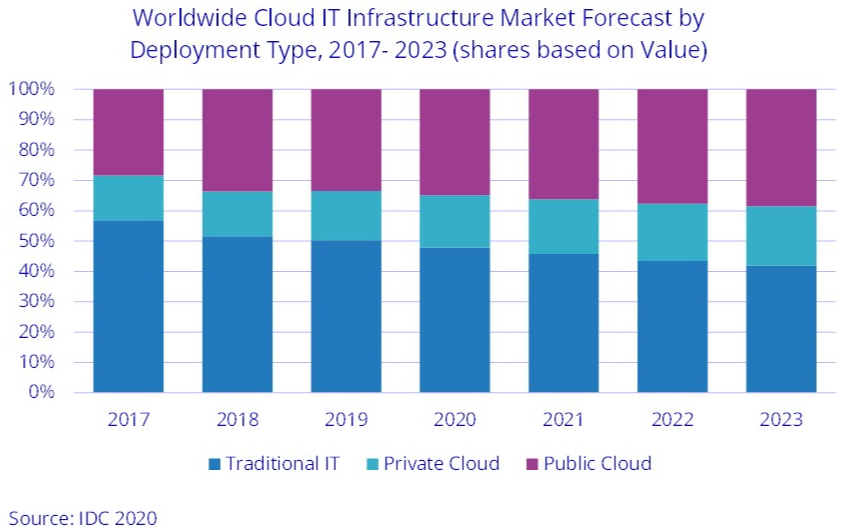
However, as demand for private cloud IT infrastructure is increasing, the share of public cloud IT infrastructure continued to decline in 2019 and will be declining slightly throughout the forecast period.

Spending on private cloud IT infrastructure has shown more stable growth since IDC started tracking sales of IT infrastructure products in various deployment environments. In 3Q19, vendor revenues from private cloud environments increased 3.2 percent year-over-year, reaching nearly $5 billion. IDC expects spending in this segment to grow 7.2 percent year over year in 2019 to $21.4 billion.

As investments in cloud IT infrastructure continue to increase, with some swings up and down in the quarterly intervals, the IT infrastructure industry is approaching the point where spending on cloud IT infrastructure consistently surpasses spending on non-cloud IT infrastructure.

Until 3Q19, it happened only once, in 3Q18, and in 3Q19 it crossed the 50 percent mark for the second time since IDC started tracking IT infrastructure deployments. In 3Q19, cloud IT environments accounted for 53.4 percent of vendor revenues.

However, for the full year 2019, spending on cloud IT infrastructure is expected to stay just below the 50 percent mark at 49.8 percent. This year (2020) is expected to become the tipping point with spending on cloud IT infrastructure staying in the 50+ percent range.

Across the three IT infrastructure domains, Ethernet switches is the only segment expected to deliver visible year-over-year growth in 2019, up 11.2 percent, while spending on compute platforms will decline 3.1 percent and spending on storage will grow just 0.8 percent. Compute will remain the largest category of cloud IT infrastructure spending at $34.1 billion.

Sales of IT infrastructure products into traditional (non-cloud) IT environments declined 7.7 percent from a year ago in 3Q19. For the full year 2019, worldwide spending on traditional non-cloud IT infrastructure is expected to decline by 5.3 percent.

By 2023, IDC expects that traditional non-cloud IT infrastructure will only represent 41.9 percent of total worldwide IT infrastructure spending (down from 51.6 percent in 2018). This share loss and the growing share of cloud environments in overall spending on IT infrastructure is common across all regions.

According to the IDC assessment, while the industry overall is moving toward greater use of cloud, there are certain types of workloads and business practices, and sometimes end user inertia, which keep demand for traditional dedicated IT infrastructure afloat.

Outlook for cloud infrastructure investment growth

Geographically, the cloud IT Infrastructure segment had a mixed performance in 3Q19. Declines in the U.S. market, Western Europe, and Latin America were driven by overall market weakness; in these and some other regions 3Q19 softness in cloud IT infrastructure spending was also affected by comparisons to a strong 3Q18.

In Asia-Pacific (excluding Japan), the second-largest geography after the U.S. market, spending on cloud IT infrastructure increased 1.2 percent year-over-year, which is low for this region. However, it is in comparison with strong double-digit growth in 2018. Other growing regions in 3Q19 included Canada (4.9 percent), Central & Eastern Europe (4.6 percent), and Middle East & Africa (18.1 percent).

Long-term, IDC expects spending on cloud IT infrastructure to grow at a five-year compound annual growth rate (CAGR) of 7 percent, reaching $92 billion in 2023 and accounting for 58.1 percent of total IT infrastructure spend. Public cloud datacenters will account for 66.3 percent of this amount, growing at a 6 percent CAGR. Spending on private cloud infrastructure will grow at a CAGR of 9.2 percent.

https://www.cybersecuritycloudexpo.com/wp-content/uploads/2018/09/cyber-security-world-series-1.pngInterested in hearing industry leaders discuss subjects like this and sharing their experiences and use-cases? Attend the Cyber Security & Cloud Expo World Series with upcoming events in Silicon Valley, London and Amsterdam to learn more.

Four ways to sell more cloud and mobile tools to SMBs


Fleur Doidge

27 Feb, 2020

Only 40% of SMBs have adopted public cloud offerings or plan to in the next 12 months, according to IDC’s European Tech and Industry Pulse Survey 2019-2020. Cloud boosts customer profits by supporting productivity-enhancing mobile, collaborative or flexible-working tools; the channel should be in pole position to grow this market.

Yet just 46% of respondents in the IDC survey bought their cloud tools through channel partners. What will persuade the other 54%?

Describe how tools improve employee satisfaction and productivity

Research carried out by analyst house Forrester, sponsored by Lenovo and Intel, highlights flexibility and mobility as drivers for the good employee experience that underpins an effective workplace.

Michael Littler, executive director of global SMB marketing in Lenovo’s Intelligent Devices Group,  says it suggests SMBs aren’t supplying the tools that support how people want to work.

«When we drill into why people don’t feel productive, the tech aspect is a huge piece of it. Only 26% of respondents said ‘my company is providing me with access to cloud-based tools’,» he says.

Of employees in the 2019 survey who indicated feeling productive at work, 81% were satisfied with the devices available. The converse is true among those who said they don’t feel productive: 47% of workers who feel unproductive are satisfied with device provision. Only 23% of the group who feel unproductive felt satisfied with their work overall.

74% said they have no flexibility to choose «suitable» technologies to perform their tasks, and 71% rely on desktops as their main device. Only 49% of SMB buyers said, though, that these desktops would be replaced at refresh time, with only 40% promising to invest in laptops instead, for example.

Yet 87% of buyers within these SMBs cite employee productivity as a high or critical priority over the next 12 months, notes Littler.

Offer SMBs access to dynamism and enterprise-grade offerings

The channel should be asking SMBs if their systems are sufficiently flexible and scalable for future agility or new ways of working. 

Steve Joyner, managing director for UK and Ireland at Avaya, says SMBs need more sophisticated offerings. «Once it was assumed that only enterprises needed the connectivity or higher-end use cases, because they had many employees and really worried about how to collaborate.

«Everyone now expects to be able to collaborate and work together and use systems and applications the same way,» Joyner says.

Meanwhile, younger employees who grew up using mobile tools flexibly and collaboratively expect to do so in the workplace as well. 

In response Avaya, like other vendors, has rejigged its offerings, opening up its platforms as well as researching customer needs, offering a full suite of solutions, education and training to all sizes of customer and channel partner, says Joyner.

Devise specific solutions that deal with questions about cost

SMBs that don’t use cloud often perceive it as expensive or insecure – even though moving non-core tech and systems to the cloud can save money.

Avaya’s Joyner thinks this preconception goes back to the days of on-prem, when sophistication, reliability, redundancy and security came at a premium. Cloud can enable complexity to be delivered per user.

«Smaller firms can enjoy the security and encryption that large enterprises do, because the platforms in the cloud are actually large-enterprise platforms,» he says. «And there’s nothing stopping them taking private cloud – still consuming and not having all those up-front costs.»

Demonstrate benefits concretely via proofs-of-concept

Spinning up a proof-of-concept quickly can enable customers to «kick the tyres» and lay concerns to rest. Avaya’s Joyner notes that customers, large or small, typically ask to review their various cloud offerings live, whether they’re public, private or hybrid.

«Demos are far easier to do with cloud. They used to be just for the enterprise, because it was less cost-effective to do proofs-of-concept for smaller customers – but that’s not the case now,» Joyner adds.

It’s the channel’s role, as trusted advisors on cloud and mobile, to ensure it has the skills to communicate these benefits to more SMB customers.

Google to invest $10bn in US offices & data centres


Bobby Hellard

27 Feb, 2020

Google will build 11 office and data centres across the US as part of a $10 billion investment plan.

The tech giant announced these new buildings will create thousands of jobs and provide opportunities for local businesses.

It follows on from the company’s ambitious 2019 plan to invest $13 billion in rural states such as South Carolina and Nevada. Along with R&D funding, this made Alphabet the largest investor into the US, according to the Progressive Policy Institute.

The new investment will be used to build on that by adding 11 new sites in Colorado, Georgia, Massachusetts, Nebraska, New York, Oklahoma, Ohio, Pennsylvania, Texas, Washington and California.

As an example of the impact Google’s investments could have, CEO Sundar Pichai pointed to the company’s data centre in Mayes County, Oklahoma.

«Last year, I visited Pryor to announce a $600 million investment, our fourth expansion there since 2007,» Pichai said in a blog post. «It felt like the whole community came out to welcome us, from small business owners to teachers to Google employees.

«Pryor Mayor Larry Lees told the crowd that Google’s investments have helped provide local schools with the resources they need – including the latest textbooks and STEM courses – to offer a world-class education. He talked about the small businesses we have helped train and the mentorship Googlers have provided to Pryor’s students.»

The new offices and data centres will create roles with Google, as well as jobs in construction and renewable energy facilities, the company said.

This is also further evidence of Google’s relentless investment into its cloud business. Recently it announced the $2 billion acquisition of Looker, a data analytics firm and also Cornerstone Technology, a mainframe-to-cloud migration firm.

Salesforce acquires Vlocity in $1.33bn all-cash deal amid executive shuffle

Salesforce is to acquire Vlocity, a provider of industry-specific cloud and CRM apps, for $1.33 billion (£1.04bn) in an all-cash deal – amid an action-packed end to the company’s fiscal year.

The news was tucked away at the very end of Salesforce’s fourth quarter update. The company’s financial results were described as ‘phenomenal’ by CEO Marc Benioff – not co-CEO, more on which shortly – with Q4 revenue up 35% year over year to $4.8bn (£3.7bn), and total fiscal 2020 revenue at $17.1bn on a 29% increase.

Vlocity’s acquisition by Salesforce – in terms of the acquiring company – should come as little surprise. The Vlocity solution is built natively on the Salesforce platform, with Salesforce Ventures co-leading its most recent funding, a $60 million series C round in March.

The six primary industries targeted by Vlocity are communications, energy and utilities, government, health, insurance, and media and entertainment, with key customers including T-Mobile, Telus, and Sky. The company placed in the top 25 of the most recent Forbes Cloud 100 ranking, as well as just outside the top 50 on the Inc. 5000 Series earlier this month, representing the fastest growing private companies in California.

Writing to customers following the Salesforce acquisition news, Vlocity CEO David Schmaier noted the growth the company had undertaken to this point. “Every organisation, including the world’s largest customer-centric corporations and industries, must digitally transform,” Schmaier wrote. “It is more important than ever for our customers to have products that speak the language of their industries.

“The best customer experiences are industry-specific,” Schmaier added. “Together, our customers, our partners and our employees have accomplished so much. I am thrilled about our future with Salesforce.”

Speaking to investors following the earnings report, Benioff noted that Vlocity was a ‘relatively small transaction’ – not idle words when you’ve previously spent $15.7bn on Tableau – but that the time was right to invest. “In our relationship with Vlocity and the way that we originally invested in the company, it created a situation for acquisition that we needed to take advantage of and which is why we have acquired it at a very attractive price, because we have been partners with them from the very beginning,” he said.

Alongside this, it was announced that Keith Block has stepped down as co-CEO of Salesforce, with Benioff carrying on alone. Block will remain an advisor to the CEO, with Benioff leading the tributes to an executive who ‘helped position [Salesforce] as a global leader and… the envy of the industry.’ Gavin Patterson, former BT chief, is joining the company as president and CEO of Salesforce International, based in London.

The Vlocity transaction is expected to close during the second quarter.

https://www.cybersecuritycloudexpo.com/wp-content/uploads/2018/09/cyber-security-world-series-1.pngInterested in hearing industry leaders discuss subjects like this and sharing their experiences and use-cases? Attend the Cyber Security & Cloud Expo World Series with upcoming events in Silicon Valley, London and Amsterdam to learn more.

The cloud news categorized.