SYS-CON Events announced today that 910Telecom will exhibit at the 19th International Cloud Expo, which will take place on November 1–3, 2016, at the Santa Clara Convention Center in Santa Clara, CA.
Housed in the classic Denver Gas & Electric Building, 910 15th St., 910Telecom is a carrier-neutral telecom hotel located in the heart of Denver. Adjacent to CenturyLink, AT&T, and Denver Main, 910Telecom offers connectivity to all major carriers, Internet service providers, Internet backbones and exchanges.
Todas las entradas hechas por Latest News from @CloudExpo
The New Age of the Internet | @CloudExpo #IoT #AWS #DevOps
Enterprises and service providers are moving to cloud. Cloud providers are expanding their infrastructure, reach and ease of adoption. Users are becoming mobile, they access their information and services on their personal mobile devices first. We have seen game changers like Netflix and AirBnB become vastly successful by using the power of public cloud as their infrastructure of choice. Service providers like Microsoft, Adobe and Oracle are quickly moving their services to cloud, offering them as a SaaS subscription. So why are we seeing this new «app store» model of development, delivery and consumption gain so much popularity now than ever? and what does it mean for the internet? Is the internet infrastructure equipped to handle this additional load? Lets first look at it from the three main constituents cloud effects: Enterprises or app providers, public cloud vendors and, of course, the consumers of these services.
Amazon’s IoT Strategy | @ThingsExpo #IoT #M2M #AWS #BigData
Amazon has gradually rolled out parts of its IoT offerings in the last year, but these are just the tip of the iceberg. In addition to optimizing their back-end AWS offerings, Amazon is laying the ground work to be a major force in IoT – especially in the connected home and office.
Amazon is extending its reach by building on its dominant Cloud IoT platform, its Dash Button strategy, recently announced Replenishment Services, the Echo/Alexa voice recognition control platform, the 6-7 strategic investments of its Venture group, strategic partnerships with 50+ major consumer package goods companies and the 50-70 million current Prime customers to become a dominant force in IoT.
Amazon’s IoT Strategy | @ThingsExpo #IoT #M2M #AWS #BigData
Amazon has gradually rolled out parts of its IoT offerings in the last year, but these are just the tip of the iceberg. In addition to optimizing their back-end AWS offerings, Amazon is laying the ground work to be a major force in IoT – especially in the connected home and office.
Amazon is extending its reach by building on its dominant Cloud IoT platform, its Dash Button strategy, recently announced Replenishment Services, the Echo/Alexa voice recognition control platform, the 6-7 strategic investments of its Venture group, strategic partnerships with 50+ major consumer package goods companies and the 50-70 million current Prime customers to become a dominant force in IoT.
The Business Case for Hybrid Cloud Services Adoption | @CloudExpo #API #Cloud #Storage
Forging a viable business technology strategy for today’s global networked economy is a high priority for most forward-thinking CEOs across the globe. Their guidance to CIOs is to create the fusion between existing IT infrastructure and modern cloud services. Moreover, the shift to a Hybrid IT model must support the organization’s key commercial expansion objectives.
The savvy leaders who have a superior approach can extract greater value from their legacy IT investments, and launch new initiatives based upon public and private cloud computing services. This is the new normal — CIOs must create the optimal blended environment for purposeful technology-enabled innovation.
Primary Motivation
A global study of 500 hybrid cloud decision makers revealed that organizations are increasingly integrating cloud computing and storage resources with traditional IT infrastructure to accommodate dynamic needs and specific business priorities, according to a market study by the IBM Center for Applied Insights.
This thought-provoking study found that improving productivity is currently the number one goal of cloud service adoption, as the most progressive senior executives plan to offload some of their IT resources and management complexity to the cloud.
A close second goal of digital transformation is improved security and risk reduction — using the flexibility of a hybrid solution to choose which workloads and data to move to the cloud and which to maintain on-premise.
The other two most mentioned goals by survey respondents are IT infrastructure cost reduction — i.e. shifting costs from fixed IT to as-needed cloud services — and scalability to handle dynamic IT workloads.
Why Maturity Matters
Following their detailed analysis, the IBM report authors grouped the survey respondents into three categories, based upon the maturity of their hybrid management capabilities and whether they’re reporting a strategic edge that’s realized from their hybrid cloud deployments:
- Frontrunners: are gaining a competitive advantage through hybrid cloud and are managing their environment in an integrated, comprehensive fashion for high visibility and control (as an example, through a single data-driven dashboard).
- Challengers: are on the journey toward competitive advantage, but haven’t fully achieved unified management of their hybrid cloud environment.
- Chasers: are not yet using hybrid cloud to drive competitive advantage and are in the early stages of gaining integrated control over their hybrid environment.
Benefits of Hybrid Leadership
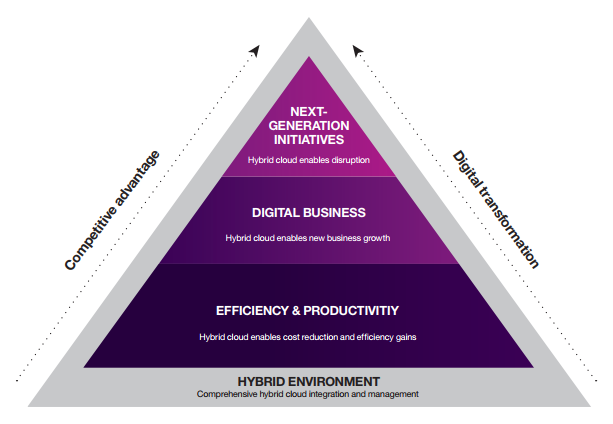
What’s the big improvement of being a visionary frontrunner in your industry? They’re achieving noteworthy business outcomes with a hybrid cloud — such as productivity gains, including cutting operational costs and maximizing the value of existing IT infrastructure — at a higher rate than other organizations.
Frontrunners are also more effectively using hybrid cloud to drive digital business innovation, including the creation of new products and services and the expansion into new markets. They also apply hybrid cloud solutions to experiment with cognitive computing and the Internet of Things (IoT) — which have the potential to enable the development of new business models.
Moreover, the frontrunners are using hybrid solutions as a driver of business process change, with 85 percent reporting that hybrid cloud service adoption is accelerating a progressive digital transformation agenda at their companies.
Hybrid Challenges and Opportunities
Most frontrunners say they have achieved measurable progress from their hybrid cloud efforts. However, more than one in four have experienced difficulty executing their plan to integrate legacy IT infrastructure and cloud computing environments.
Finding and retaining the technical staff with the desired experience is often a challenge, with one in three survey respondents citing an internal skills gap as a big unresolved issue. Furthermore, while companies adopt cloud services to improve security, it remains their number one concern.
In fact, frontrunners cite management complexity and security as a major obstruction to progress. Over three-quarters report that hybrid introduces greater IT management complexity into their environment, and 70 percent say that their hybrid environment causes them greater security concerns.
How are these early-adopters leveraging hybrid environments to achieve a meaningful and substantive competitive advantage? Study findings indicate that they apply a very intentional and holistic approach to implementing and managing their hybrid solutions.
Culture is a Key to Ongoing Hybrid Success
The established frontrunners also understand that the complexity of hybrid environments is best tackled through a collaborative approach to IT investment decision making — bringing both the managers of IT organizations and Line of Business (LoB) leaders together on a common cause.
The IBM study findings also uncovered that in almost three-quarters of frontrunner organizations, hybrid cloud has elevated the extent to which the CIO is now acting as a trusted adviser to the overall business leadership team.
The collective C-suite and senior IT roles collaborate on key technology decisions that impact business goals. This newfound collaboration sheds light on the benefits of Shadow IT, where the progressive LoB leadership is already using forward-looking cloud services to advance their growth agenda.
Besides, 81 percent of the frontrunners report that hybrid cloud is helping to reduce Shadow IT growth within their organizations. Proving, once again, that savvy CIOs are the ones that are proactively embracing the shift to Hybrid IT models, and thereby regaining workload deployment momentum that was lost due to prior computing and storage resource provisioning constraints.
The Business Case for Hybrid Cloud Services Adoption | @CloudExpo #API #Cloud #Storage
Forging a viable business technology strategy for today’s global networked economy is a high priority for most forward-thinking CEOs across the globe. Their guidance to CIOs is to create the fusion between existing IT infrastructure and modern cloud services. Moreover, the shift to a Hybrid IT model must support the organization’s key commercial expansion objectives.
The savvy leaders who have a superior approach can extract greater value from their legacy IT investments, and launch new initiatives based upon public and private cloud computing services. This is the new normal — CIOs must create the optimal blended environment for purposeful technology-enabled innovation.
Primary Motivation
A global study of 500 hybrid cloud decision makers revealed that organizations are increasingly integrating cloud computing and storage resources with traditional IT infrastructure to accommodate dynamic needs and specific business priorities, according to a market study by the IBM Center for Applied Insights.
This thought-provoking study found that improving productivity is currently the number one goal of cloud service adoption, as the most progressive senior executives plan to offload some of their IT resources and management complexity to the cloud.
A close second goal of digital transformation is improved security and risk reduction — using the flexibility of a hybrid solution to choose which workloads and data to move to the cloud and which to maintain on-premise.
The other two most mentioned goals by survey respondents are IT infrastructure cost reduction — i.e. shifting costs from fixed IT to as-needed cloud services — and scalability to handle dynamic IT workloads.
Why Maturity Matters
Following their detailed analysis, the IBM report authors grouped the survey respondents into three categories, based upon the maturity of their hybrid management capabilities and whether they’re reporting a strategic edge that’s realized from their hybrid cloud deployments:
- Frontrunners: are gaining a competitive advantage through hybrid cloud and are managing their environment in an integrated, comprehensive fashion for high visibility and control (as an example, through a single data-driven dashboard).
- Challengers: are on the journey toward competitive advantage, but haven’t fully achieved unified management of their hybrid cloud environment.
- Chasers: are not yet using hybrid cloud to drive competitive advantage and are in the early stages of gaining integrated control over their hybrid environment.
Benefits of Hybrid Leadership
What’s the big improvement of being a visionary frontrunner in your industry? They’re achieving noteworthy business outcomes with a hybrid cloud — such as productivity gains, including cutting operational costs and maximizing the value of existing IT infrastructure — at a higher rate than other organizations.
Frontrunners are also more effectively using hybrid cloud to drive digital business innovation, including the creation of new products and services and the expansion into new markets. They also apply hybrid cloud solutions to experiment with cognitive computing and the Internet of Things (IoT) — which have the potential to enable the development of new business models.
Moreover, the frontrunners are using hybrid solutions as a driver of business process change, with 85 percent reporting that hybrid cloud service adoption is accelerating a progressive digital transformation agenda at their companies.
Hybrid Challenges and Opportunities
Most frontrunners say they have achieved measurable progress from their hybrid cloud efforts. However, more than one in four have experienced difficulty executing their plan to integrate legacy IT infrastructure and cloud computing environments.
Finding and retaining the technical staff with the desired experience is often a challenge, with one in three survey respondents citing an internal skills gap as a big unresolved issue. Furthermore, while companies adopt cloud services to improve security, it remains their number one concern.
In fact, frontrunners cite management complexity and security as a major obstruction to progress. Over three-quarters report that hybrid introduces greater IT management complexity into their environment, and 70 percent say that their hybrid environment causes them greater security concerns.
How are these early-adopters leveraging hybrid environments to achieve a meaningful and substantive competitive advantage? Study findings indicate that they apply a very intentional and holistic approach to implementing and managing their hybrid solutions.
Culture is a Key to Ongoing Hybrid Success
The established frontrunners also understand that the complexity of hybrid environments is best tackled through a collaborative approach to IT investment decision making — bringing both the managers of IT organizations and Line of Business (LoB) leaders together on a common cause.
The IBM study findings also uncovered that in almost three-quarters of frontrunner organizations, hybrid cloud has elevated the extent to which the CIO is now acting as a trusted adviser to the overall business leadership team.
The collective C-suite and senior IT roles collaborate on key technology decisions that impact business goals. This newfound collaboration sheds light on the benefits of Shadow IT, where the progressive LoB leadership is already using forward-looking cloud services to advance their growth agenda.
Besides, 81 percent of the frontrunners report that hybrid cloud is helping to reduce Shadow IT growth within their organizations. Proving, once again, that savvy CIOs are the ones that are proactively embracing the shift to Hybrid IT models, and thereby regaining workload deployment momentum that was lost due to prior computing and storage resource provisioning constraints.
LeaseWeb to Exhibit at @CloudExpo | @LeaseWebUSA #IoT #DataCenter
SYS-CON Events announced today that LeaseWeb USA, a cloud Infrastructure-as-a-Service (IaaS) provider, will exhibit at the 19th International Cloud Expo, which will take place on November 1–3, 2016, at the Santa Clara Convention Center in Santa Clara, CA. LeaseWeb is one of the world’s largest hosting brands. The company helps customers define, develop and deploy IT infrastructure tailored to their exact business needs, by combining various kinds cloud solutions.
Three Things dPaaS Has in Common with Pokémon GO | @CloudExpo #API #Cloud #dPaaS
Have you seen people wandering around in public spaces, eyes glued to their smartphones, pausing and turning in different directions as if seeking some invisible landmark? Chances are you’ve spotted someone playing Pokémon GO, a location-based augmented reality game that is taking the world by storm.
Released just last month, Pokémon GO has already smashed previous records for mobile game downloads while inspiring millions to leave their homes in search of virtual Pokémon creatures. The creatures are invisible to the naked eye, of course, but they appear on user’s screens as if occupying real-world space.
Synchronoss Launched Secure Mobility Platform | @CloudExpo @Synchronoss #Cloud #Security
Synchronoss announced the general availability of its Secure Mobility Platform (SMP) – the combination of a highly secure application container and integrated productivity suite that together improves the productivity and performances of enterprise mobile workforces.
Designed and built using secure enterprise mobility technology contributed by Goldman Sachs through the venture announced last November, Synchronoss SMP consists of:
Synchronoss Lagoon – a secure device container which encrypts the enterprise’s data on the device and over the air
Sauce Labs Selects @SumoLogic for Machine Data Analytics | @CloudExpo #Cloud #DevOps #BigData
Sauce Labs has selected Sumo Logic to troubleshoot and better track log performance issues to predict potential issues before they occur. With Sumo Logic, Sauce Labs now has the ability to better help its customers accelerate the software and development cycle.
Sauce Labs provides a high-performance, cloud-based automated testing platform that is optimized for Continuous Integration and Continuous Deployment (CI/CD) workflows. Catering to fast-moving companies that employ modern development techniques that support DevOps, Sauce Labs creates a large amount of internal log data, with log volumes ranging up to 600 GBs on some days. It’s critical for the company to be able to keep pace by offering scalable, yet secure, automated testing in the cloud.