Deutsche Bank estimates AWS derives about 15% of its total revenue mix or has attained a $1.5B revenue run rate in Europe, while AWS is now approximately 6x the size of Microsoft Azure globally according to Deutsche Bank.
These and other insights are from the research note published earlier this month by Deutsche Bank Markets Research titled AWS/Cloud Adoption in Europe and the Brexit Impact written by Karl Keirstead, Alex Tout, Ross Sandler, Taylor McGinnis and Jobin Mathew. The research note is based on discussions the research team had with 20 Amazon Web Services (AWS) customers and partners at the recent AWS user conference held in London earlier this month, combined with their accumulated research on public cloud adoption globally.
These are the five ways Brexit will accelerate AWS and public cloud adoption:
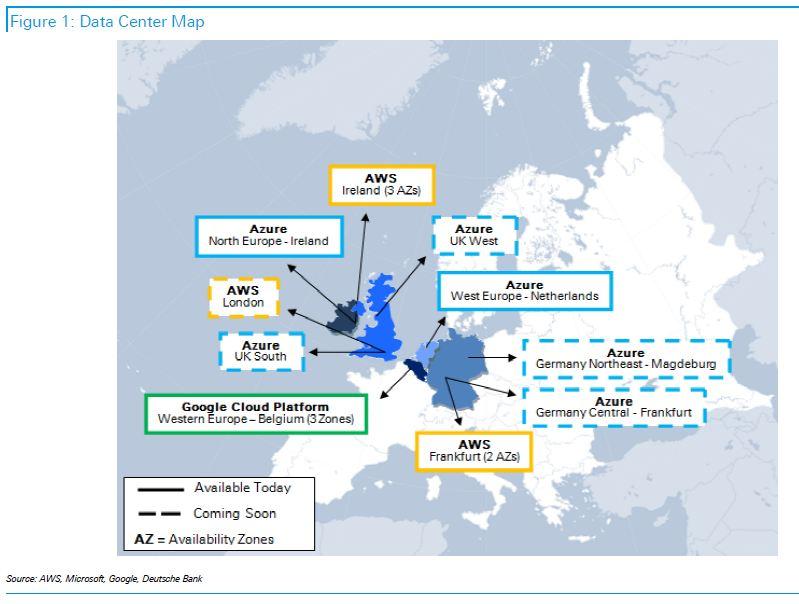
The proliferation of European-based data centres is bringing public cloud stability to regions experiencing political instability. AWS currently has active regions in Dublin and Frankfurt, with the former often being used by AWS’ European customers due to the broader base of services offered there. An AWS Region is a physical geographic location where there is a cluster of data centers. Each region is made up of isolated locations known as availability zones. AWS is adding a third European Union (EU) region in the UK with a go-live date of late 2016 or early 2017. Microsoft has 2 of its 26 global regions in Europe, with two more planned in the UK. Google’s Cloud Platform (GCP) has just one region active in Europe. The following Data Centre Map provides an overview of data centres AWS, Microsoft Azure and GCP have in Europe today and planned for the future.
Brexit is making data sovereignty king. European-based enterprises have long been cautious about using cloud platforms to store their many forms of data. Brexit is accelerating the needs European enterprises have for greater control over their data, especially those based in the UK. Amazon’s planned third EU region based in London scheduled to go live in late 2016 or early 2017 is well-timed to capitalise on this trend.
Up-front costs of utilising AWS are much lower and increasingly trusted relative to more expensive on-premise IT platforms. Brexit is having the immediate effect of slowing down sales cycles for managed hosting, enterprise-wide hardware and software maintenance agreements. The research team found that the uncertainty of just how significant the economic impact Brexit will have on the European economies is making companies tighten capital expense (CAPEX) budgets and trim expensive maintenance agreements. UK enterprises are reverting to OPEX spending that is already budgeted.
CEOs are pushing CIOs to get out of high-cost hardware and on-premise software agreements to better predict operating costs faster thanks to Brexit. The continual pressure on CIOs to reduce the high hardware and software maintenance costs is accelerating thanks to Brexit. Because no one can quantify with precision just how Brexit will impact European economies, CEOs, and senior management teams want to minimize downside risk now. Because of this, the cloud is becoming a more viable option according to Deutsche Bank. One reseller said that public cloud computing platforms are a great answer to a recession, and their clients see Brexit as a catalyst to move more workloads to the cloud.
Brexit will impact AWS Enterprise Discount Program (EDP) revenues, forcing a greater focus on incentives for low-end and mid-tier services. Deutsche Bank Markets Research team reports that AWS has this special program in place for its very largest customers. Under an EDP, AWS will give price discounts to large customers that commit to a full year (or more) and pay upfront, in many cases with minimum volume increases. One AWS partner told Deutsche Bank that they’re aware of one EDP payment of $25 million. In the event of a recession in Europe, it’s possible that such payments could be at risk. These market dynamics will drive AWS to promote further low- and mid-tier services to attract new business to balance out these larger deals.
HP Thin Clients One of the biggest advantages of the cloud computing revolution is optimized infrastructure costs. Today, businesses can use virtualization technology along with thin clients to significantly reduce IT costs. Because the applications are run on the server, businesses need only minimal hardware for the client devices. HP Thin Clients take this advantage […]
I know one of the challenges I faced when switching from PC to a Mac was learning how to game. It felt overwhelming that gaming was exclusively in the realm of PC’s. Ric from MacgamerHQ.com is here to remind us that isn’t so! Ric and I sat down to nerd out about gaming on a […]
Let’s face it, embracing new storage technologies, capabilities and upgrading to new hardware often adds complexity and increases costs. In his session at 18th Cloud Expo, Seth Oxenhorn, Vice President of Business Development & Alliances at FalconStor, discussed how a truly heterogeneous software-defined storage approach can add value to legacy platforms and heterogeneous environments. The result reduces complexity, significantly lowers cost, and provides IT organizations with improved efficiencies, all while delivering real freedom and flexibility. Come learn how to #BeFree.
A data breach could happen to anyone. Data managed by your company is valuable to someone, no matter what the data is. Everything has a price tag on the dark web. It is especially true when it is customer data, such as personal and payment card details.
When your customers’ data turns up somewhere unexpected on the Internet, you may feel the world is collapsing around you. People start tweeting about the hack, angry customers phone in, and Brian Krebs publishes his first article. Your organization switches to an emergency mode to handle the situation. It is the time when your incident response team takes control to put the genie back in the bottle.
Microsoft took another step toward being king of the cloud hill when it announced in January that it was releasing its Azure stack to the public. There are many technical reasons why this is cool, but more importantly, it’s the psychological advantage this gives Microsoft.
Google has always had the ability for developers using its stack to develop locally on the same tools that run in Google App Engine. It recently forked its environments, so now the local and cloud environments are slightly different for some of the configurations — I can’t tell you how many nights I have lost sleep because of environments being slightly different! Development and hosting are two completely different things. What Microsoft did is one-upped Google and Amazon.
«My role is working with customers, helping them go through this digital transformation. I spend a lot of time talking to banks, big industries, manufacturers working through how they are integrating and transforming their IT platforms and moving them forward,» explained William Morrish, General Manager Product Sales at Interoute, in this SYS-CON.tv interview at 18th Cloud Expo, held June 7-9, 2016, at the Javits Center in New York City, NY.
It feels like the barbarians are continually at the gate. We can’t seem to go more than a week before a new data breach is in the news, impacting potentially millions of individuals. The targets range from companies like Omni Hotels, which had been breached affecting up to 50,000 customers whose personal and credit card information was exposed, to North Carolina State University, where over 38,000 students’ personal information, including their SSNs, were at risk. As I mentioned in a recent blog ‘Internet of Things and Big Data – who owns your data?’, we have been storing our personal and credit card information in a variety of systems, credit card companies, banks, online retailers, hotels – and that’s just naming a few. The information in those systems is more valuable than gold to the hackers. The hacker attacks are constant, creative, and changing frequently.
In an era of unified IT, you can no longer afford to take a silo-based approach to monitoring and troubleshooting IT problems. It’s time for network engineers, server admins and application engineers to expand beyond their particular domains anddepartment-specific tools. It’s time to embrace a new, integrated approach to network and application monitoring that lets you view your entire IT infrastructure from a single console and resolve issues before they affect end users. It’s time for applications-aware network performance monitoring (AANPM).