
Are you open to new ideas, and given a compelling choice are you really prepared to change? That’s what informed CEOs are asking their C-suite leadership team.
The context of those questions is about determining who is most qualified to guide the organisation’s digital transformation journey. It’s also about setting expectations for C-level executives to partner.
IT and business leaders must acknowledge that they’ve likely reached a significant turning point. Business technology advances are disrupting the legacy status quo and bringing huge market turmoil in their wake. Industries are converging, and unfamiliar competitors are surfacing.
Granted, that convergence is creating opportunities for growth by shifting from products and services made by solo entities, to new cross-sector customer experiences built via strategic partnerships. But it’s also intensifying market competition. One company’s convergence can become another’s encroachment. So, how do you navigate through this labyrinth?
Open collaboration in the connected economy
Welcome to the ‘connected economy’ (CE) – a new business reality in which value is created through technology-enabled links among people, open digital systems and business partner networks. Across industries, huge opportunities are available for savvy organisations to become connected economy leaders.
Implementing connected business models and associated processes can help you significantly increase revenue growth and enhance your competitive edge. At the same time, a very real downside to falling behind exists: laggards risk becoming prey to disruptive innovations.
It’s a scenario in which a competitor with a completely different business model can put your traditional revenue stream at risk — or worse, put you out of business. So, with that backdrop, how do you survive and prosper? What does it take to be a leader in the connected economy?
IBM asked Harvard Business Review (HBR) Analytic Services to uncover the drivers for business change, assess the preparedness of organisations, and identify the types of adjustments we must make to capitalise on emerging opportunities. Here’s what they found.
A profile of the global CE leaders
Whatever their industry, the global CE leaders see their world rapidly changing, and they’re determined to be at the forefront of that change in order to remain relevant and claim their competitive advantage.
Their success is increasingly dependent on participation in broader business ecosystems. That being said, even the CE followers and laggards recognise the growing importance of tighter connections with other organisations in adjacent industries.
However, CE leaders are radically better positioned within their own business ecosystems – something that could lead to a long-term advantage. The rest are under pressure to catch up. Fifty-two percent say that a substantial part of their revenue is already under threat from digital disruption.
To counter that threat, savvy organisations are changing how they operate. Moreover, the progressive CE leaders are already reaping the rewards of their new connected business models.
They’ve seen significantly stronger revenue growth over the past two years than their less-connected rivals – in large part due to their ability to exploit information at speed through their use of hardware, software, and networking technologies.
How CE leaders leverage IT infrastructure
What really sets CE leaders apart is the degree to which they recognise the threat from digital disruption and the value of their IT leadership in bringing them into the connected economy. That awareness is causing them to make digital initiatives a C-level priority.
CE leaders have built relationships between CIOs or CTOs and line of business (LoB) leaders, based on collaborative engagement. They invest more in digital technology, skills, and projects. They’ve created digital transition teams, while emphasising that digital is part of everyone’s job.
That being said, only 18 percent of survey respondents say that their organisation have applied progressive CE business models or open innovation to a significant extent. A key to success is the ability to exploit information at speed through the use of open hardware, software, and networking technologies.
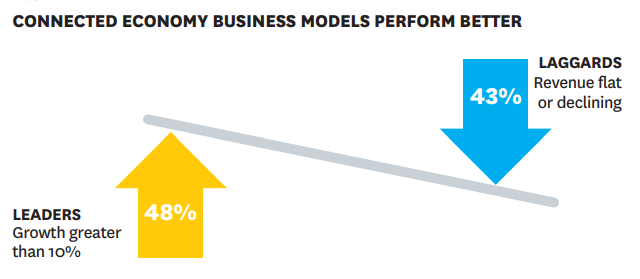
As a result, 48 percent of CE leaders have seen double-digit revenue growth. And three times as many CE leaders claim growth of 30 percent or more, when compared to the laggards.
Common traits of proven CE market leaders
CE leaders are much more likely than other companies to:
- Have C-level executives involved in leading digital initiatives.
- Dedicate teams to help with various aspects of the transformation.
- Break down organisational silos through restructuring and fostering cross-functional collaboration.
- Invest in a data-centric IT infrastructure needed to build their digital platform.
- Recognise the need for new, more advanced skills, and ensure their teams are acquiring or developing them.
- Have a “business innovator” CIO or CTO.
HBR believes C-level involvement is crucial, given the profound changes that must take place to transition to a connected-economy business model. In fact, all senior executives at CE leader organisations take an active role in their digital business initiatives.
Why open innovation ecosystems matter
As internal resistance to change is overcome, the connected economy will become even more connected, with success relying on participation in a broader business ecosystem, defined as an interdependent network of collaborative individuals and organisations.
More than half of all survey respondents (and three-quarters of CE leaders) said their organisation’s success is tied to relationships with organisations in adjacent industries. And, 80 percent of CE leaders are more likely to be favorably positioned within their partner ecosystem.
In conclusion, these strategic shifts don’t just happen; they’re led by change agents. CE leaders have made this transition to open innovation a C-level priority. They’re significantly more likely to benefit from business-innovator or transformational CIOs and CTOs who drive cross-functional integration and collaboration between IT and other parts of the business.
Not only are they breaking down silos inside their own organisations, they’re connecting to new business partners that apply open technologies in creative ways, as part of a broader digital business transformation model. This is the new normal; leaders adopt open ecosystems.


