DevOpsSUMMIT at CloudEXPO, to be held June 25-26, 2019 at the Santa Clara Convention Center in Santa Clara, CA – announces that its Call for Papers is open. Born out of proven success in agile development, cloud computing, and process automation, DevOps is a macro trend you cannot afford to miss. From showcase success stories from early adopters and web-scale businesses, DevOps is expanding to organizations of all sizes, including the world’s largest enterprises – and delivering real results. Among the proven benefits, DevOps is correlated with 20% faster time-to-market, 22% improvement in quality, and 18% reduction in dev and ops costs, according to research firm Vanson-Bourne. It is changing the way IT works, how businesses interact with customers, and how organizations are buying, building, and delivering software.
Announcing @NanoVMs to Exhibit at @CloudEXPO New York | #Cloud #CIO #Serverless #DevOps #DigitalTransformation
NanoVMs is the only production ready unikernel infrastructure solution on the market today. Unikernels prevent server intrusions by isolating applications to one virtual machine with no users, no shells and no way to run other programs on them. Unikernels run faster and are lighter than even docker containers.
Analyst note indicates Alibaba Cloud ‘force to be reckoned with’ in APAC and beyond

Alibaba Cloud is naturally dominant in the locally-dominated Chinese cloud market – but it's gaining significantly in the rest of the Asia-Pacific (APAC) market, according to the latest note from data and analytics firm GlobalData.
APAC cloud services, according to the analyst house, will hit $55.2 billion in 2022 at a CAGR of 27.7%. This will be driven by an 'insatiable' trend of product launches by cloud providers drawing on the next wave of cloud services and technologies, including artificial intelligence, big data analytics, blockchain, and the Internet of Things (IoT).
The company adds that Alibaba is 'a force to be reckoned with'. "Alibaba Cloud is now betting big on some emerging markets such as India, Malaysia and Indonesia while competing with others in developed markets such as Hong Kong, Japan, Singapore and Australia," said Siow Meng Soh, technology analyst at GlobalData.
Regular readers of this publication will be aware of Alibaba's concerted expansion outside of its home base. In August the company launched no fewer than nine products around cloud architecture, machine learning, IoT and security focused on Asia Pacific, having previously announced a second infrastructure zone in Malaysia.
In June, Synergy Research argued Alibaba was already at second position in public cloud in APAC, behind AWS, which leads in every geography. Across the other geographies Alibaba did not threaten the top five – but its APAC positioning gave it fourth position overall.
The GlobalData analysis also notes the importance of partnerships to help achieve greater global footprint.
"With the ongoing migration of IT to the cloud, telecom providers and IT service providers have developed a cloud practice to help customers migrate their workloads, implement hybrid cloud and manage multi-cloud environments," added Soh. "These providers often partner with top players, particularly AWS and Microsoft Azure, to help customers keen to use the public cloud services.
"Going forward, they need to broaden the list of partners since customers are likely to be using a wider range of cloud services – and Alibaba Cloud should be on the list for consideration."
Photo source: www.alibabagroup.com
 Interested in hearing industry leaders discuss subjects like this and sharing their experiences and use-cases? Attend the Cyber Security & Cloud Expo World Series with upcoming events in Silicon Valley, London and Amsterdam to learn more.
Chris Kocher to Present #DigitalTransformation and Disruption, Amazon Style | @ExpoDX @Xopher5 #AI #IoT #IIoT #SmartCities
Digital Transformation and Disruption, Amazon Style – What You Can Learn. Chris Kocher is a co-founder of Grey Heron, a management and strategic marketing consulting firm. He has 25+ years in both strategic and hands-on operating experience helping executives and investors build revenues and shareholder value. He has consulted with over 130 companies on innovating with new business models, product strategies and monetization. Chris has held management positions at HP and Symantec in addition to advisory roles at startups. He has worked extensively on monetization, SAAS, IoT, ecosystems, partnerships and accelerating growth in new business initiatives.
Seven IT upgrades that pay for themselves
8 Oct, 2018
In business, the bottom line is the bottom line. It’s all about making – or saving – more money than you spend.
When it comes to IT projects, however, things always prove a little more complicated. They require you to make a bunch of assumptions or projections about how a system is likely to benefit a business, and balance those against initial setup costs and additional expenses like training and the removal of legacy equipment. As such, it’s not always easy to make guarantees that a return on investment is certain.
Those various complications add up to a total cost of ownership, and that total cost can be a red flag for senior management, particularly if they lean towards an «if it ain’t broke…» attitude.
Of course, some projects are easier wins than others. We’ve identified a handful of IT upgrade projects – some practical and some more strategic – that are almost guaranteed to benefit almost any business. If your organisation hasn’t started these already, it should certainly be considering them.
1. Get virtual
There’s something reassuringly tangible about physical hardware, and, although we’re nearing the end of 2018, there’s plenty of hardware resellers out there that will happily supply you with a room full of servers.
If you’re wanting something more cost-effective, virtual machines are by far the best option. The great bit is that you don’t have to go all-out to see immediate benefits, as running just two VMs in a single server can help you cut your physical footprint in half.
And of course, that’s the most conservative setup. The big cloud hosts and enterprise IT people routinely wedge in 20 server instances per physical machine, and technologies such as Docker and Container Virtualisation can take the figure higher still. You don’t need super-powered hardware to do it, either: most individual servers run at under 5% load most of their lives.
Yes, there are plenty of people around who have been burned by too-early, too-ambitious attempts at wholesale virtualisation. But in the decade or more that hypervisor technology has been mainstream, things have only been getting better and easier. Most of the annoying bugs that bit early adopters are mere painful memories.
2. Offload into the cloud – where it makes sense
I’ve seen it argued that the cloud gives you the best return on investment in the business; after all, since cloud services are classified as a running cost rather than a capital expenditure, you’re getting a benefit without technically making an investment. However, if your business already owns a rack of perfectly good servers, mothballing them in favour of hosted services doesn’t maximise your return on that investment ƒ it minimises it.
Indeed, if you unthinkingly shift everything into the cloud you’re almost certainly throwing money away. Azure VMs can cost around $200 a month in fairly low-usage situations, for example. That’s a year’s worth of running costs for a small, sensibly specified business server. Cloud providers emphasise that such pricing covers spikes in compute power, for those distressing days when you just don’t have enough of your own. But do you really need to pay distress-load rates for a year-round, non-distress requirement?
It’s also important to be realistic about the value of what you’re replacing. Quite a lot of migrations are based on absurd comparative costings. I recently walked through a bank’s server room and found it filled with 7U servers, each with a single CPU sitting in a four-way motherboard, and a single 9GB hard disk occupying its 12-tray RAID enclosure. Clearly, some rationalisation was overdue; I might have recommended that the racks be consolidated into a single 12-core, 1U server and a storage array network, offering a more flexible performance envelope and more easily controlled costs, looking into the future.
However, the bank had decided that cloud was the way to go – because it had accounted for each server in each rack as a cost of £250,000. That huge sum had been arrived at by factoring in all sorts of considerations such as premises, insurance, and so on, which of course could not be ditched by moving into the cloud. Once it became apparent that the cost-saving was likely to be minimal, the argument for the cloud seemed far weaker. Then the first few emails announcing tariff shifts from their hosting provider came in.
The lesson is that you should engage with the cloud, but only where it’s cost-effective to do so. Don’t be swayed by TCO comparisons that include irreducible overheads such as pension contributions, plus inflated costs for service and inappropriately specified top-end gear. Most corporate servers are perfectly capable of participating in a well-designed hybrid cloud deployment: this lets you extract the maximum value out of the assets you already own.
3. Outsource IT functions to specialists
This is a superset of the cloud option, but it’s a more multi-faceted idea. The logic, though, is simple: «computer people» are broadly the same no matter what industry they inhabit, so it makes sense to treat them as a commodity. Better career prospects for them, less admin for you: you can focus your budget on people who advance your business.
The catch is the notion that all IT bods are created equal. Back in about 1998, you could get away with that assumption. But today it’s likely that IT is the core of your business: it’s the machinery that delivers your products or services, the way staff communicate and even the way you interact with customers. Think about that and it’s clear that you don’t want all the knowledge of how your processes work to be left in the care of someone who has no particular stake in your business.
Even if everything goes well, there’s the question of continuity when you switch or leave providers. We’ve all heard stories of online systems asking for passwords and credentials nobody has, because the setup was handled by a contractor.
This is another area where the return looks great if you focus only on the balance sheet – but it’s key to weigh the benefits carefully against the potential savings. You may decide to outsource only certain roles, while keeping the engineers in-house.
4. Get on board with Web 2.0
You want your business’ web presence to be accessible to as many people as possible, using as many different devices as possible, for as little as possible. That’s especially true for sites that do business in the browser, such as online retailers. It’s no surprise, then, that the great and grand retail houses run continuous development models; they invest in making it as easy as possible for customers to spend money, without having to think too hard about how to use features or a particular platform.
So if your site doesn’t work like theirs do, why not? Of course, most IT-savvy businesses now have histories of product buying and code cutting and document production. It may seem a challenge to shift from historic architecture over to a modern, adaptive design and presentation that accommodates phones and tablets as well as desktop browsers.
But if you can follow the models of the established online giants, your visitors will immediately know how to interact with you: in effect, they’ll come to you having been organically, socially trained.
Just remember that it’s about more than aping the appearance and feel of a site. It can be more discouraging and frustrating for customers if a site looks familiar, but doesn’t work in the same way as other sites.
5. Don’t just call – hyperconverge!
The name sounds futuristic, but hyperconvergence mostly just means moving telephony onto VoIP and bringing it within the purview of your IT department. This can be a great money-saver, because phone costs are a big fat number on most larger business’ balance sheets. Run your phone calls over your network and you cut out a lot of phone-specific line items. No more great big hot 50V power boxes buzzing away in a cupboard, with those odd button-festooned phones running from them: simply give everyone a free desktop app and a headset.
It’s the same persuasive rationale as the original Skype for home users, translated into businesses. And it’s becoming increasingly powerful as most businesses are experiencing lower volumes of calls these days than a decade or two ago. It makes perfect sense to ditch the high-cost telephone infrastructure and replace it with something that can also be used for internal and external videoconferencing.
The only question is if your company network is up to the job. It’s a good bet that even your senior IT staff don’t know exactly how many Ethernet packets are dropped per year, month, day or hour. That’s because most applications can handle the odd network hiccup without missing a beat – but that’s very hard to do with audio, and stuttering, glitchy phone calls create a very unprofessional impression.
As a result, some companies with business-critical telephony traffic allow their phone provider to put in a whole separate infrastructure for voice; or they might give VoIP top priority across the entire LAN and effectively squeeze the data part out of the equation. Whatever approach you choose, it’s likely to provide an eye-opening insight into the state of your network, and a chance to make your LAN work more for its money.
6. Let employees bring their own devices
Like many bright ideas, this one looks like a no-brainer at first glance – just think how much you’ll save if you don’t have to buy and support a fleet of laptops and smartphones! – but it comes with a lot of caveats.
One is simply about how shiny consumer devices can colour the way your employees do their jobs. If your web developers are all using iPhones, that doesn’t promise a great customer experience for Android users. At the least, you need to provide a spread of platforms for testing, including a grubby old Windows PC. That ought to shake up the inexperienced developer who always upgrades to the latest iPad.
There’s also the management overhead to think about. If employees are reading work emails, accessing work servers and writing work code on their own devices, you need clear policies handling issues like privacy and intellectual property, and you’ll also want some sort of MDM (mobile device management) system in place to deal with lost phones and leavers.
You’ll still need to think about segmenting tasks: there are simple everyday jobs that can be left out in BYO land, and some complex, critical ones that can’t. It’s extremely unlikely you’ll be able to completely abdicate responsibility for client systems, so when it comes to that RoI meeting it’s best not to over-promise the potential of BYOD.
7. Embrace open-source
Many businesses rely on a library of bespoke scripts and cobbled-together apps that do specific tasks with a minimum of fuss. Unfortunately, these normally also come with a minimum of documentation, and no guarantee of compatibility with future OS releases, unfamiliar networks and so on.
Even if it seems less efficient in the short run, you’re generally better off using established systems. In particular, if you can build your processes on open-source software, a huge amount of testing, upgrading and support comes for free.
Of course, in practice it’s not always quite that easy. You do need to plan for what happens when the relevant coding team has an internal hissy fit and suddenly bifurcates into two coding teams. Even so, that’s a small price to pay, compared to your average industry-partner quote for a custom solution. And when it comes to taking on new employees, you may well be able to draw on a huge pool of existing open-source expertise.
However, there aren’t that many OSS projects that address the kind of kind of industry-specific IT jobs that tend to attract bespoke solutions in the first place. If you really want to drive RoI then it’s worth exploring to what extent it’s possible to structure your processes around the open-source tools available, rather than vice versa.
Why cloud IT infrastructure revenue will reach $62.2 billion

According to the latest worldwide market study by International Data Corporation (IDC), vendor revenue from sales of infrastructure products for cloud IT – including public and private cloud – grew 48.4 percent year-over-year in the second quarter of 2018 (2Q18), reaching $15.4 billion.
IDC also raised its forecast for total spending (vendor recognised revenue plus channel revenue) on cloud IT infrastructure in 2018 to $62.2 billion with year-over-year growth of 31.1 percent.
Cloud infrastructure market development
Quarterly spending on public cloud IT infrastructure has more than doubled in the past three years to $10.9 billion in 2Q18 – growing 58.9 percent year-over-year.
By end of the year, public cloud will account for the majority, 68.2 percent, of the expected annual cloud IT infrastructure spending, growing at an annual rate of 36.9 percent.
In 2Q18, spending on private cloud infrastructure reached $4.6 billion, an annual increase of 28.2 percent. IDC estimates that for the full year 2018, private cloud will represent 14.8 percent of total IT infrastructure spending – growing 20.3 percent year-over-year.
The combined public and private cloud revenues accounted for 48.5 percent of the total worldwide IT infrastructure spending in 2Q18 – that's up from 43.5 percent a year ago and will account for 46.6 percent of the total worldwide IT infrastructure spending for the full year.
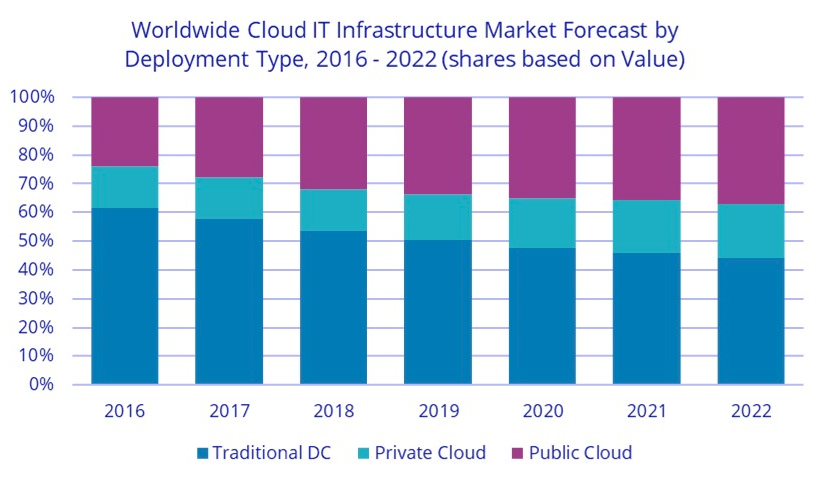
Spending in all technology segments in cloud IT environments is forecast to grow by double digits in 2018. Compute platforms will be the fastest growing at 46.6 percent, while spending on Ethernet switches and storage platforms will grow 18 percent and 19.2 percent year-over-year in 2018, respectively.
According to the IDC assessment, investments in all three technologies will increase across all cloud computing deployment models – public cloud, private cloud off-premises, and private cloud on-premises.
The traditional (non-cloud) IT infrastructure segment grew 21.1 percent from a year ago, a rate of growth comparable to 1Q18 and exceptional for this market segment, which is expected to decline in the coming years.
At $16.4 billion in 2Q18 it still accounted for the majority, 51.5 percent, of total worldwide IT infrastructure spending. For the full year, worldwide spending on traditional non-cloud IT infrastructure is expected to grow by 10.3 percent as the market goes through a technology refresh cycle, which will wind down by 2019.
By 2022, IDC expects that traditional non-cloud IT infrastructure will only represent 44 percent of total worldwide IT infrastructure spending – that's down from 51.5 percent in 2018. This share loss and the growing share of cloud environments in overall spending on IT infrastructure is common across all regions.
"As share of cloud environments in the overall spending on IT infrastructure continues to climb and approaches 50 percent, it is evident that cloud is now the norm. One of the tasks for enterprises now is not only to decide on what cloud resources to use but, actually, how to manage multiple cloud resources," said Natalya Yezhkova, research director at IDC.
All regions grew their cloud IT Infrastructure revenue by double digits in 2Q18. Asia-Pacific (APeJ) grew revenue the fastest, by 78.5 percent year-over-year. Within APeJ, China's cloud IT revenue almost doubled year-over-year, growing at 96.4 percent, while the rest of Asia-Pacific (excluding Japan and China) grew 50.4 percent.
Other regions among the fastest growing in 2Q18 included Latin America (47.4 percent), USA (44.9 percent), and Japan (35.8 percent).
Outlook for cloud infrastructure growth
Long-term, IDC expects spending on cloud IT infrastructure to grow at a five-year compound annual growth rate (CAGR) of 11.2 percent, reaching $82.9 billion in 2022, and accounting for 56 percent of total IT infrastructure spend.
Public cloud data centres will account for 66 percent of this amount, growing at an 11.3 percent CAGR. Spending on private cloud infrastructure will grow at a CAGR of 12 percent.
IBM to Present CIO’s Guide to Enterprise #DigitalTransformation | @IBMcloud @CloudEXPO @SmarterFitz #Cloud #CIO #SmartCities
Business professionals no longer wonder if they’ll migrate to the cloud; it’s now a matter of when. The cloud environment has proved to be a major force in transitioning to an agile business model that enables quick decisions and fast implementation that solidify customer relationships. And when the cloud is combined with the power of cognitive computing, it drives innovation and transformation that achieves astounding competitive advantage.
Power Panel at @DevOpsSUMMIT New York | @AndiMann #DevOps #Monitoring #APM #CloudNative #Serverless #DigitalTransformation
«DevOps is set to be one of the most profound disruptions to hit IT in decades,» said Andi Mann. «It is a natural extension of cloud computing, and I have seen both firsthand and in independent research the fantastic results DevOps delivers. So I am excited to help the great team at @DevOpsSUMMIT and CloudEXPO tell the world how they can leverage this emerging disruptive trend.»
Announcing @Delphix to Present at @DevOpsSUMMIT New York | #Serverless #CloudNative #DevOps #DataOps #ContinuousDelivery
Updating DevOps to the latest production data slows down your development cycle. Probably it is due to slow, inefficient conventional data management practices to copy data between different developer and test environment. This problem doesn’t scale as teams are adopting faster software release cycles.
In this session, Dhiraj Sehgal in Product and Solution at Delphix, will talk about DevOps and cloud-focused strategies to update hundreds of developer and test copies with updates from a master database in minutes, saving hours or even days in each development cycle. He will also discuss how new practices in DataOps to manage data across multiple sources is making their life easier and helps becoming invisible to developers for data provisioning.
Announcing @Wasabi_Cloud «Technology Sponsor» of @CloudEXPO New York | @Wasabi_Dave #Cloud #SDN #Storage #DataCenter
Wasabi is the hot cloud storage company delivering low-cost, fast, and reliable cloud storage. Wasabi is 80% cheaper and 6x faster than Amazon S3, with 100% data immutability protection and no data egress fees. Created by Carbonite co-founders and cloud storage pioneers David Friend and Jeff Flowers, Wasabi is on a mission to commoditize the storage industry. Wasabi is a privately held company based in Boston, MA. Follow and connect with Wasabi on Twitter, Facebook, Instagram and the Wasabi blog.