Government policy-makers should level the playing field for cloud services

Dr Steve Hodgkinson, Research Director, IT, Asia-Pacific

Cloud services policies are being developed and iterated in all jurisdictions. Having reviewed a number of draft policies in recent months, we believe policy-makers need to work harder to create a level playing field for cloud services adoption, mindful of the potential for a type I procurement error (buying a “bad” cloud service) or a type II procurement error (buying a “bad” in-house, shared, or outsourced service, when a cloud service would have been better).

Policies tend to be biased toward avoiding type I errors, so even in policies that are well-intended the playing field is tilted away from cloud services. Type II errors can, however, create worse outcomes, arising from missed or delayed opportunities for productivity improvement and innovation in policy and service delivery.

Innovation-minded governments need to level the playing field

The logic of government cloud computing policy usually starts with …

About the Openness of Eucalyptus, CloudStack, OpenStack and OpenNebula

We have just published a post at the OpenNebula blog with our view about the different measures that should be considered to evaluate the openness of the main open-source Cloud Management Platforms (CMPs). Which is the most important measure of openness in cloud computing? Do the cloud users really care about this? Users mainly want a solution that meets their functional needs, and are interested in open-source as a way to enhance flexibility, lower costs and avoid lock-in. However, as discussed in the post, most of these benefits are only available when an open-source software can be used in production environments without the addition of proprietary components. 
 It is worth reading!.
 

read more

Move Over SDN – NFV Taking the Spotlight

Energetic debates of what SDN is and the expanding scope of what it can do for our customers continue to race along in a chaotic frenzy. In addition, the overall SDN market is somewhat fragmented in terms of both vendor positioning and marketing. Collectively, the conversation really comes down to improving business agility and the efficiencies gained in bringing new services to market. Essentially, the goal is to enable operators to make their networks and services go much faster.

read more

Don’t miss the 3rd Annual Talkin’ Cloud 100 survey

Just a heads up. Our friends at Talkin’ Cloud informed us that their 3rd Annual Talkin’ Cloud 100 survey is now open! You can nominate your own company so all Parallels Partners should to take a few moments to participate!


The deadline for nominations is March 28th. The results will be revealed in May 2013.


The Talkin’ Cloud annual list tracks the world’s top 100 cloud services providers, cloud aggregators, cloud brokers, cloud integrators, VARs and MSPs focused on cloud computing and cloud services. The results are based on such metrics as annual cloud services revenues, percentage growth, dollar growth, cloud computing project revenues, and more. Learn more about the Talkin’ Cloud 100.


Click here to participate.

Parallels named Finalist for Best Cloud Solution for the 2013 IBM Tivoli Business Awards

On the heels of being named a Finalist for IBM’s 2013 Beacon Award for Best Industry Solution for Telecommunications, Parallels was honored to receive another award from IBM. This time we were a Finalist for the Best Cloud Solution for the 2013 IBM Tivoli Business Awards. Congrats to the other Finalist, Computer Gross Italia S.p.A, and the Winner, Front-safe A/S.


The 2013 IBM Tivoli Business Awards recognizes IBM Tivoli Business Partners who have demonstrated excellence in delivering exceptional business value with Tivoli software.


Our very own Matt Vasey and Todd Carter were recognized during the Tivoli Business Partner Forum on Sunday, March 3, 2013.

Cloud Expo NY: Big Data into a Small Storage Package with Cloud Storage

In his session at the 12th International Cloud Expo, Nicos Vekiarides, CEO & Co-Founder of TwinStrata, will examine in-depth the problems created, common workarounds and why they fail, and how cloud storage can be a simpler, far more effective alternative. Attendees will learn about the common and often devastating issues surrounding the storage and management of data. Among the issues discussed will be offsite backup, offsite active archiving, business continuity, disaster recovery, disaster tolerance and scaling capacities in the data center and in the public cloud.

read more

OpenStack, CloudStack, Eucalyptus and OpenNebula

We described in a previous post our experience about the different types of cloud models, and our view about how the main open-source Cloud Management Platforms (CMPs) are targeting their needs. Our aim was to demonstrate that we will see an open-source cloud space with several offerings focused on different environments and/or industries, due to the fact that no single CMP can be all things to all people. The four open-source CMPs will coexist and, in some cases, work together in a broad open cloud ecosystem.
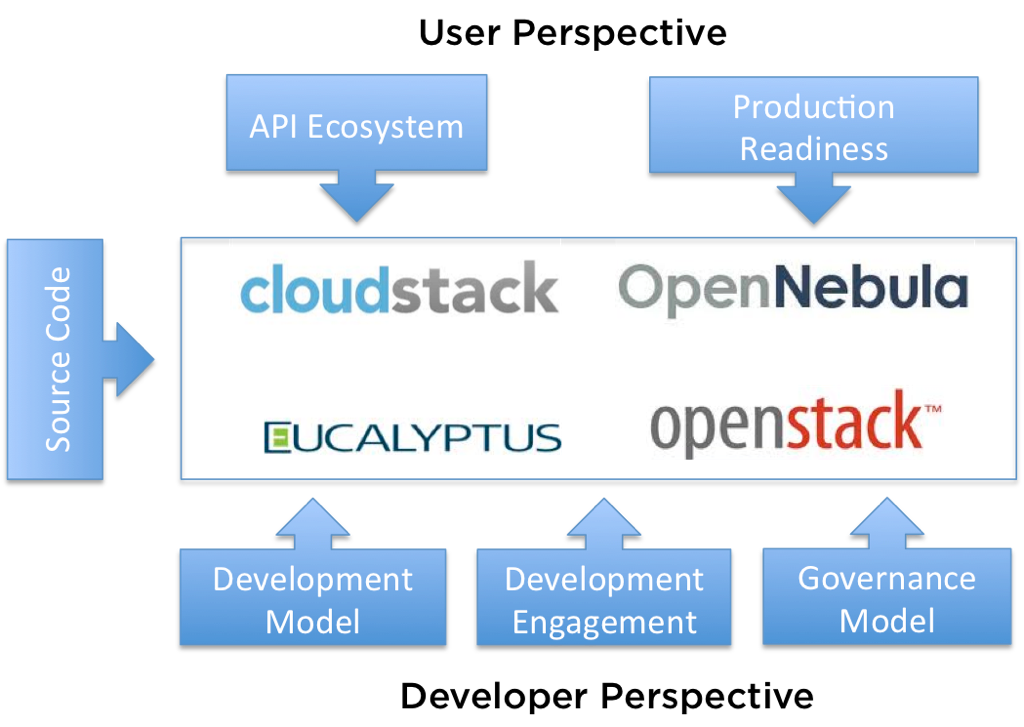
This article tries to answer another quite common question in open-source cloud computing discussions and presentations… which CMP is the most open? Of course such analysis should go beyond just considering the openness of the code (which as far as we know is fully open-source in the four projects) and the development process to additionally address the perspectives of the consumers and the builders of the cloud infrastructure.

read more

Rain From the Cloud (and Some Sun At the End)

Guest Post by Roger Keenan, Managing Director of City Lifeline

Cloud computing is changing the way in which computing and data communications operate.  The availability of high speed low cost communications through fibre optics means that remote hosting of computing and IT applications is economically possible, and there are clear cost benefits for both users and providers.  The migration from in-house computing to cloud has not been as fast as expected.  Putting aside the usual over-optimism of marketing spread-sheets, what holds users back when they think about cloud adoption?

Firstly, there is much conflicting hype in the market and many variations on which type of cloud – public, private, bare-metal, hybrid and so on, and the user must first find his way through all the hype.  Then he must decide which applications to migrate.  In general, applications with low communications requirements, important but not mission critical security needs and a low impact on the business if they go wrong are a good place to start.

Security is always the first concern of users when asked about the cloud.  When an organisation has its intellectual property and critical business operations in-house, its management (rightly or wrongly) feels secure.  When those are outside and controlled by someone else who may not share the management’s values of urgency about problems or confidentiality, management feels insecure.  When critical and confidential data is sent out over an internet connection, no matter how secure the supplier claims it is, management feels insecure.  There are battles going on in parliament at the moment about how much access the British security services should have to user data via “deep packet inspection” – in other words spying on users’ confidential information when it has left the user’s premises, even when it is encrypted.  The “Independent” newspaper in London recently reported that “US law allows American agencies to access all private information stored by foreign nationals with firms falling within Washington’s jurisdiction if the information concerns US interests.”  Consider that for a moment and note that it says nothing about the information being on US territory.  Any IT manager considering cloud would be well advised not to put forward proposals to management that involve critical confidential information moving to the cloud.  There are easier migrations to do.

Regulatory and compliance issues are barriers to adoption.  For example, EU laws require that certain confidential information supplied by users be retained inside EU borders.  If it is held on-site, there is no problem.  If it is in a cloud store, then a whole set of compliance issues arise and need to be addressed, consuming time and resources and creating risk.

Geographic considerations are important.  For a low bandwidth application with few transactions per user in any given period and limited user sensitivity to delays, it may be possible to host the application on a different continent to the user.  A CRM application such assalesforce.com is an example where that works.  For many other applications, the delays introduced and the differences in presentation to the user of identical transactions may not be acceptable.  As a rule of thumb, applications for a user in London should be hosted in London and applications for a user in Glasgow should be hosted in Glasgow.

When applications are hosted on-site, management feels in control.  If management gives its critical data to someone else, it risks lock-in – in other words, it becomes difficult for management to get its data back again or to move its outsourced operations to another supplier.  Different providers have different ethics and processes around this, but there are some real horror stories around and management’s fears are not always misplaced.

Where cloud implementations involve standard general IT functions provided by standard software optimised for cloud, the user can have confidence it will all work.  Where there is special purpose software integrated with them, life can get very complicated.  Things designed for in-house are not usually designed to be exported.  There will be unexpected undocumented dependencies and the complexity of the integration grows geometrically as the number of dependencies grows.  Cloud has different interfaces and controls and ways of doing things and the organisation may not have those skills internally.

Like the introduction of any new way of working, cloud throws up unexpected problems, challenges the old order and challenges the people whose jobs are secure in the old order.  The long term benefits of cloud are sufficiently high for both users and providers that, over time, most of the objections and barriers will be overcome.

The way in which organizations employ people has changed over the last thirty years or so from a model where everyone was a full-time employee to one where the business is run by a small, tight team pulling in subcontractors and self-employed specialists only when needed.  Perhaps the future model for IT is the same – a small core of IT in-house handing the mission critical operations, guarding corporate intellectual property and critical data and drawing in less critical or specialised services remotely from cloud providers when needed.

Roger Keenan, Managing Director of City Lifeline

Roger Keenan joined City Lifeline, a leading carrier neutral colocation data centre in Central London, as managing director in 2005.  His main responsibilities are to oversee the management of all business and marketing strategies and profitability. Prior to City Lifeline, Roger was general manager at Trafficmaster plc, where he fully established Trafficmaster’s German operations and successfully managed the $30 million acquisition of Teletrac Inc in California, becoming its first post-acquisition Chief Executive.

VMware Sets Up New Hybrid Cloud Unit

VMware has started a new Hybrid Cloud Services Business Unit and hired Bill Fathers, the former president of Savvis, the cloud computing and managed hosting outfit, to run it.
VMware, whose stock is at its lowest ebb in three years, made the announcement at a Strategic Forum for Institutional Investors Wednesday.
VMware CEO Pat Gelsinger said the new unit was meant to extend the software-defined data center. VMware is supposed to launch a vCloud Hybrid Service later this year and push it through existing channels. It’s supposed to let customers “reap the benefits of the public cloud without changing their existing applications while using a common management, orchestration, networking and security model.”

read more

Cloud Computing: Oracle To Acquire Nimbula

Oracle announced today that it has agreed to acquire Nimbula, a provider of private cloud infrastructure management software. Nimbula’s technology helps companies manage infrastructure resources to deliver service, quality and availability, as well as workloads in private and hybrid cloud environments. Nimbula’s product is complementary to Oracle, and is expected to be integrated with Oracle’s cloud offerings. The transaction is expected to close in the first half of 2013.

read more