One of the biggest challenges with adopting a DevOps mentality is: new applications are easily adapted to cloud-native, microservice-based, or containerized architectures – they can be built for them – but old applications need complex refactoring. On the other hand, these new technologies can require relearning or adapting new, oftentimes more complex, methodologies and tools to be ready for production.
In his general session at @DevOpsSummit at 20th Cloud Expo, Chris Brown, Solutions Marketing Manager at Nutanix, explored how Nutanix is bringing these sides together – agility for pets, governance for cattle – in a single unified platform. With this combined approach, Nutanix removes silos – both technological and human – propelling your applications to a new level.
[video] Dovetailing #DevOps | @DevOpsSummit @CAinc @Aruna13 #CloudNative #Serverless
As DevOps methodologies expand their reach across the enterprise, organizations face the daunting challenge of adapting related cloud strategies to ensure optimal alignment, from managing complexity to ensuring proper governance. How can culture, automation, legacy apps and even budget be reexamined to enable this ongoing shift within the modern software factory?
Digital Transformation Leaders Adopt Open Ecosystems | @CloudExpo #DX #Cloud #Analytics
Are you open to new ideas, and given a compelling choice are you really prepared to change? That’s what informed CEOs are asking their C-suite leadership team. The context of those questions is about determining who is most qualified to guide the organization’s digital transformation journey. It’s also about setting expectations for C-level executives to partner.
IT and business leaders must acknowledge that they’ve likely reached a significant turning point. Business technology advances are disrupting the legacy status quo and bringing huge market turmoil in their wake. Industries are converging, and unfamiliar competitors are surfacing.
ATMs Are IT Too | @CloudExpo #ITaaS #Cloud #FinTech
That world of homogenous IT technology managed entirely by the internal IT organization has long disappeared. Operations today require efficient and global management of technologically heterogeneous environments. The challenges and mistakes organizations make when tackling this important task include: operational disconnects caused by ineffective internal communications; resource contention when multiple, independently developed project plans compete; incompatible technical documentation; and inconsistent communications with vendors.
HPE to acquire Cloud Technology Partners to bolster consulting services

Hewlett Packard Enterprise (HPE) has announced it is to acquire Cloud Technology Partners (CTP) to extend its cloud consulting presence and beef up its hybrid IT capabilities.
Cloud Technology Partners, whose SVPs include renowned thought-leader David Linthicum, have specialisms in a variety of environments, including Amazon Web Services (AWS) – the company announced it had achieved AWS security competency in June – and Google Cloud’s application development specialisation. The company was last month also placed in Fifty Five and Five’s Inbound Marketing Excellence report for the second year running, indicating its renown in the Microsoft partner network.
For HPE, the rationale is straightforward, with CTP moving into HPE Pointnext, the company’s consultancy unit previously known as Enterprise Services. “CTP’s consulting, design and operational advisory services for cloud environments will strengthen our hybrid IT consulting expertise in a fast growing market,” Ana Pinczuk, SVP and GM for HPE Pointnext, explained in a blog post.
“Together, we will be even better positioned to capitalise on this market trend,” Pinczuk added. “The CTP team has built strong customer momentum and will be able to accelerate that momentum by leveraging HPE’s global brand and go-to-market.”
As HPE explained, CTP helps enterprise clients on a three-pronged cloud journey, from migration – determining which applications are optimal for both public and private clouds – to innovation, through technologies such as the Internet of Things (IoT), big data and machine learning, and operation.
HPE cited a McKinsey study from February which found that spending on hybrid IT consulting and cloud native developments is at approximately $6 billion today, growing at more than 18%. Speaking to The Cube at HPE Discover in June, Pinczuk explained the opportunity ahead. “Nobody owns ‘advise and transform’,” she said. “Nobody owns the whole digital transformation journey. The opportunity there greatly outweighs the constraints that we have in that space.”
Financial terms of the deal were not disclosed.
Hybrid Cloud – Key Benefits and Must-Have Requirements | @CloudExpo #DX #Compliance
Gartner says by 2020, a corporate “No-Cloud” Policy will be as rare as a “No-Internet” policy is today and specifically the Infrastructure as a Service (IaaS) market is projected to continue to grow more than 25 percent per year through 2019. This surge in cloud adoption also represents a huge shift in cloud spending by IT organizations, directly or indirectly affecting more than $1 trillion dollars in Cloud IT purchases by 2020, according to Gartner.
Huawei’s cloudy Connect announcements analysed: Microsoft, AI, and more

Huawei’s Connect event kicked off earlier today – and the announcements flowed at a pace with its cloud offering front and centre of the majority of the news.
First off was the announcement of a partnership between the Chinese giant and Microsoft with Redmond’s apps being released on Huawei’s platform as part of an ‘in-depth cooperation on the public cloud.’
The two companies signed a Memorandum of Understanding (MoU) to seal the deal whereby more Microsoft enterprise-level products will be brought online.
“Huawei Cloud looks forward to cooperating with Microsoft to build an open and win-win ecosystem,” said Zheng Yelai, president of Huawei’s cloud BU and IT product line. “The signing of this MoU marks the start of strategic cooperation between the two companies.” Alain Crozier, CEO of Microsoft China, added: “Our increased collaboration will drive innovation as we build a seamless platform to benefit customers through industry-leading technology.”
Next up on the agenda – with the event theme as ‘grow with the cloud’ – was around assuring customers that Huawei has, and will continue to make, investments in the public cloud domain.
Huawei believes there will be five major global clouds – and it wants a piece of the pie, with Guo Ping, Huawei rotating CEO, citing the Matthew effect – the idea of ‘the rich getting richer and the poor getting poorer’ – as reason for keeping up with the Joneses.
“The cloud is a cornerstone of the intelligent world,” he told attendees. “Society is experiencing a tangible Matthew effect in digital technology development. Because of this, as well as economies of scale in investment, clouds around the world will begin to converge – becoming more and more centralised.
“In the future, we predict there will be five major clouds in the world,” Guo added. “Huawei will work with our partners to build one of those five clouds, and we’ve got the technology and know-how to do it.”
Alongside this was the debut of Huawei’s ‘innovative enterprise intelligence’ (EI) solution, which aims to beef up enterprise cloud deployments with a bit of AI. To put this more specifically, these include machine learning, deep learning and graph analysis platforms, API services such as visual and voice recognition, as well as scenarios specific to particular industries.
A real-life example of this in action – the EI today made its international debut – is around logistics. Through EI, Huawei can offer a logistics company the best containers for packing, as well as a 3D view of each container thus improving efficiency. Data analysis can be used to clear customs at the first hurdle, as well as improve warehouse space efficiency by up to 10%.
“The best cloud must be able to deliver the services that customers need, and AI needs to create more value for enterprises,” said Zheng. “We’re positioning Huawei Cloud as an enabler of the intelligent world. It provides AI, IoT, computing, and storage capabilities that provide enterprises with more innovative, intelligent cloud services.”
You can take a look at the full list of Huawei Connect announcements here.
Picture credit: “Huawei”, by “Kārlis Dambrāns“, used under CC BY 2.0 / Modified from original
Why digital transformation leaders are adopting open ecosystems

Are you open to new ideas, and given a compelling choice are you really prepared to change? That’s what informed CEOs are asking their C-suite leadership team.
The context of those questions is about determining who is most qualified to guide the organisation’s digital transformation journey. It’s also about setting expectations for C-level executives to partner.
IT and business leaders must acknowledge that they’ve likely reached a significant turning point. Business technology advances are disrupting the legacy status quo and bringing huge market turmoil in their wake. Industries are converging, and unfamiliar competitors are surfacing.
Granted, that convergence is creating opportunities for growth by shifting from products and services made by solo entities, to new cross-sector customer experiences built via strategic partnerships. But it’s also intensifying market competition. One company’s convergence can become another’s encroachment. So, how do you navigate through this labyrinth?
Open collaboration in the connected economy
Welcome to the ‘connected economy’ (CE) – a new business reality in which value is created through technology-enabled links among people, open digital systems and business partner networks. Across industries, huge opportunities are available for savvy organisations to become connected economy leaders.
Implementing connected business models and associated processes can help you significantly increase revenue growth and enhance your competitive edge. At the same time, a very real downside to falling behind exists: laggards risk becoming prey to disruptive innovations.
It’s a scenario in which a competitor with a completely different business model can put your traditional revenue stream at risk — or worse, put you out of business. So, with that backdrop, how do you survive and prosper? What does it take to be a leader in the connected economy?
IBM asked Harvard Business Review (HBR) Analytic Services to uncover the drivers for business change, assess the preparedness of organisations, and identify the types of adjustments we must make to capitalise on emerging opportunities. Here’s what they found.
A profile of the global CE leaders
Whatever their industry, the global CE leaders see their world rapidly changing, and they’re determined to be at the forefront of that change in order to remain relevant and claim their competitive advantage.
Their success is increasingly dependent on participation in broader business ecosystems. That being said, even the CE followers and laggards recognise the growing importance of tighter connections with other organisations in adjacent industries.
However, CE leaders are radically better positioned within their own business ecosystems – something that could lead to a long-term advantage. The rest are under pressure to catch up. Fifty-two percent say that a substantial part of their revenue is already under threat from digital disruption.
To counter that threat, savvy organisations are changing how they operate. Moreover, the progressive CE leaders are already reaping the rewards of their new connected business models.
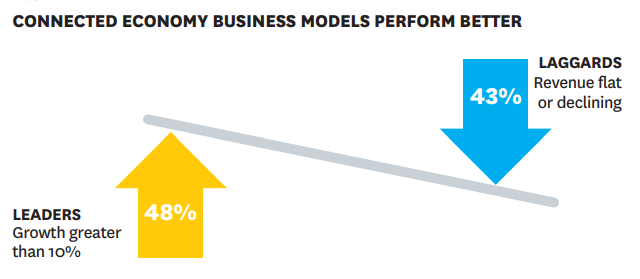
They’ve seen significantly stronger revenue growth over the past two years than their less-connected rivals – in large part due to their ability to exploit information at speed through their use of hardware, software, and networking technologies.
How CE leaders leverage IT infrastructure
What really sets CE leaders apart is the degree to which they recognise the threat from digital disruption and the value of their IT leadership in bringing them into the connected economy. That awareness is causing them to make digital initiatives a C-level priority.
CE leaders have built relationships between CIOs or CTOs and line of business (LoB) leaders, based on collaborative engagement. They invest more in digital technology, skills, and projects. They’ve created digital transition teams, while emphasising that digital is part of everyone’s job.
That being said, only 18 percent of survey respondents say that their organisation have applied progressive CE business models or open innovation to a significant extent. A key to success is the ability to exploit information at speed through the use of open hardware, software, and networking technologies.
As a result, 48 percent of CE leaders have seen double-digit revenue growth. And three times as many CE leaders claim growth of 30 percent or more, when compared to the laggards.
Common traits of proven CE market leaders
CE leaders are much more likely than other companies to:
- Have C-level executives involved in leading digital initiatives.
- Dedicate teams to help with various aspects of the transformation.
- Break down organisational silos through restructuring and fostering cross-functional collaboration.
- Invest in a data-centric IT infrastructure needed to build their digital platform.
- Recognise the need for new, more advanced skills, and ensure their teams are acquiring or developing them.
- Have a “business innovator” CIO or CTO.
HBR believes C-level involvement is crucial, given the profound changes that must take place to transition to a connected-economy business model. In fact, all senior executives at CE leader organisations take an active role in their digital business initiatives.
Why open innovation ecosystems matter
As internal resistance to change is overcome, the connected economy will become even more connected, with success relying on participation in a broader business ecosystem, defined as an interdependent network of collaborative individuals and organisations.
More than half of all survey respondents (and three-quarters of CE leaders) said their organisation’s success is tied to relationships with organisations in adjacent industries. And, 80 percent of CE leaders are more likely to be favorably positioned within their partner ecosystem.
In conclusion, these strategic shifts don’t just happen; they’re led by change agents. CE leaders have made this transition to open innovation a C-level priority. They’re significantly more likely to benefit from business-innovator or transformational CIOs and CTOs who drive cross-functional integration and collaboration between IT and other parts of the business.
Not only are they breaking down silos inside their own organisations, they’re connecting to new business partners that apply open technologies in creative ways, as part of a broader digital business transformation model. This is the new normal; leaders adopt open ecosystems.
Parallels Mac Management – Configuring Automatic Deployment Rules for Apple Updates
One of coolest Parallels® Mac Management for Microsoft® SCCM features is an ability to deliver macOS® and Apple® software updates and patches via integration with SCCM’s software update delivery features. Some Parallels Mac Management customers have been asking if the integration with SCCM supports the Automatic Deployment Rules (ADR). The answer is yes, Automatic […]
The post Parallels Mac Management – Configuring Automatic Deployment Rules for Apple Updates appeared first on Parallels Blog.
Patterns, Platforms and Automation in #DigitalTransformation | @CloudExpo #DX #IoT #SmartCities
Any significant business process that can be documented and best practices identified – will be. Any defined process that can be standardized – will be. Standardized processes that can be codified and automated (through robotic software automation), will be – if the volume justifies it. If the process is repeatable across many companies it will be offered as a shared service on a platform in a cloud.