First, let’s outline a frame of reference for multithreading and why we may need to use a thread pool.
A thread is an execution context that can run a set of instructions within a process – aka a running program. Multithreaded programming refers to using threads to execute multiple tasks concurrently. Of course, this paradigm is well supported on the JVM.
Although this brings several advantages, primarily regarding the performance of a program, multithreaded programming can also have disadvantages – such as increased complexity of the code, concurrency issues, unexpected results and adding the overhead of thread creation.
In this article, we’re going to take a closer look at how the latter issue can be mitigated by using thread pools in Java.
Huawei’s Ambitious Plans for its Cloud Future
Demand for cloud services is increasing and the overall cloud market is growing at an astronomical rate. Almost every company in the cloud business wants to make the most of this growth, and Huawei is no exception.
It has decided to build a global cloud network on its own public cloud. Well, if that sounds confusing, it means, the cloud data center infrastructure will be owned, managed and branded by Huawei’s public cloud partners, but it is built on Huawei’s network. In many ways, we can imagine this network to be like a Hydra creature with many heads, spreading across different regions in the world.
Essentially, it is creating the infrastructure that includes itself and its partners, so that its customer base and network is spread all over the world. With such a plan in place, Huawei wants to be one of the top five public cloud providers in the world. According to the CEO, it believes Alibaba, Microsoft, Google and Amazon Web Services to be the other four public cloud providers against which it will be competing in the future.
This is a strategic move for many reasons. Firstly, the top four companies, according to Huawei, have already established their infrastructure, so it will require massive investments to compete with them. By partnering with other companies, it may be much easier for Huawei to penetrate into different markets.
Secondly, managing the entire infrastructure can be mind-boggling to say the least. The cost and resources involved will be enormous, so by leasing out its infrastructure, Huawei can have a more workable model that will also be load-friendly.
Lastly, it can avoid vendor lock-ins as all its partners don’t necessarily have to use this network. They can partner with Microsoft, Google, Alibaba or AWS for other operations too. In fact, Huawei offers hybrid solutions that make it easy for applications and customers to integrate with other third-party cloud platforms that include the platforms of its competitors as well.
This idea and its implementation has been progressing at a rapid pace. This unit of Huawei was first formed in March 2017 and since then, the company has seen a 238 percent increase in its customer base. This goes to show that many of its customers are looking forward to this public cloud product from Huawei.
So far, it has also released 40 new cloud services out of the total 85 cloud services it has released so far. This includes a data warehouse, DDoS protection and content delivery network that are having a big impact on its clients’ operations.
Many notable companies such as Volkswagen, Mercedes-Benz, Industrial bank of China and Philips are using Huawei’s products. It has also partnered with cloud service providers and telecom companies like Deutsche Telecom, Telefonica and Orange to further its plans.
Overall, it seems ambitious, but it also looks like Huawei has a firm plan in place to further its ambitions. The next few months can give us a better idea of the progress of this product and its acceptance among the global cloud clients.
The post Huawei’s Ambitious Plans for its Cloud Future appeared first on Cloud News Daily.
How digital evolution is defined by trusted relationships

Billions of people around the world use the internet to share ideas and trade with one another. With worldwide internet penetration at nearly 50 percent, the global digital economy has become a space of immense opportunity.
It’s clear that business transactions are becoming heavily reliant on us being connected onlne. Digital flows are now responsible for more GDP growth globally than trade in traditional offline goods and services. Digital transformation is now driving globalization.
As such, achieving a competitive advantage in the global digital arena has become a key priority for governments and businesses who strive for inclusion and relevance. It is also clear that trust has a critical role to play when countries look to improve their eCommerce adoption.
It’s in this context that The Fletcher School at Tufts University, in partnership with MasterCard, present findings from the 2017 edition of the ‘Digital Evolution Index’ (DEI 17).
Exploring national digital trust development
The DEI 17 includes analysis of each country’s DEI score and digital momentum – the rate at which countries have been developing their digital economies. To investors and businesses, momentum is indicative of market attractiveness and potential; to policymakers, it is a proxy for national competitiveness.
The DEI 17 reveals how a country measures up and also how it might take inspiration from techniques and initiatives that have proved successful elsewhere. This is essential knowledge in the changing digital landscape, and also for governments and policymakers overseeing digital transformation.
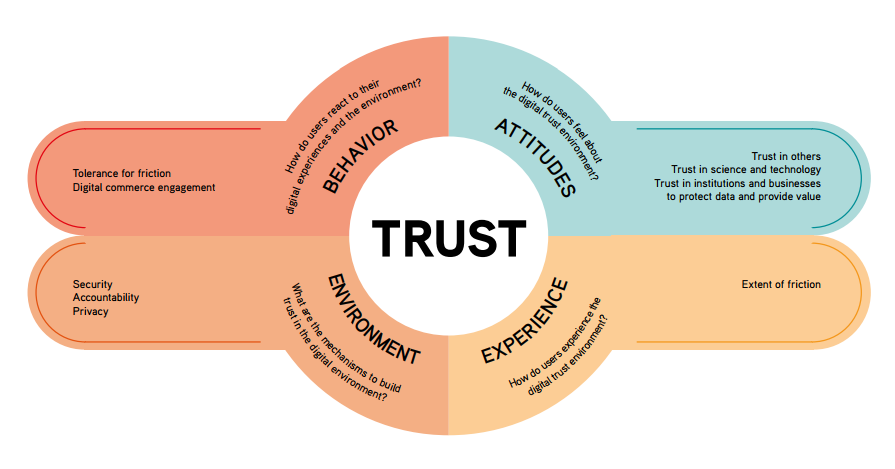
DEI 17 incorporates a framework for Digital Trust that includes:
- Trustworthiness of the digital environment and the users experience.
- Attitudes towards key institutions and commercial organizations.
- Citizen’s behavior when they interact with the digital world.
According to the global study findings, digital trust is rooted in relationships. The guarantors of digital trust form one axis: the institutions, businesses, individuals and governments that are responsible for creating and fostering a trustworthy digital environment.
The DEI 17 reveals the identities of the digital elites operating at this level. As a group, they are split in two. First, there are the international trade hubs of Hong Kong, Singapore and the UAE. And second, there are the nation states of the UK, Estonia, Israel and New Zealand.
These four countries are powering ahead of their rivals thanks to a complex formula of IT and network infrastructure, incubating start-ups, a cultural commitment to innovation, and government support.
“The top five scoring countries in the DEI 17 – Norway, Sweden, Switzerland, Denmark and Finland – are all ‘Stall Out’ countries, reflecting the challenges of sustaining fast upward momentum,” says Dr Bhaskar Chakravorti, senior associate dean of International Business and Finance at The Fletcher School at Tufts University.
One important indicator of a country’s digital potential is its uptake of mobile internet via tablets and smartphones. Countries that reached this stage through iterations of services originally aimed at traditional desktop computing. Others, however, have taken a more direct route, with a singular focus on internet access via mobile devices.
Outlook for digital trust advancements
“The U.S. and UK markets were introduced to the internet through desktops and laptops, but the 1.5 billion new internet users added in the past five years had their first brush with the internet on a mobile device,” said Dr Chakravorti.
Trust is becoming increasingly important to online transactions. But this isn’t universal. The DEI 17 study found major differences in the level of digital trust in different countries. In those nations undergoing rapid advances in digital tech – such as China, Malaysia, Bolivia, Kenya and Russia – individuals are more tolerant of slow and unreliable online technology.
By the time the next DEI comes around, we will know just how well they fared, as well as how insights gleaned from the DE1 2017 helped the developing nations to navigate a path forward.
[slides] Analytics and #FinTech | @CloudExpo #AI #ML #DL #DX #API #DigitalTransformation
Historically, some banking activities such as trading have been relying heavily on analytics and cutting edge algorithmic tools. The coming of age of powerful data analytics solutions combined with the development of intelligent algorithms have created new opportunities for financial institutions. In his session at 20th Cloud Expo, Sebastien Meunier, Head of Digital for North America at Chappuis Halder & Co., discussed how these tools can be leveraged to develop a lasting competitive advantage in priority areas: customer analytics, financial crime prevention, regulatory compliance and risk management.
Cutting Alert Fatigue | @DevOpsSummit @PagerfDuty #AI #DevOps #Monitoring
The convergence of rapid feature development, automation, continuous delivery, and the shifting makeup of modern tech stacks has pushed monitoring requirements to a potentially overwhelming scale. But while the systems you need to monitor are complex, your monitoring strategy doesn’t have to be. The scale and pace of change involved in ops today dictate a carefully crafted monitoring and incident response strategy. Keeping the strategy simple will take some of the pain out of monitoring.
Sponsor #WebRTC at @CloudExpo | #IoT #AI #Java #RTC #Telecom #UCaaS
WebRTC is the future of browser-to-browser communications, and continues to make inroads into the traditional, difficult, plug-in web communications world. The 6th WebRTC Summit continues our tradition of delivering the latest and greatest presentations within the world of WebRTC. Topics include voice calling, video chat, P2P file sharing, and use cases that have already leveraged the power and convenience of WebRTC.
Co-Chairs of @DevOpsSummit Announced | @CAinc @Aruna13 #CloudNative #Serverless #DevOps
Cloud Expo, Inc. has announced today that Andi Mann and Aruna Ravichandran have been named Co-Chairs of @DevOpsSummit at Cloud Expo Silicon Valley which will take place Oct. 31-Nov. 2, 2017, at the Santa Clara Convention Center in Santa Clara, CA. “DevOps is at the intersection of technology and business-optimizing tools, organizations and processes to bring measurable improvements in productivity and profitability,” said Aruna Ravichandran, vice president, DevOps product and solutions marketing, CA Technologies. “It’s this results-driven combination of technology and business that makes me so passionate about DevOps and its future in the industry. I am truly honored to take on this co-chair role, and look forward to working with the DevOps Summit team at Cloud Expo and attendees to advance DevOps.”
[video] #BigData-Driven #DevOps | @DevOpsSummit #CloudNative #Serverless #AI #DX #Hadoop
DevOps is being widely accepted (if not fully adopted) as essential in enterprise IT. But as Enterprise DevOps gains maturity, expands scope, and increases velocity, the need for data-driven decisions across teams becomes more acute. DevOps teams in any modern business must wrangle the ‘digital exhaust’ from the delivery toolchain, “pervasive” and “cognitive” computing, APIs and services, mobile devices and applications, the Internet of Things, and now even blockchain.
[video] #DevOps and #DigitalTransformation | @DevOpsSummit #CloudNative #Serverless #DX
New competitors, disruptive technologies, and growing expectations are pushing every business to both adopt and deliver new digital services. This ‘Digital Transformation’ demands rapid delivery and continuous iteration of new competitive services via multiple channels, which in turn demands new service delivery techniques – including DevOps. In this power panel at @DevOpsSummit 20th Cloud Expo, moderated by DevOps Conference Co-Chair Andi Mann, panelists examined how DevOps helps to meet the demands of Digital Transformation – including accelerating application delivery, closing feedback loops, enabling multi-channel delivery, empowering collaborative decisions, improving user experience, and ultimately meeting (and exceeding) business goals.
Everything as a Service | @CloudExpo @Catchpoint #SaaS #PaaS #Serverless
Whenever I write about the cloud, I tend to break it down into three categories: software as a service (SaaS), infrastructure as a service (IaaS), and platform as a service (PaaS). As I was working on a cloud performance management ebook, a coworker suggested that I also include function as a service (FaaS) and containers as a service (CaaS) in the definitions. I’ll admit, I had never heard of these categories so after these suggestions were made, I went to do some research.
SaaS was one of the first cloud solutions to hit the market. It provides the ability to consume information through a browser or API. IT teams don’t have to manage applications, hardware, security, or storage; everything is managed by the vendor. Users subscribe to a SaaS service on a recurring basis and can easily scale. The uses of SaaS include business productivity, business management, tools, and customer relationship management.