Data scientists must access high-performance computing resources across a wide-area network. To achieve cloud-based HPC visualization, researchers must transfer datasets and visualization results efficiently.
HPC clusters now compute GPU-accelerated visualization in the cloud cluster. To efficiently display results remotely, a high-performance, low-latency protocol transfers the display from the cluster to a remote desktop. Further, tools to easily mount remote datasets and efficiently transfer that data into the HPC cluster are described, including performance characterization results.
Oracle posts more strong cloud results – but analysts unconvinced on guidance

Oracle has announced its latest financial results with cloud again the backbone of success – although its stock slipped due to a struggling guidance.
Total cloud revenues were up 44% year over year to $1.5 billion, with software as a service contributing almost three quarters of that figure at $1.1bn, a yearly increase of 55%. Platform and infrastructure as a service was at $396 million, representing year over year growth of 21%. In total, cloud revenues represented 16% of Oracle’s total revenues, again up from 12% this time last year.
Proposed guidance for cloud revenue, including SaaS, PaaS and IaaS, was at between 21% and 25%, while Mark Hurd, Oracle co-CEO, said that the company expects to sell around $2 billion in enterprise software as a service revenues in the coming four quarters.
The announcement of BYOL – bring your own license – in September reaped dividends, according to co-CEO Safra Catz. “With BYOL, we are seeing a strong increase in our technology install base as customers renew their unlimited license agreement, investing more licenses and options and renew support,” said Catz, as transcribed by Seeking Alpha. “Because BYOL is now available and customers better understand their tradition options to move to the Oracle Cloud, technology new software license revenue is dramatically improving from the declines we were seeing previously.”
Catz added this trend was likely to continue as Oracle rolls out its long-awaited autonomous database – and this was the primary focus of CTO Larry Ellison’s remarks. The elimination of human labour and the price advantages – particularly when compared to Amazon – was nothing different from when Ellison took to the OpenWorld stage in October. The bullishness, however, remains. “We expect this innovative new technology to dramatically accelerate the growth of our PaaS and SaaS businesses and keep our database license business strong as well,” said Ellison.
Total revenues for Oracle in the most recent quarter were at $9.6bn, up 6%. You can read the full set of results here (pdf).
How more industry cloud services are gaining momentum in 2017

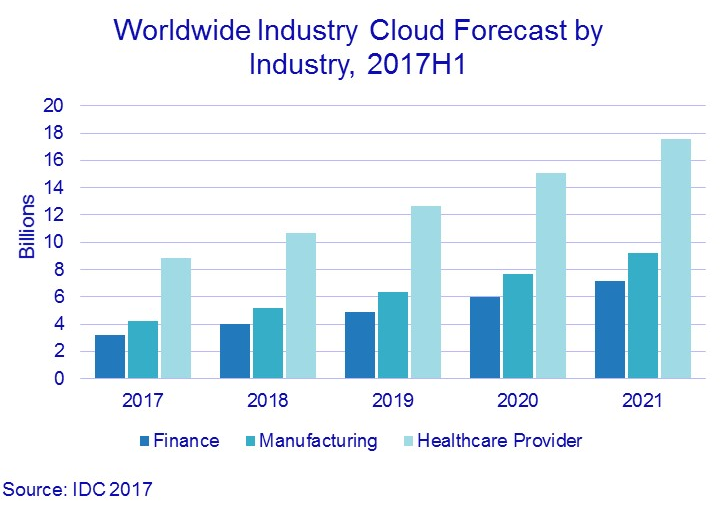
Worldwide spending on industry cloud services in the finance sector – such as banking, insurance, securities and investment services – is expected to reach $3.2 billion in 2017, according to the latest market study by International Data Corporation (IDC).
Furthermore, IDC expects the amount to more than double in 2021, amassing total worldwide spending of $7.2 billion.
Industry cloud market development
The manufacturing industry (both discrete and process combined) was a larger spender on industry cloud though, relative to its finance counterpart. This industry is expected to spend $4.2 billion in 2017 and achieve year-over-year growth of 23 percent in 2018. Similar to the finance industry, the manufacturing industry is also set to double its 2017 spending in 2021, reaching a total of $9.2 billion.
However, IDC forecasts healthcare providers across the world will spend a total of $8.9 billion in adopting industry cloud solutions during 2017. This industry is expected to increase spending by 20 percent year-over-year in 2018 on industry cloud solutions – by 2021, that's a staggering $17.6 billion.
On a geographic basis, the United States leads by a very large margin in terms of industry cloud adoption across the three aforementioned industries combined. It's expected to reach 73 percent of worldwide spend in 2017, followed by Western Europe at 12 percent.
The U.S. is also forecast to grow 20 percent year-over-year in 2018 while the other regions are expected to achieve 27 percent annual growth during the same period. The three industries are expected to spend a total of $330 million on industry cloud solutions in China in 2018, representing very strong growth of 39 percent year-over-year.
"The industry cloud market is young, yet growing fast, with double-digit growth expected to continue for at least the next five to ten years. Dozens of new industry collaborative clouds are emerging each year, helping to foster digital transformation, streamline industry value chains, and ultimately drive innovation, while most software vendors are also shifting their portfolios to focus more heavily on designing industry cloud solutions," said Eric Newmark, program vice president at IDC.
Outlook for vertical industry cloud growth
Healthcare continues to lead the charge from a vertical standpoint, but many industries have picked up momentum, including manufacturing, financial services, and even government.
Though the market's tipping point is still a few years away, IDC believes the industry cloud market represents one of the largest vertical growth opportunities for technology and professional services firms through 2025.
According to the IDC assessment, IT vendors who become strategic suppliers to a successful industry cloud win the business of not just that one organization, but of that customer's entire digital ecosystem.
Can You Run a VM from an External Drive?
At a recent conference for Mac® IT admins, I was asked, “Can you run a VM from an external drive?” Short answer: “Yes, absolutely. I do this all the time.” Longer answer: You have always been able to run a Parallels Desktop® for Mac virtual machine from an external drive. In Parallels Desktop 13, this […]
The post Can You Run a VM from an External Drive? appeared first on Parallels Blog.
[video] Data Traffic Management with @Cedexis | @CloudExpo #Cloud #BigData #Analytics
“There’s plenty of bandwidth out there but it’s never in the right place. So what Cedexis does is uses data to work out the best pathways to get data from the origin to the person who wants to get it,” explained Simon Jones, Evangelist and Head of Marketing at Cedexis, in this SYS-CON.tv interview at 21st Cloud Expo, held Oct 31 – Nov 2, 2017, at the Santa Clara Convention Center in Santa Clara, CA.
[slides] Security in a Cloud-First World Is Cloudy | @CloudExpo #API #Cloud #Security
Enterprises are moving to the cloud faster than most of us in security expected. CIOs are going from 0 to 100 in cloud adoption and leaving security teams in the dust. Once cloud is part of an enterprise stack, it’s unclear who has responsibility for the protection of applications, services, and data.
When cloud breaches occur, whether active compromise or a publicly accessible database, the blame must fall on both service providers and users.
In his session at 21st Cloud Expo, Ben Johnson, Co-Founder and CTO of Obsidian Security, explored how both groups must do more to make cloud more secure, from leveraging AI to improving APIs, to incorporating cloud into current security programs.
Cryptocurrencies, Bitcoin, and Nanocrime: A Looming Dark Cloud? | @CloudExpo #Bitcoin #FinTech
Bitcoins are a digital cryptocurrency and have been around since 2009. As a substitute for legal tender, they are becoming the rage for investors and others but because there is no government agency auditing or performing regulatory oversights, you wonder if it is the perfect breeding ground for electronic nanocrime.
Since the introduction of the Bitcoin, some competitors have emerged and the whole segment of cryptocurrencies are defined as Altcoins. Altcoins include Dogecoin, Ethereum Feathercoin, Litecoin, Novacoin, Peercoin, and Zetacoin. Some of these cryptocurrencies are considered improvements on the original Bitcoin algorithm structure, and they are gaining some traction as well.
Top Tech Gifts of 2017 from Team GreenPages
Just in time for your last minute holiday shopping! Here are our picks for the top tech gifts this holiday season, chosen by Chris Williams, Tony Ramsey, Tim Ferris, David Jones, and me, Jake Cryan. Hopefully, this will help you find something for the techies on your list!
Chris Williams
Enterprise Consultant
2nd Generation Amazon Echo
All of the same features and sound quality of the original Alexa, but smaller, more stylish, and cheaper at $100!
Nintendo Switch
It’s a great gaming platform both for at home and on the road. With several great games already and more coming out in time for Christmas, now is the time to get it!
Fitbit Charge HR
I’ve been using this fitness wearable for the past year and it’s still the best mid-range priced device out there. Compatible with both Android and iPhones, synchs with phones GPS for running, biking and hiking and many more activities. If you want to go high end, get the Fitbit Ionic and you’ll upgrade to waterproof (for swimming) and built-in GPS.
Tony Ramsey
Practice Manager, Network & Security
Bose Sports Wireless Earbuds
Bose is well known for the best quality sound, however, these are perfect for any type of sport and listening to music or audiobooks. They’re also weather and water resistant, perfect for use anywhere. The best part is, if you lose them, there’s an app that will help you find them!
Quadrocopter Drone
This drone is great for beginners, kids and adults alike. It also comes equipped with a 720P camera and one key return. You simply press a button and it’ll fly back to its place of initial take off! You can also control it by remote control or smartphone. Plus, at $60 you won’t be breaking the bank for your first drone.
Tim Ferris
Solutions Architect
2nd Generation Amazon Echo Dot
The perfect starter device for your home. If you aren’t ready to make the plunge and buy an Amazon Echo, invest in the more affordable, Echo Dot. This simple device gives you access to all of Alexa’s skill and the ability to control a variety of smart home gadgets. P.S. most retailers are currently offering it for a discounted price before the holidays.
David Jones
Enterprise Consultant
Amazon Echo & Wink Hub
One Two Combo
I use this combination of devices to control my entire house. Lights, fans, door locks, you name it. I’ve created “macros,” so by telling Alexa “goodnight,” she will turn off most of the lights in the house, dim the remaining, lock the front door, and set the thermostat. It’s pretty amazing stuff. I also use it in conjunction with sensors, and my garage doors to automatically turn lights on when certain doors opened (like the one to my basement) without having to fumble in the dark for a light switch.
Jake Cryan
Digital Marketing Specialist
A 4G LTE global wifi hotspot and power bank. As an avid traveler, this is the perfect device to connect to fast wifi anywhere in the world. It helps me get online when I’m away, whether it’s for work or personal reasons, I get access to high-speed internet in over 100+ countries. I had it with me while on a recent trip to Iceland and no matter how deep into the isolated snowy tundra I was, it worked perfectly. The bonus of the Solis is that it’s also packed with a 60000 mAh power bank, allowing you to charge your gadgets while you are on the go.
New studies explore importance of data security – and how some companies struggle with it

Two pieces of research have hit CloudTech HQ, both examining how the security of data is perceived – and which data is more private than others.
Information security provider Trustwave, in its ‘Value of Data Report’ published today, aimed to look at which data was most important to the 500 IT decision makers polled across five countries. On average, the per capita value of personally identifiable information (PII) in the US is more than double that of the UK – $1,820 and $843 respectively. The UK ended up having scantest regard for their data, behind Australia ($1,186), Japan ($1.040) and Canada ($1,025) respectively.
What’s more, PII is of greater import than all other types of data – in most sectors, anyway. 47% of respondents cited it as a high priority, compared with intellectual property (27%), payment card data (18%), with corporate email (6%) bringing up the rear. Healthcare and hospitality give the biggest priority to PII data, with average scores of 3.5 and 3.4 out of four respectively, while industrial companies and IT firms rank IP as most important.
Given this around how fiercely protected certain types of data are, findings from Kaspersky in another report released today make for particularly interesting reading. Polling more than 2,000 IT decision makers across Europe in organisations with more than 50 employees, fewer than three in five (55%) of respondents believe companies are looking after their personal data properly.
Almost three quarters (73%) said the security of their private data was important, while 67% admitted they were concerned about their information being hacked. A similar number (64%) said they were worried about how many organisations have access to their personal information.
Again, the UK does not come out in the best light when it comes to data security. Only 56% of IT decision makers trust organisations to keep hold of their data – a meagre number when compared to their equivalents in France (76%), but a little better than Germany (48%).
Both studies cited the importance of the upcoming General Data Protection Regulation (GDPR) – an issue which this publication has covered in chapter and verse – in their findings. “Companies that fail to accurately value their data are unlikely to make the right decisions regarding the level of cyber security investments to protect that data and are those most likely to fall short of regulations, such as the GDPR coming into effect in 2018,” commented Ziv Mador, vice president of security research at Trustwave.
“Businesses should look to the managed security services business model so that they have the confidence that full data risk vigilance is applied to all types of confidential and valuable data by specialists in the industry.”
Alibaba strengthens European cloud plans with additional C5 compliance accreditation

More evidence – as if it were needed – that Alibaba is serious about taking its cloud arm into new geographies: the company has announced compliance accreditation with Germany’s federal office for information security.
The C5 attestation – so called because its full natty title is the Cloud Computing Compliance Controls Catalogue – with additional requirements covers Alibaba’s elastic compute service, relational database, object storage, CDN, load balancer, virtual private cloud and security offerings.
The German federal office, the Bundesamt für Sicherheit in der Informationstechnik (BSI), outlines the C5 criteria thus (pdf), noting already established standards such as the ISO/IEC 27001 and 27017: “Among security experts and cloud service providers exists an informal consensus about the requirements that have to be met for secure cloud computing. A generally recognised requirements (or controls) catalogue on this, however, is not available yet. The present [C5] is intended to be an aid for the customer providing a better overview for a higher level of security and avoiding redundant audits.”
Only five cloud service providers are C5 accredited – AWS and Microsoft being among them – while Alibaba says it it’s the first company to be accredited with additional requirements.
“Alibaba Cloud is fully committed to the highest standards in all aspects of our operations no matter where that might be in the world,” said Simon Hu, Alibaba SVP and president of Alibaba Cloud in a statement. “We are proud to be the first company to meet the C5 additional requirements – something that should increase the trust placed in us by our growing client base not only in Germany, but also across the whole of Europe.”
This can be seen as the icing on the cake for a stellar year in Alibaba’s cloud operations. Naturally, its traditional eCommerce strength remains – just the $25 billion generated in sales with Singles Day last month – enabling the cloud arm to fly somewhat under the radar. CEO Daniel Zhang told analysts on an earnings call at the start of November that the cloud business “continues to defy gravity”, with revenues up 99% year on year.
Alongside an expanding partner ecosystem, the company outlined its plans to move from one million cloud customers to 10 million at its Computing Conference in Hangzhou back in October. The previous month, Gartner placed the company in third for public cloud infrastructure as a service.