The Business Case for Hybrid Cloud Services Adoption | @CloudExpo #API #Cloud #Storage

Forging a viable business technology strategy for today’s global networked economy is a high priority for most forward-thinking CEOs across the globe. Their guidance to CIOs is to create the fusion between existing IT infrastructure and modern cloud services. Moreover, the shift to a Hybrid IT model must support the organization’s key commercial expansion objectives.

The savvy leaders who have a superior approach can extract greater value from their legacy IT investments, and launch new initiatives based upon public and private cloud computing services. This is the new normal — CIOs must create the optimal blended environment for purposeful technology-enabled innovation.

Primary Motivation

A global study of 500 hybrid cloud decision makers revealed that organizations are increasingly integrating cloud computing and storage resources with traditional IT infrastructure to accommodate dynamic needs and specific business priorities, according to a market study by the IBM Center for Applied Insights.

This thought-provoking study found that improving productivity is currently the number one goal of cloud service adoption, as the most progressive senior executives plan to offload some of their IT resources and management complexity to the cloud.

A close second goal of digital transformation is improved security and risk reduction — using the flexibility of a hybrid solution to choose which workloads and data to move to the cloud and which to maintain on-premise.

The other two most mentioned goals by survey respondents are IT infrastructure cost reduction — i.e. shifting costs from fixed IT to as-needed cloud services — and scalability to handle dynamic IT workloads.

Why Maturity Matters

Following their detailed analysis, the IBM report authors grouped the survey respondents into three categories, based upon the maturity of their hybrid management capabilities and whether they’re reporting a strategic edge that’s realized from their hybrid cloud deployments:

  • Frontrunners: are gaining a competitive advantage through hybrid cloud and are managing their environment in an integrated, comprehensive fashion for high visibility and control (as an example, through a single data-driven dashboard).
  • Challengers: are on the journey toward competitive advantage, but haven’t fully achieved unified management of their hybrid cloud environment.
  • Chasers: are not yet using hybrid cloud to drive competitive advantage and are in the early stages of gaining integrated control over their hybrid environment.
Benefits of Hybrid Leadership

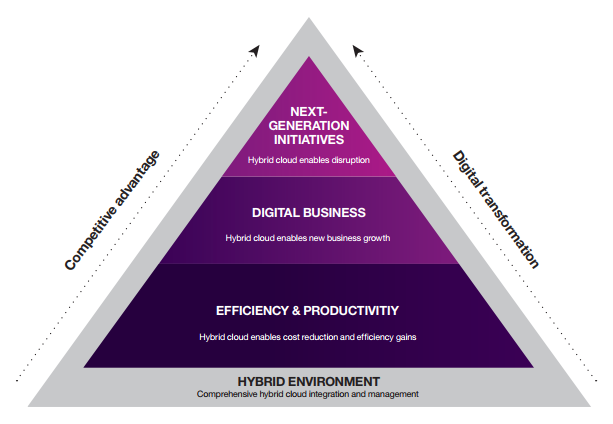
What’s the big improvement of being a visionary frontrunner in your industry? They’re achieving noteworthy business outcomes with a hybrid cloud — such as productivity gains, including cutting operational costs and maximizing the value of existing IT infrastructure — at a higher rate than other organizations.

Frontrunners are also more effectively using hybrid cloud to drive digital business innovation, including the creation of new products and services and the expansion into new markets. They also apply hybrid cloud solutions to experiment with cognitive computing and the Internet of Things (IoT) — which have the potential to enable the development of new business models.

Moreover, the frontrunners are using hybrid solutions as a driver of business process change, with 85 percent reporting that hybrid cloud service adoption is accelerating a progressive digital transformation agenda at their companies.

Hybrid Challenges and Opportunities

Most frontrunners say they have achieved measurable progress from their hybrid cloud efforts. However, more than one in four have experienced difficulty executing their plan to integrate legacy IT infrastructure and cloud computing environments.

Finding and retaining the technical staff with the desired experience is often a challenge, with one in three survey respondents citing an internal skills gap as a big unresolved issue. Furthermore, while companies adopt cloud services to improve security, it remains their number one concern.

In fact, frontrunners cite management complexity and security as a major obstruction to progress. Over three-quarters report that hybrid introduces greater IT management complexity into their environment, and 70 percent say that their hybrid environment causes them greater security concerns.

How are these early-adopters leveraging hybrid environments to achieve a meaningful and substantive competitive advantage? Study findings indicate that they apply a very intentional and holistic approach to implementing and managing their hybrid solutions.

Culture is a Key to Ongoing Hybrid Success

The established frontrunners also understand that the complexity of hybrid environments is best tackled through a collaborative approach to IT investment decision making — bringing both the managers of IT organizations and Line of Business (LoB) leaders together on a common cause.

The IBM study findings also uncovered that in almost three-quarters of frontrunner organizations, hybrid cloud has elevated the extent to which the CIO is now acting as a trusted adviser to the overall business leadership team.

The collective C-suite and senior IT roles collaborate on key technology decisions that impact business goals. This newfound collaboration sheds light on the benefits of Shadow IT, where the progressive LoB leadership is already using forward-looking cloud services to advance their growth agenda.

Besides, 81 percent of the frontrunners report that hybrid cloud is helping to reduce Shadow IT growth within their organizations. Proving, once again, that savvy CIOs are the ones that are proactively embracing the shift to Hybrid IT models, and thereby regaining workload deployment momentum that was lost due to prior computing and storage resource provisioning constraints.

read more

LeaseWeb to Exhibit at @CloudExpo | @LeaseWebUSA #IoT #DataCenter

SYS-CON Events announced today that LeaseWeb USA, a cloud Infrastructure-as-a-Service (IaaS) provider, will exhibit at the 19th International Cloud Expo, which will take place on November 1–3, 2016, at the Santa Clara Convention Center in Santa Clara, CA. LeaseWeb is one of the world’s largest hosting brands. The company helps customers define, develop and deploy IT infrastructure tailored to their exact business needs, by combining various kinds cloud solutions.

read more

Three Things dPaaS Has in Common with Pokémon GO | @CloudExpo #API #Cloud #dPaaS

Have you seen people wandering around in public spaces, eyes glued to their smartphones, pausing and turning in different directions as if seeking some invisible landmark? Chances are you’ve spotted someone playing Pokémon GO, a location-based augmented reality game that is taking the world by storm.
Released just last month, Pokémon GO has already smashed previous records for mobile game downloads while inspiring millions to leave their homes in search of virtual Pokémon creatures. The creatures are invisible to the naked eye, of course, but they appear on user’s screens as if occupying real-world space.

read more

Synchronoss Launched Secure Mobility Platform | @CloudExpo @Synchronoss #Cloud #Security

Synchronoss announced the general availability of its Secure Mobility Platform (SMP) – the combination of a highly secure application container and integrated productivity suite that together improves the productivity and performances of enterprise mobile workforces.
Designed and built using secure enterprise mobility technology contributed by Goldman Sachs through the venture announced last November, Synchronoss SMP consists of:
Synchronoss Lagoon – a secure device container which encrypts the enterprise’s data on the device and over the air

read more

AWS, Microsoft, Google and IBM continue cloud market dominance

male and female during the run of the marathon raceNew research from Synergy states while the cloud market is growing at a healthy rate quarter-by-quarter, the four dominate cloud brands are continuing to pull away from the pack, controlled more market share month-by-month, reports Telecoms.com.

Data from Synergy Research claims the four companies now collectively control more than 50% of worldwide cloud market share (IaaS, PaaS and Hosted Private Cloud), with AWS maintaining its lead at the top of the leader board controlling almost a third of worldwide share. Over the course of the second quarter of 2016, the top four grew revenues by 68%, while the next 20 players, who roughly account for a quarter of the market share, grew 41%. All other vendors in this space grew by a collective 27%.

“In a variety of ways Amazon and the other big three players have distanced themselves from the competition in this market and continue to widen the gap,” said John Dinsdale, Research Director at Synergy Research Group. “What marks them out as different is their global presence, marketing muscle, ability to fund huge investments in hyper scale data centres and, in most cases, a determination to succeed in the market.

“The ranking of the next 20 largest cloud providers features some interesting companies, with Alibaba and Oracle growing particularly strongly, but they are all starting from a long way behind Google, which is itself growing by well over 100% per year and yet remains only a sixth the size of Amazon.”

Although AWS is still the dominant market player, growth is slowing. Google and Microsoft both posted growth figures of more than 100%, though it is far too soon to write AWS’ obituary, as it still controls more than three times the market share of its nearest rival, Microsoft Azure.

Microsoft has been going through a number of transformation projects in recent years, and while the market share for cloud shows it will still be some time before it catches AWS, the team are finding success in other arenas. According to additional research from Synergy, in the data centre infrastructure market, HPE and Cisco may be leading the way for public and private cloud hardware, but Microsoft now accounts for just over 40% of cloud software share, with VMWare its nearest competitor at roughly 20%. The research including share for servers, server OS, storage, networking, network security and virtualization software.

“With spend on cloud services growing by over 50% per year and spend on SaaS growing by over 30%, there is little surprise that cloud operator capex continues to drive strong growth in public cloud infrastructure,” said Jeremy Duke, Synergy Research Chief Analyst. “But on the enterprise data centre side too we continue to see a big swing towards spend on private cloud infrastructure as companies seek to benefit from more flexible and agile IT technology. The transition to cloud still has a long way to go.”

Microsoft Azure to deliver 2016 Olympics

athletics trackMicrosoft has announced it has partnered with broadcaster NBC for its Azure cloud platform to help deliver cross-platform multi-streaming coverage of the 2016 Olympic Games, reports Telecoms.com.

The Azure cloud platform will help NBC deliver more than 4,500 hours of coverage from the Rio de Janeiro Olympic Games throughout August. According to Microsoft, it will be providing cloud encoding and hosting with video workflows for the NBC Olympics’ production of the Games, and will assist with live and on-demand multiplatform streaming coverage.

The NBC app will host all of the content and will be available on most devices and platforms including Android, iOS, the US’s biggest selling smart TV set top box Roku, Amazon Fire TV, any device running Windows 10, including Xbox, as well as PC and Mac.

“We always strive to deliver more content in real time to more channels and devices around the world,” said Scott Guthrie, executive vice president of the Cloud and Enterprise Group at Microsoft. “During the Sochi Olympic Games, NBC Olympics had more than 1 million concurrent live viewers watching a collective average of 600,000 hours of coverage per day. We are planning for even greater viewing numbers for Rio, and are excited to power the experience again using Microsoft Azure.”

“The Rio Olympics have nearly three times as many events per day as the Sochi Games,” said Rick Cordella, senior vice president and general manager, Digital Media, NBC Sports Group. “With the Azure cloud platform, Microsoft is partnering with us to deliver the secure, scalable cloud we depend on to bring the Games to millions of viewers on whichever device they prefer, via end-to-end live streaming entirely in the cloud.”

This agreement is in addition to NBC’s plans on delivering more than 80 hours of content through virtual reality headsets, after it signed an agreement with Samsung last month to bring the next-generation viewing experience to mobile users with the Galaxy Gear VR and compatible accompanying handset.

AWS, Microsoft, IBM and Google own more than half of global cloud infrastructure market

(c)iStock.com/Catherine Lane

Amazon Web Services (AWS), Microsoft, IBM and Google continue to grow more quickly than their smaller competitors and own between them more than half of the global cloud infrastructure service market.

That’s according to the latest figures put out by Synergy Research, who issued a note after Amazon and Alphabet – the parent company of Google – put out their second quarter financial results last week.

Comparing the charts for this quarter compared to Q415, Amazon’s year on year growth has slowed a little – from 63% to 53% – with a similar tale being told for Microsoft (124% to 100% yearly growth respectively). The big winner, if you could call it that, is Google, which Synergy assesses is growing at a 162% yearly clip, where it was at 108% previously. IBM’s growth (57%) is unchanged from Q4, with its strong showing mainly down to leadership in the hosted private cloud segment.

The figures reveal little in the way of surprises for those who have been following the segment.

While Synergy argues the best of the rest, including Alibaba and Oracle – which bought NetSuite for $9.3bn last month – are growing particularly strongly, their current position is miles behind Google, never mind AWS.

“Amazon/AWS remains far ahead and in a league of its own, despite some valiant efforts from the other big three cloud providers,” said John Dinsdale, Synergy chief analyst, in an email.

“Despite its huge scale Amazon is still growing faster than the market and is increasing its market share. It continues to lead in all geographic regions and most market segments.”

Dinsdale told CloudTech at the time of the Oracle/NetSuite deal going public that the move would strengthen the Redwood giant’s position in the enterprise SaaS market, and assessed Oracle as a top 10 PaaS and top 20 IaaS player. NetSuite on its own was considered by Synergy as a top 15 enterprise SaaS vendor.

The market overall grew by 51%, Synergy argues, while quarterly cloud infrastructure service revenues – including IaaS, PaaS and SaaS – have now hit the $8bn mark.

Analysing effective security management in a software-defined world

(c)iStock.com/4x-Image

Software defined infrastructure (SDx), along with use of private and public clouds completely transforms the way IT departments manage enterprise data centres and workloads. Automation is a key component of software defined networking (SDN), bringing together network, server, security management and other IT functions or teams together.

In the past, when organisations deployed new applications, the application owner needed to collaborate with several teams. For example, one team installed the required HW and OS servers, a separate team connected servers to the network, and yet another team provisioned the security and firewall rules. It was as if the stars – or functional teams – had to align in order for all of the necessary components to provision so that the application owners could start using the new infrastructure to deploy and make use of their new applications.

Today, private and public cloud infrastructures allows IT to automate these operations; virtual machines are dynamically created and deployed, operating systems are quickly and easily provisioned, and connecting new services to the network is streamlined and automatic. As a result, pre-configured templates of commonly used and well defined services are available to the application owner with a single click on a self-service portal, across multiple data centres, private and public clouds.

In this new world where new apps are instantly created or moved to a different location as the infrastructure gets provisioned, changed and elastically scaled based on demand, security officers are challenged to enforce the organisation’s security policy and retain full visibility of security incidents. As we will find out, the keys to getting control back are creating dynamic security policies, API scoping, and security management consolidation.

Creating dynamic security policies

Dynamic security policies in modern networks are achieved by close integration with network virtualisation and public IaaS solutions, such as VMware NSX, Cisco ACI, OpenStack, or AWS/Azure. By integrating with these solutions, objects defined by those systems, such as groups and tags, are learned and utilised security policies. This creates dynamic policies where changes in the software-defined environment are immediately translated and instantly reflected into an effective and active security policy that is applied to all traffic automatically – without human intervention.

Additionally, leveraging and populating this contextual information in log files gives security admins the ability to better understand and investigate any security incident.

API scoping

In order to completely automate the deployment of new applications, organisations need to grant developers access to APIs that in many cases involve modification of security policies. It is vital to ensure this access is coped or limited appropriately; otherwise, a mistake by a developer could potentially alter the security policy of the entire organisation, making it vulnerable to threats.

An example of scoping access to APIs can be seen through the printer admin. The printer admin uses an app to add printers to the network. In doing so, this involves modifying firewall rules using an API. The security policy must ensure that the printer application can only add new printers – nothing else – and is only permitted within relevant network segments.

Security management consolidation

Consolidation of management functions is necessary to gain complete and holistic visibility of security policies and incidents across the entire organisation’s infrastructure, including all north-south, east-west, virtual and physical, private and public cloud traffic. Without management consolidation, incidents are difficult to identify, correlate and analyse across the various cloud networks, making it operationally impossible to secure these environments.

CheckPoint aims to integrate with leading cloud and network virtualisation solutions, as well as allowing customers to confidently embrace automation and the cloud while retaining advanced security using effective security management for software-defined data centres and public cloud environments. You can find out more here.

Sauce Labs Selects @SumoLogic for Machine Data Analytics | @CloudExpo #Cloud #DevOps #BigData

Sauce Labs has selected Sumo Logic to troubleshoot and better track log performance issues to predict potential issues before they occur. With Sumo Logic, Sauce Labs now has the ability to better help its customers accelerate the software and development cycle.
Sauce Labs provides a high-performance, cloud-based automated testing platform that is optimized for Continuous Integration and Continuous Deployment (CI/CD) workflows. Catering to fast-moving companies that employ modern development techniques that support DevOps, Sauce Labs creates a large amount of internal log data, with log volumes ranging up to 600 GBs on some days. It’s critical for the company to be able to keep pace by offering scalable, yet secure, automated testing in the cloud.

read more

The cloud news categorized.