Digital Transformation: Crossing the Skills Chasm By @DHDeans | @CloudExpo #Cloud

Most informed CEOs seem to know intuitively that the most qualified person to lead their forward-looking business technology advancement isn’t likely to have the profile of a typical legacy CIO. In contrast, the role of a Digital Business Transformation innovator has very different requirements to the traditional IT utility infrastructure custodian of the past.

That said, some progressive CIOs are already making the transition to lead the digital competitiveness quest, and others will surely follow. Moreover, a few multinational companies currently have a CIO in a highly strategic, visible and collaborative position within the company. Their challenge is to guide the rest of the organization’s leadership to attain the required skills that will enable them to actively participate in the planning and execution of a new strategy – empowered by digital technologies.

The Harvard Business Review (HBR) market research team recently completed a global study of the path that several organizations have taken to develop and deliver the digital learning support resources that their key internal stakeholders both need and want. The results of this research portrays an environment that may be familiar to many CEOs that have, or are about to, embark upon a similar journey.

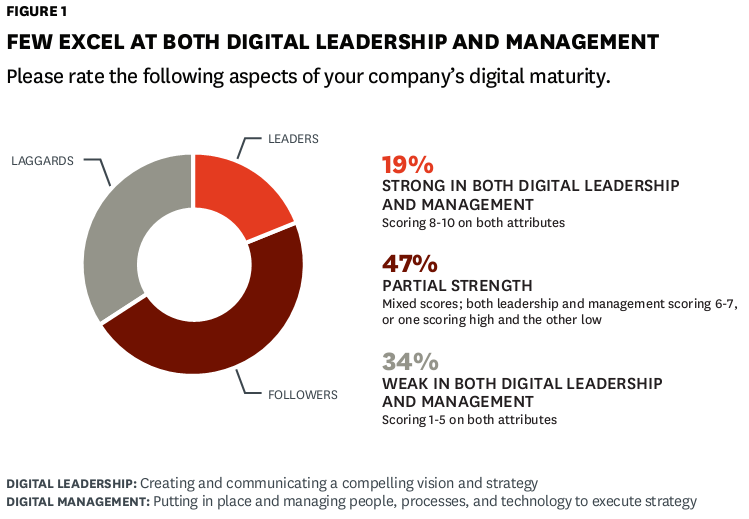
The HBR survey found that companies that rate highly in both digital leadership and management have better business results than their peers, with stronger revenue growth and greater profit margins.

Just under a fifth of survey respondents fell into this early-adopter or “Digital Leader” category, while over a third were deemed to be “Laggards” – i.e. an organization that’s weak in both digital leadership and management. Moreover, nearly half of the survey respondents had mixed scores and were rated as “Followers.”

What set the leaders apart from their peer group, in laggard or follower organizations? These proactive CIOs help their business colleagues to understand which digital knowledge and skills need to reside in their function, and which they can defer to the IT support team. The CIOs and their staff typically communicate in language that makes sense to a Line of Business (LoB) leader that’s focused on achieving outcomes.
Why Superior Digital Acumen Matters Most

According to the HBR study findings, digital acumen has become a critical component of all forward-thinking senior leadership teams. But there’s often a significant gap between what’s needed to succeed, and the current state inside many mainstream companies today.

About 23 percent of the survey respondents indicated that they’re confident their organizations have the necessary knowledge and skills to succeed in the digital aspects of their business transformation.

However, the recognized Digital Leaders in the respondent group were significantly more confident that their organizations have the both the required knowledge and skills they need — in fact, 67 percent were extremely confident, compared with only 19 percent of the Followers and 5 percent of Laggards.

Clearly, there’s no substitute for the credibility and confidence that comes from having qualified digital-savvy executive talent at your disposal. Put simply, HBR discovered that the lack of leadership is the number-one issue holding most companies back, when it came to determining their digital business readiness; particularly among the Laggard companies.

Business Imperative for Digital Competency

Perhaps you’re wondering, is the skills development effort really worth the trouble? Does the payback justify the investment in time and energy? Let’s now explore the primary motivation for attaining digital supremacy, and you can decide what’s best for your company, within your industry.

The Digital Leaders in the survey were significantly more likely to have seen revenue growth of 10 percent, or more, over the past two years (58 percent of the Leaders vs. 43 percent of the Followers and 38 percent of the Laggards).

There’s no reward for taking a wait-and-see approach, even if the conservative late-adopter posture was taken with the best of intentions. The Laggards reported that they were twice as likely to have seen revenues decline (18 percent vs. 9 percent).

Fostering Collaboration and Shared Objectives

The CIOs at Digital Leaders are much more likely to be characterized as digital coaches or masters (45 percent of respondents, compared with 26 percent at Follower companies, and only 14 percent at Laggard companies).

By comparison, 45 percent of the Laggard companies had a CIO that’s been characterized as a “turf protector” that inhibits or resists collaboration — or they merely had no designated CIO role at all.

A full 74 percent of the Digital Leaders have CIOs who support business-led IT projects. That is, when Line of Business leaders directly fund, contract, and/or develop technology capabilities themselves. This response compares with 64 percent of the Followers and only 40 percent of the Laggards.

Furthermore, the respondents who characterized their CIO as a digital coach or master had significantly higher scores — over 80 percent of those respondents said their CIO supports business-led IT projects. This doesn’t mean, however, that those CIOs are ceding procurement control — rather, they’re willingly sharing it in order to achieve the desired business outcome objectives of the whole leadership team.

Digital Skills Education and Mentoring

According to the HBR assessment, there’s little doubt that organizations need to do more to increase their business leader’s digital acumen. In the past, learning new skills might be a task that was assigned to the internal Training group or the Human Resources department. In this scenario, the education and mentoring responsibility should go to those who have mastered the digital transformation craft.

That said, finding a role model(s) for digital acumen knowledge transfer can be problematic. While 46 percent of respondents said they would like to learn more about digital trends from their CIO, close to two-fifths said their CIO doesn’t seek to educate and empower LoB leaders when it comes to digital skills.

Besides, over a third of the respondents said their IT team doesn’t provide useful knowledge about technology applications or understand which digital knowledge is most important to specific functions or lines of business.

In a follow-on editorial I’ll share more details about the illuminating findings from this study, and the associated recommendations for a plan of action. HBR Analytic Services interviewed a total of 436 business leaders from across the globe. The survey was sponsored by Red Hat, Inc., as part of The Enterprisers Project.

read more

Mounting frustration with cloud technology is stifling adoption – research

An influential group of senior business executives is being disillusioned by experiences with cloud hosted applications, according to new research. The proportions, though relatively low, are growing as cloud disenchantment threatens to set in.

The revelations come from research by cloud service provider Stratogen. Its main finding was that the expense, the lack of both applications and support and the downtime involved are all disappointing the company decision makers who backed cloud computing in their companies.

If news of the disenchantment spreads among the business community, the bad feedback could nip cloud growth in the bud, according to Karl Robinson, chief commercial officer at StratoGen. “The research highlights a major problem for cloud technology,” said Robinson, “It is clear UK businesses today have a distinct lack of confidence in the cloud’s ability to deliver the benefits it is capable of.”

The study, conducted independently by Arlington Research, involved a survey of 1000 senior business executives. Around three quarters (74 per cent) of the survey group reported day to day frustrations with using cloud hosted applications.

The main complaint for 20 per cent of the study group was the high cost of their cloud applications. Another minority (17 per cent) complained about the lack of available cloud applications. The lack of IT support was mentioned by 16 per cent of the survey and one tenth of those surveyed were not happy with the amount of downtime.

As a result, a minority of the survey group (17 per cent of the business leaders quizzed) are concerned that their cloud systems are preventing their company from growing. Around the same proportion (14 per cent) are worried that downtime is affecting employee productivity and creating a loss of company earnings.

Though these are complaints from a small minority, the survey figures seem to indicate that their influence is disproportionally high, since 33 per cent of the business leaders say they are now ready to remove their business off the cloud completely. A further 31 per cent are also considering a cloud exodus.

“The perceived high cost of cloud hosting is a direct result of the unexpected metered costs businesses are all too often hit with,” said Robinson, “migration challenges and the time invested in integrating cloud technology with legacy applications can further increase the cost of cloud computing.”

NXTmonitor, @eCubeSystems’ DevOps Solution | @DevOpsSummit #DevOps

eCube Systems has released NXTmonitor, a full featured application orchestration solution. NXTmonitor, which inherited the code base of NXTminder, has been extended to support multi-discipline processes and will act as a DevOps utility in a heterogeneous enterprise environment. Previously, NXTminder was packaged with NXTera middleware to configure and manage Entera and NXTera RPC servers.
“Since we are widening the focus of this solution to DevOps, we felt the need to change the name to NXTmonitor to accurately reflect the operations monitoring features it provides,” says Kevin Barnes, President of eCube Systems.

read more

SAP announces improvements to cloud platform and Vora analytics software

SAP HANA VoraSAP has released new software that it claims will make analytics easier for users of open source Hadoop software.

The SAP HANA Vora is a new in-memory query engine that improves the performance of the Apache Spark execution framework. As a result, anyone running data analysis should be able to get better interactions with their data if it’s held on Hadoop and companies will benefit from more useful intelligence.

SAP claims this new software will overcome the general ‘lack of business process awareness’ that exists in companies across enterprise apps, analytics, big data and Internet of Things (IoT) sources. The software will make it easier for data scientists and developers to get access to the right information by simplifying the access to corporate and Hadoop data.

SAP HANA Vora will bring most benefit in industries where Big Data analytics in business process context is paramount. SAP identified financial services, telecommunications, healthcare and manufacturing as target markets. The savings created by the new software will come from a number of areas, it said. In the financial sector, the return on investment in the systems will come from mitigating risk and fraud by detecting new anomalies in financial transactions and customer history data.

Telecoms companies will benefit from optimising their bandwidth, SAP claims, as telcos use the software to analyse traffic patterns to avoid network bottlenecks and improve the quality of service. Manufacturers will benefit from preventive maintenance and improved product re-call processes as a result of SAL HANA Vora’s newly delivered powers of analysis of bills-of-material, services records and sensor data.

The use of Hadoop and SAP HANA to manage large unstructured data sets left room for improvement, according to user Aziz Safa, Intel IT Enterprise Applications and Application Strategy VP. “One of the key requirements is better analyses of big data,” said Safa, “but mining these large data sets for contextual information in Hadoop is a challenge.”

SAP HANA Vora will be released by the end of September, when a cloud-based developer edition will also be available. Here’s a SAP vid on the matter.


Announcing @Pythian Named “Bronze Sponsor” of @CloudExpo | #DevOps #BigData #IoT #Microservices

SYS-CON Events announced today that Pythian, a global IT services company specializing in helping companies leverage disruptive technologies to optimize revenue-generating systems, has been named “Bronze Sponsor” of SYS-CON’s 17th Cloud Expo, which will take place on November 3–5, 2015, at the Santa Clara Convention Center in Santa Clara, CA.
Founded in 1997, Pythian is a global IT services company that helps companies compete by adopting disruptive technologies such as cloud, Big Data, advanced analytics, and DevOps to advance innovation and increase agility. Specializing in designing, implementing, and managing systems that directly contribute to revenue growth and business success, Pythian’s highly skilled technical teams work as an integrated extension of our clients’ organizations to deliver continuous transformation and uninterrupted operational excellence.

read more

Citrix Workspace Suite Features vs. Parallels RAS

Citrix offers a range of products that cater to different virtualization needs of business networks. XenApp is a software that virtualizes applications and publishes them to remote users. XenDesktop software lets you deliver virtual desktops across remote networks. The main drawback with Citrix virtualization products is that you have to purchase licenses for each one […]

The post Citrix Workspace Suite Features vs. Parallels RAS appeared first on Parallels Blog.

StorageCraft’s New Pricing

San Francisco, StorageCraft Technology Corporation has recently announced that they are going to adopt a new pricing model as well as enhancements for its StorageCraft Cloud Services disaster recovery solution. This new model allows users to recover their systems and data without excessive costs by permitting users to customize cloud coverage. This customization allows the service to meet the unique needs and budgets of individual customers. Users will also have access to systems and data anytime with instant failover in a cloud built specifically for disaster recovery. Several recovery options are offered by StorageCraft Cloud Services to decrease system downtime as well as data loss. Users may choose from the myriads of options according to what fits their unique budget.

StorageCraft cloud services


Mike Kunz, StorageCraft’s Vice President of Worldwide Sales, has commented: “Data is the life-blood of a business. A business owner with data in a cloud should not be forced to pay a ransom to gain access to his or her data after a disaster. The new, simple pricing model makes StorageCraft Cloud Services as affordable as generic clouds, while offering recovery options that other clouds do not offer. To put it simply, StorageCraft Cloud Services’ pricing allows users to focus on the recovery — not on what is affordable to recover or how to pay for a recovery. Other vendors charge high fees at the time of recovery, such as essential CPU, RAM, and bandwidth resources.  StorageCraft Cloud Services supports your business’ recovery point objectives and recovery time objectives, including full virtualization.”

StorageCraft Cloud Services allows users to store backup images offsite in the StorageCraft Cloud and gives users the opportunity run networked systems in the Cloud when local access to systems and data is unavailable. StorageCraft Cloud Services is offered in a myriad of budget-friendly tiered options and service+ levels, Cloud Basic (Secure offsite storage of your critical business backups with full system restore via a bare metal restore drive), Cloud+ (Includes everything in Cloud Basic, plus immediate file and folder recovery), and finally Cloud Premium (Includes everything in Cloud+, as well as instant virtualization of data and systems in the cloud). Since its initial launch in 2012, StorageCraft Cloud Services has exemplified both extreme growth and stability. The company, StorageCraft, has been renowned for both its speed and reliability within the Cloud Industry.

The post StorageCraft’s New Pricing appeared first on Cloud News Daily.

Future Business Trends in Tech: Looking Forward to 2025 By @Stratustician | @CloudExpo #Cloud #BigData

When it comes to how trends like Big Data, mobility, cloud computing and social networking have impacted organizations, it’s clear that it has led to a large shift that has paved the way for a new market of startups who boldly embrace these trends and other organizations who are still struggling to keep up. But these trends have only started to pave the way for what we might see in the next 10 years, and the future is exciting.

We’ve seen the impact the four tech mega trends; Big Data, Always-Connected Mobile Devices, Social Networking and Cloud Computing, have on the way organizations operate. These trends mean they now need to be able to not just spot new opportunities, but also be able to innovate in an agile way, demonstrate transparency and trust, and deliver a unique and personalized user experience 24/7 in real time. These changes have had a significant impact in how the global economy interacts between customers and organizations across all platforms both physical and digital.

read more

AppZero Joins Microsoft Enterprise Cloud Alliance | @CloudExpo #Cloud

Cloud and datacenter migration innovator AppZero has joined the Microsoft Enterprise Cloud Alliance Program. AppZero is a fast, flexible way to move Windows Server applications from any source machine – physical or virtual – to any destination server, in any cloud or datacenter, using its patented container technology. AppZero’s container is also called a Virtual Application Appliance (VAA). To facilitate Microsoft Azure onboarding, AppZero has two purpose-built offerings: AppZero SP for Azure, a SaaS portal, https://azure.appzero.com/, and an Azure Certified app in the Microsoft Azure Marketplace. The first five migrations on AppZero SP for Azure can be done at no cost.

read more

Cloud strategy still tentative for many UK corporations – study

IT managers and CIOs should not feel they’ve missed the boat as the majority of enterprises have only just started their cloud journey, according to a new enterprise study.

If a study of 200 senior IT managers in large public and private sector organisations is an accurate reflection of the nation’s IT, only 3 per cent of enterprises have arrived at their final cloud destination. Not far from half (41 per cent) of IT managers surveyed were categorised as ‘still taking their first tentative steps towards cloud’ by the survey conductor Vanson Bourne. The study, run on behalf of UK cloud services provider Redcentric, also identified another significantly large group (32 per cent) that said they’re only half way to their cloud destination.

The study also identified the five types of personality trait that emerge among IT managers and CIOs as the pressure to adopt cloud technology builds. Five genres of manager were identified – in ascending order of caution – as Experimenters, Evolutionaries, Accelerators, Progressives and Cautionaries.

The relative proportions of these self-identified personality types did not always match the spread of cloud installations, however. Four per cent of cloud managers identified themselves as ‘risk-taking experimenters’ who were ‘willing to accept the ups and downs of moving to the cloud and not entirely sure the direction they will take’. This roughly equated to the proportion of managers (3%) who were satisfied they had completed their cloud journey.

Equal numbers of IT mangers and CIOs saw themselves as Accelerators (16%) who want to move to the cloud as fast as possible and Progressives (16%) who want to use cloud to make bold business changes. Taken together, these categories indicate that 32 per cent of the study group are frustrated in their ambitions for the cloud. This matched exactly the number (32 per cent) of companies that have yet to reach the half way point of their cloud migration.

The majority of the study group (50 per cent) identified themselves as Evolutionary and stated that they take a steady approach where cloud is a natural progression for the business.

There is a significant group of Cautionaries (15 per cent) who are most cynical about cloud overall. However, only 3 per cent of the group have not embarked on cloud projects, which indicates that 12 per cent of IT managers and CIOs have embarked on a cloud migration without having any faith in the technology.

“We wanted to help UK organisations understand where they are and where their journey is likely to take them next,” said Redcentric sales director Andy Mills, “The findings show there is huge untapped potential still to explore.”

The cloud news categorized.