Coolest Drone Videos

Drones have given us a greater understanding of the world, thanks to its capability to provide information from the remotest corners of the world where human inhabitation is impossible. In fact, drone photography has caught on in a big way, and it’s being used to capture moments from disaster zones, sporting events, concerts, nature and so much more. There are also some funny moments captured on quadcopters that is sure to bring a smile on your face.

To get a glimpse of the power of drones, we have compiled a list of the coolest drone videos for you.

Dolphin Stampede and Whales:

This jaw-dropping footage of a mega-pod of thousands of dolphins stampeding off the coast of Dana Point in California gives a rare glimpse into the life of dolphins. Also in this video, is a heartwarming close-up of a new humpback whale snuggling with its mother.

Dji Phantom flies into volcano:

This drone was sent straight into the Yasur volcano on the island of Tanna in the Pacific nation of Vanavatu. This volcano has been erupting continuously for eight centuries, so this drone brought back some spectacular images of this phenomenon to give geologists a better understanding of what’s going on here.

Angry ram takes down a drone and its owner:

In this hilarious video, a confused ram uses its horns to take down a drone hovering over it. The owner also has a close escape as he was knocked down into a bush by the raging ram.

Aerial video of tornado damage in Vilonia and West Pulaski county in Arkansas:

A tornado struck near Little Rock, Arkansas on April 27, 2014. This drone video shows the images of the disaster, including a heartbreaking footage of a home that was wiped off its foundation.  Such videos can greatly help with rehabilitation and emergency response systems.

Beijing from above:

In this drone video, Trey Ratcliff caught an aerial view of Beijing with his drone. However, he was detained by the police as drones are forbidden in the Chinese capital. He was later released and was allowed to keep the video because it gives a fresh perspective of Beijing and the everyday life here.

Drone’s eye view of Burning Man 2013:

Once a year, artists come together to create Black Rock City, a temporary city on Nevada’s Black Rock Desert. The incredible creativity and energy of this event was captured by drones to give an idea of what 70,000 people can do together.

Postcards from Pripyat, Chernobyl:

A city called Pripyat was evacuated in 1986 due to the Chernobyl nuclear disaster. Almost three decades later, Danny Cook of CBS TV visited this place. The video footage he filmed using drones showed how the city had frozen in time, allowing nature to take over much of the city’s open spaces.

Koh Yao Noi:

Philip Bloom went to a Thai island called Koh Yao Noi near Phuket to showcase the beauty of this island to the rest of the world. This enchanting video is different from other drone videos as it’s shot very close to the ground to give a whole new perspective to viewers.

Drone hits groom in the head:

Drone videos like this are sure to give you a hearty laugh. During a couple’s bridal shoot, the drone hit the groom’s head and knocked them down to the ground, right when he was about to kiss his bride-to-be!

OK Go – I won’t let you down:

This rock band called OK Go used a drone camera to capture the entire dance sequence performed using umbrellas, Honda unicycles and school girls. The camera starts inside a building and zooms out into the air to provide the most entertaining dance ever. No wonder it’s one of the coolest drone videos at more than 28 million views on YouTube.

Have you come across any interesting drone videos? Do let us know by commenting below.


The post Coolest Drone Videos appeared first on Cloud News Daily.

How commercial blockchain deployments are gaining traction

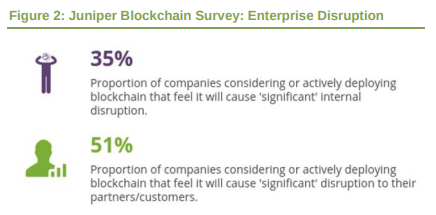
Many organisations are now actively considering blockchain deployments, and a significant proportion are already anticipating integration of blockchain into their IT systems within the next 18 months, according the latest worldwide market study by Juniper Research.

The Juniper survey found that among the largest companies (those with 20,000 of more employees) that were considering deploying or were in the process of deploying blockchain, 54 percent had reached the PoC (Proof of Concept) stage, with a further 16 percent involved in trial deployments.

Among all companies that have reached the PoC stage, 66 percent expected blockchain to be integrated into their systems by the end of 2018. Integration was expected to take longer as companies got larger among the smaller companies surveyed (i.e. those with less than 1,000 employees), 81 percent expecting integration to be completed by the end of 2018 – compared with 57 percent of companies with over 20,000 employees.

IBM leads blockchain market development

That being said, IBM is regarded by survey respondents as having the most proven credentials within the emerging blockchain sector, well ahead of all competitors. That’s based upon almost 400 company founders, senior executives, managers and IT leaders that responded to Juniper’s survey.

Among enterprises either actively considering, or in the process of deploying blockchain technology, 43 percent of the survey respondents ranked IBM first – that’s more than twice the proportion selecting second-placed Microsoft (20 percent).

According to the study, this reflected IBM’s high-profile R&D engagement with initiatives such as the Hyperledger project, and its extensive list of blockchain clients across an array of key verticals and use cases – including banking, asset tracking and the music industry.

Among respondents who were prepared to state their levels of investment in blockchain, 67 percent stated they had already invested more than $100,000 by the end of 2016, while 91 percent of these companies confirmed that they would be spending at least this amount in 2017.

The study findings stated that this suggested most initial investments had delivered results that were sufficiently encouraging for companies to pursue more extensive trials and/or integrations.

Outlook for blockchain application growth

When challenges are measured against the scale of the upside market opportunity, automotive, financial settlement and land registry emerge as particularly interesting growth prospects.

However, Juniper analysts urge interested companies and other organizations to focus on private blockchains for commercial deployments, rather than attempt to utilise public chains – such as Bitcoin.

It also argued that most corporate applications would require the capability to restrict access to permissioned users, while companies would also need to have a degree of control over the development of the blockchain on which their systems have become dependent.

“Even if companies conduct initial testing using a public blockchain, in most cases the shortcomings of these chains should disqualify them from many use cases,” said Dr Windsor Holden, head of forecasting & consultancy at Juniper Research.

Editor’s note: Read more about blockchain technologies at our sister publication, The Block.

Should You Be Considering Web-Scale Networking? | @CloudExpo #IoT #M2M #Cloud #DataCenter

Web-scale networking, also known as hyperscale, is a concept that has been popularized by companies like Google, Netflix and Facebook, who adopted this model for its proven cost economics, resiliency, scalability, and in some cases, better performance for large companies.
In recent months, the web-scale strategy has begun to gain the attention of enterprises in response to the changing data center landscape and growth of compute-heavy, complex technologies like AI, machine learning, and big data analytics initiatives. What should IT pros know about web-scale?

read more

Nine out of 10 CIOs see DevOps skills as key for developers and infrastructure professionals

Demand for DevOps professionals continues apace, according to the latest analysis from Robert Half, with nine out of 10 CIOs in the UK seeing DevOps as a core competency for developers and infrastructure professionals in the next five years.

The study, which is based on more than 100 interviews with CIOs from companies across the UK, found that for 90% of respondents DevOps would be effective if security was built into continuous service and application delivery. 94% agreed that DevOps would need to incorporate greater security measures.

When it came to more specific routes to success, 37% of those polled said establishing IT security checks was a primary consideration when thinking about skills needed for effective DevOps implementation. 34% opted for incorporating data regulation requirements.

Respondents, when faced by the challenges of DevOps implementations, found them much of a muchness. 32% said needing strong management structures was key, as well as enhancing communications within the IT team, while 31% opted for getting the right skills within IT.

As other research has shown, if you have the right skills in this domain then you can be set up nicely. Earlier this month, a report from Puppet revealed that 66% of DevOps engineers and 69% of software engineers in the US took home pay packets of more than $100,000 per year.

“In this new age of digitalisation, DevOps is creating new opportunities for technology professionals to support the business and opening up new career paths,” said Neil Owen, director at Robert Half Technology UK. “There is a growing need for IT and technology professionals to become more business and commercially savvy.

“As the DevOps movement increases the collaboration between technology functions and the business, this is a key way for technology professionals to improve their opportunities for career progression.”

Gartner puts Alibaba in third place for public cloud IaaS behind AWS and Microsoft

Amazon Web Services (AWS) continues to hold all the aces in public cloud infrastructure as a service (IaaS) ahead of Microsoft – but Alibaba is ahead of Google to take third place in the market.

That is according to the analysts at Gartner, who argue the global IaaS public cloud market grew 31% in 2016 to total $22.1 billion (£16.5bn). AWS comprises 44% of that market share, at $9.78bn, with Microsoft in second on $1.58bn, Alibaba third on $675m, Google on $500m and Rackspace at $484m.

Alibaba, not surprisingly, was the fastest growing vendor year on year at 126.5% growth, with Google (100%) and Microsoft (61.1%) next. As other research firms have noted, the competition in the market continues to grow more quickly than AWS, although the latter is hardly standing still. Gartner puts AWS’ growth at 45.9% between 2015 and 2016.

Sid Nag, research director at Gartner, argues IaaS will show the fastest growth over the next five years, ahead of platform and software as a service. “The worldwide public cloud service market growth continues, driven by digital business initiatives, data centre consolidations and application migrations to the cloud,” said Nag. “Technology strategic planners must build both relevant offerings and partner-based ecosystems to seize the opportunity.”

Compare and contrast with Synergy Research. Earlier this month the company said the public cloud market had grown 35% between the second quarters of 2015 and 2017, with the private cloud – or cloud-enabled – market growing 16%. In comparison, spending on traditional, non-cloud data centre hardware and software had dropped 18%.

When it came to cloud infrastructure services, Synergy’s research has similarities with Gartner. This time last year – Q216 – their analysis was that Amazon held more than 30% of the market but growing at 53%, with Microsoft second growing at 100%, IBM third, Google fourth – growing at 162% – and Alibaba in the chasing pack.

ANSeeN to Exhibit at @CloudExpo Silicon Valley | #DX #AI #ML #Cloud #DataCenter

SYS-CON Events announced today that Taica will exhibit at the Japan External Trade Organization (JETRO) Pavilion at SYS-CON’s 21st International Cloud Expo®, which will take place on Oct 31 – Nov 2, 2017, at the Santa Clara Convention Center in Santa Clara, CA.
ANSeeN are the measurement electronics maker for X-ray and Gamma-ray and Neutron measurement equipment such as spectrometers, pulse shape analyzer, and CdTe-FPD. For more information, visit http://anseen.com/.

read more

Google adds per-second billing to Compute Engine, Container Engine and App Engine… ahead of AWS

Amazon Web Services (AWS) may have been the first of the major cloud vendors to announce per-second billing, but Google has become the first to implement it.

The company announced yesterday that customers of Compute Engine, Container Engine, Cloud Dataproc, and App Engine flexible environment virtual machines (VMs) will move to the new system, applicable to all VMs.

Google’s change was made effective as of September 26, while AWS customers will have to wait until October 2 for their move. Google customers need to purchase for a minimum of one minute before the per-second billing kicks in.

“In most cases, the difference between per-minute and per-second billing is very small – we estimate it as a fraction of a percent,” Paul Nash, group product manager for Compute Engine wrote. “On the other hand, changing from per-hour billing to per-minute billing makes a big difference for applications (especially website, mobile apps and data processing jobs) that get traffic spikes.

“The ability to scale up and down quickly could come at a significant cost if you had to pay for those machines for the full hour when you only needed them for a few minutes,” Nash added.

As this publication noted when AWS made its move, another strong pull factor towards per-second billing is the rise of serverless computing, where code may not run for more than a few seconds.

Nash theorised that if the average business’ VM lifetime was rounded up by 30 seconds due to per minute billing, then at 2,600 vCPUs, you would save…99 cents per day. For per hour billing, naturally, it goes up to more than $100.

Either way, the customer does get greater control. “As you can see, the value of increased billing precision is mostly in per-minute,” wrote Nash. “This is probably why we haven’t heard many customers asking for per-second. But we don’t want to make you choose between your morning coffee and your core hours, so we’re pleased to bring per-second billing to your VMs.”

Nash added that Google had been using per-second billing for persistent disks since 2013, and for committed use discounts and GPUs since their introduction. The Google Cloud Platform has duly been updated with per-second billing, under the tagline “you pay per-second, which is how a cloud should work.” Previously, it was “you pay per-minute, not per hour, which is how a cloud should work.”

You can read the full blog post here.

TAZMO to Exhibit at @CloudExpo Silicon Valley | #DX #AI #ML #Cloud #DataCenter

SYS-CON Events announced today that Taica will exhibit at the Japan External Trade Organization (JETRO) Pavilion at SYS-CON’s 21st International Cloud Expo®, which will take place on Oct 31 – Nov 2, 2017, at the Santa Clara Convention Center in Santa Clara, CA.
TAZMO technology and development capabilities in the semiconductor and LCD-related manufacturing fields are among the best worldwide. For more information, visit https://www.tazmo.co.jp/en/.

read more

Google Cloud acquires Bitium for greater identity and access management

Google Cloud has beefed up its identity and access management game with the acquisition of Bitium, a Santa Monica-based firm.

Bitium, founded in 2012, offers a variety of identity management features, including secure access, user provisioning and deprovisioning, app management and single sign on.

In a short blog post confirming the news, Karthik Lakshminarayanan, director of product management for G Suite and Cloud Identity, said the move will help mitigate customers’ risks around managing and securing cloud applications.

“Our enterprise customers want a comprehensive solution for identity and access management and SSO that works across their modern cloud and mobile environments,” wrote Lakshminarayanan. “Bitium helps us deliver a broad portfolio of app integrations for provisioning and SSO that complements our best in class device management capabilities in the enterprise.

“As we add Bitium’s capabilities, we’ll continue to work closely with our vibrant ecosystem of identity partners so that customers are able to choose the best solutions to meet their needs,” he added.

From Bitium’s side, a note from the two founders, CEO Scott Kriz and CTO Erik Gustavson, thanked their investors and explained the move. “When we started Bitium, our goal was to change how people and companies work by fundamentally changing the way they interact with software, starting with single sign-on and identity access management,” the note read. “Joining the team at Google Cloud allows us to continue along this path and accelerate these efforts.

“The Google Cloud team shares our vision for improving the way companies use software, enabling them to innovate faster.”

Financial terms of the deal were not disclosed.

Google Cloud Acquires Bitium

Google Cloud has acquired a company called Bitium for an undisclosed sum, and this company is soon expected to become a part of the Google Cloud team.

Bitium was founded in 2012 and it provides identity and access management service for its customers. With this product, customers can give their employees a single access credential for using multiple applications like Google apps, Office 365, CRM, marketing tools, social media and more.

Also called as single sign on (SSO), this product gives customers greater security than before as IT administrators have a centralized process to control employees’ identity throughout the organization. At a time when insider activity is becoming an increasing cause of breaches, this is definitely a product that can control that.

In addition, customers need to remember only one set of username and password details to access all applications. As a result, this product from Bitium offers a high level of security and flexibility for organizations to manage their employee access and identity.

From an organization’s point of view, it’s a great way to reduce nefarious and “shadow IT” activities by its employees, as they can readily access many cloud-based applications.

These advantages are what caught Google’s attention too.

With this acquisition, Google plans to continue the good work that Bitium is doing, but all that will now happen under Google’s name. Going forward, Google plans to extend this application to its partners as well. At the same time, it plans to keep this application open for third-party providers, so that they can integrate it along with Google Cloud and G suite.

The larger reason for this acquisition is to take on competition from Amazon Web Services and Microsoft. Repeatedly, research has shown that cloud security is one of the factors that deter companies from moving to the cloud, With such an identity and access management system, cloud security is greatly increased as the chances for employees to access unauthorized content is greatly reduced. Google hopes that such an increased security can enthuse more customers to opt for Google Cloud over that of AWS and Azure.

Overall, this looks like a good move for Google as it can get the much-needed edge that it’s looking for against its stronger opponents – Amazon and Microsoft.

But, how it translates will be interesting and time will best judge the impact of this acquisition on Google’s customer base and profitability.


The post Google Cloud Acquires Bitium appeared first on Cloud News Daily.

The cloud news categorized.