When applications are hosted on servers, they produce immense quantities of logging data. Quality engineers should verify that apps are producing log data that is existent, correct, consumable, and complete. Otherwise, apps in production are not easily monitored, have issues that are difficult to detect, and cannot be corrected quickly. Tom Chavez presents the four steps that quality engineers should include in every test plan for apps that produce log output or other machine data. Learn the steps so your team’s apps not only function but also can be monitored and understood from their machine data when running in production.
How to type “CTRL + ALT + Delete” on Mac with Parallels Desktop
Having problems typing “Control-Alt-Delete” (also sometimes abbreviated as “Ctrl+Alt+Del”) in your Windows virtual machine on your Mac®? This article has everything you need to know about entering this important Windows shortcut. Since I have already admitted one character flaw on this blog (font addiction), I might as well fess up about another: key combos. Unlike […]
The post How to type “CTRL + ALT + Delete” on Mac with Parallels Desktop appeared first on Parallels Blog.
Announcing @IoTGN “Media Sponsor” of @CloudEXPO NY | #IoT #IIoT #SmartCities #DigitalTransformation
SYS-CON Events announced today that IoT Global Network has been named “Media Sponsor” of SYS-CON’s @ThingsExpo, which will take place on June 6–8, 2017, at the Javits Center in New York City, NY. The IoT Global Network is a platform where you can connect with industry experts and network across the IoT community to build the successful IoT business of the future.
What to expect from HPE Discover 2018
15 Jun, 2018
HPE Discover is upon us once again, and the infrastructure company’s executives, representatives, customers and fans will shortly be descending on Las Vegas’ Palazzo hotel to hear what the company has in store for the forthcoming year.
CEO Antonio Neri will need to come out swinging, too. Despite HPE’s first-quarter revenue beating estimates to the tune of $600 million, his first year in the role has seen the company lose ground to main rivals Dell EMC in the server market in both revenue and market share.
HPE does have some things to shout about, however; the last few months have seen the company announce major deals, including a network modernising contract with Gatwick Airport worth $15 million, and the installation of a supercomputer cluster across three UK universities. The company has also launched new offerings based around AI and blockchain – two themes that will be pushed hard at next week’s event.
Of course, hand-in-hand with AI and machine learning comes big data and analytics. Hardcore number-crunching and AI algorithms are two big reasons for companies to upgrade their servers, so expect these to be big use-cases for HPE to use in promoting its latest ProLiant data centre products. After all, that’s what Dell did at its conference earlier this year.
HPE also launched its Greenlake pay-per-use pricing structure last year, so we wouldn’t be at all surprised to see new announcements around this as part of the conference. Flexible consumption models are all the rage at the moment as more and more businesses shift their expenditure towards OpEx and away from CapEx, so now is an excellent time for HPE to big up its capabilities in this area.
Another thing we wouldn’t be surprised to see the company making a big deal about is the work it’s doing in the field of high-performance computing. The aforementioned partnerships with UK universities are one such example, but a far more impressive one is the fact that HPE has sent a number of its servers into space – we’d love to hear more about this, and we suspect that we won’t be disappointed.
We’re also hoping to see some new metal from Neri and company. The last few products that IT Pro has had the pleasure of testing have been deeply impressive, including the ProLiant DL560 Gen10, MSA 2052 Storage, and the ProLiant ML110 Gen10 – five-star scores and Editor’s Choice awards across the board. If HPE continues this trend, it may be able to gain some ground back on Dell.
All in all, HPE has some points to prove to investors and customers alike – but it’s got some good cards in its hand. Whether it’ll be able to play them correctly is something we’ll have to wait and see.
Image courtesy of HPE
Google App Maker gives end users a low-code way to automate tasks
15 Jun, 2018
Line of business users can create apps for routine tasks not covered by traditional CRM, ERP and HR tools with Google’s new low-code environment App Maker, the cloud giant said yesterday.
End users with little or no experience of coding can speed up workflows by using G Suite’s new low-code development feature to build apps that make specific manual processes far more efficient.
Tasks that are often specific to a particular organisation aren’t covered by the large apps bought in by IT, which tend to have a broader, utilitarian focus.
“Too few businesses have the means, let alone the resources, to invest time and effort in building custom apps,” said Geva Rechav, product manager for App Maker.
“Why? Because their IT budget centres on big enterprise apps like CRM, ERP and SCM, and beyond those priorities, IT executives’ attention focuses on security and governance.”
But tasks like requesting purchase orders or filing and resolving help desk tickets are key to how departments like HR, sales and finance operate.

Google App Maker (credit: Google)
Game development firm Electronic Arts (EA) found it was often allocating staff to different projects with little notice, from designers joining new game projects or HR advisers helping set up studios. On Google’s Early Adopter Program, EA used App Maker to automate the process.
“Pooling talent resources was always an ad hoc process,” said EA’s director of IT, Peter McAuley, “but App Maker let us quickly build an app that tracks allocation requests in detail.
“Our custom app also calculates and provides management with a view of total resource utilisation by month, something which was always more of a chore to put together manually.”
End users and IT developers can use its drag-and-drop UI design, and declarative data modelling, to build their apps quickly.
App Maker-built apps can hook into Gmail, Sheets and Calendar for useful integrations, Google said, while Apps Script offers connections to 40 other Google services, and Google Cloud Platform.
It offers built-in support for Google Cloud Platform’s managed database, Cloud SQL, but users can also integrate it into their own database with the Java API JDBC or a REST API.
The service is available to G Suite Business and Enterprise users, as well as G Suite for Education customers.
Picture: Bigstock
Parallels Mac Management 7 Feature Focus: Internet-Based Client Management for Mac
Internet-Based Client Management for Mac The new version of Parallels® Mac Management for Microsoft® SCCM brings one of the most-demanded and long-awaited features: internet-based client management for Mac computers. From the very first release of Parallels Mac Management, our goal was to extend all the capabilities of SCCM to Mac computers. Internet-based client management for […]
The post Parallels Mac Management 7 Feature Focus: Internet-Based Client Management for Mac appeared first on Parallels Blog.
Why digital transformation spending will reach $1.1 trillion – and what happens from here

Across the globe, CEOs continue to promote business technology-enabled growth. Worldwide spending on the technologies and services that enable digital transformation (DX) is forecast to be more than $1.1 trillion in 2018 – that's an increase of 16.8 percent over the $958 billion spent in 2017, according to the latest market study by International Data Corporation (IDC).
DX spending will be led by the discrete and process manufacturing industries, which will not only spend the most on DX solutions but also set the agenda for many DX priorities, programs, and use cases.
Discrete manufacturing and process manufacturing are expected to spend more than $333 billion combined on DX solutions in 2018. This represents nearly 30 percent of all DX spending worldwide this year.
From a technology perspective, the largest categories of spending will be applications, connectivity services, and IT services as manufacturers build out their digital platforms to compete in the digital economy.
The main objective and top spending priority of DX in both industries is smart manufacturing, which includes programs that focus on material optimization, smart asset management, and autonomic operations.
IDC expects the two industries to invest more than $115 billion in smart manufacturing initiatives this year. Both industries will also invest heavily in innovation acceleration ($33 billion) and digital supply chain optimization ($28 billion).
Driven in part by investments from the manufacturing industries, smart manufacturing ($161 billion) and digital supply chain optimization ($101 billion) are the DX strategic priorities that will see the most spending in 2018.
Other strategic priorities that will receive significant funding this year include digital grid, omni-experience engagement, omnichannel commerce, and innovation acceleration.
The strategic priorities that are forecast to see the fastest spending growth over the 2016-2021 forecast period are omni-experience engagement (38.1 percent compound annual growth rate (CAGR)), financial and clinical risk management (31.8 percent CAGR), and smart construction (25.4 percent CAGR).
"Some of the strategic priority areas with lower levels of spending this year include building cognitive capabilities, data-driven services and benefits, operationalizing data and information, and digital trust and stewardship," said Craig Simpson, research manager at IDC.
To achieve its DX strategic priorities, every business will develop programs that represent a long-term plan of action toward these goals. The DX programs that will receive the most funding in 2018 are digital supply chain and logistics automation ($93 billion) and smart asset management ($91 billion), followed by predictive grid and manufacturing operations (each more than $40 billion).
The programs that IDC expects will see the most spending growth over the five-year forecast are construction operations (38.4 percent CAGR), connected automated vehicles (37.6 percent CAGR), and clinical outcomes management (30.7 percent CAGR).
Each strategic priority includes a number of programs which are then comprised of use cases. These use cases are discretely funded efforts that support a program objective, and the overall strategic goals of an organization.
Outlook for new DX use cases
Use cases can be thought of as specific projects that employ line-of-business and IT resources, including hardware, software, and IT services. The use cases that will receive the most funding this year include freight management ($56 billion), robotic manufacturing ($43 billion), asset instrumentation ($43 billion), and autonomic operations ($35 billion).
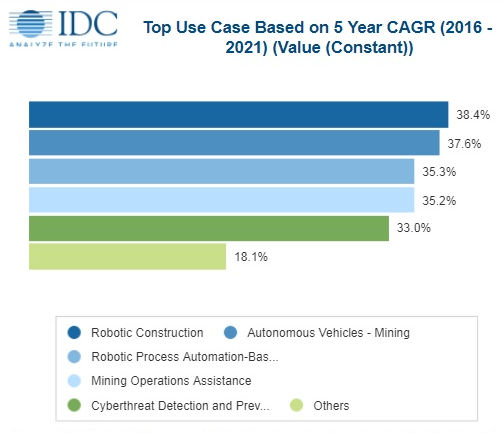
The use cases that will see the fastest spending growth over the forecast period include robotic construction (38.4 percent CAGR), autonomous vehicles – mining (37.6 percent CAGR), and robotic process automation-based claims processing (35.5 percent CAGR) within the insurance industry.
In the construction industry, DX spending is expected to grow at a compound annual rate of 31.4 percent while retail, the third largest industry overall, is forecast to grow its DX spending at a faster pace (20.2 percent CAGR) than overall DX spending (18.1 percent CAGR).
Microsoft Azure Stack underpins Thales’ military Nexium Defence Cloud
14 Jun, 2018
Defence firm Thales has taken Microsoft’s Azure Stack and repurposed it for use in military field operations, to enable armies to keep their data secure while benefitting from working within a cloud environment.
Microsoft worked with the French contractor to integrate its ‘cloud-in-box’ platform with Thales’ own connectivity, encryption, and end-to-end cyber security products, allowing armed forces to keep sensitive data within their own infrastructure.
“Together with Thales, we will be able to provide a flexible cloud platform with an unequalled level of security that will help overcome challenges within the defence industry,” said Jean-Philippe Courtois, Microsoft’s executive vice president and president of global sales, marketing and operations.
Providing a form of cloud connectivity in the field is not the most complex of operations, given it’s fairly straightforward to package servers, network connectivity, compute and storage components into a portable and durable package – SAP has done this with onshore data harvesting and processing systems for the Extreme Sailing series.
But doing it in a secure fashion that keeps data within a military infrastructure but still enables developers to build apps and services on top of the cloud system, is more of a challenge.
Thales’ Nexium Defence Cloud works around this by creating a “highly secluded” private cloud that uses the Azure Stack as a baseline system onto which Thales adds its security and connectivity technology. This keeps the data within the system either when it’s at military headquarters or deployed to forward operating bases.
Given connectivity can be disrupted in conflict zones and operations theatres, the cloud can operate offline, giving it a degree of autonomy from the infrastructure based back at a military headquarters.
This level of flexibility is something Thales claims other secured defence clouds cannot currently offer.
In the future, Thales plans to boost Azure Stack with the Guavus Reflex analytic platform to allow for real-time in-the-field data analysis without relying on a connection back to HQ. This could make it easier for military forces to tap into sensor data gathered by field sensors or exchange data with mobile apps used by soldiers “augmented” with the latest technology.
The military industrial complex is vast and a lucrative market with a healthy appetite for technology, which both Thales and Microsoft could further tap into with the Nexium Defence Cloud.
Image credit: Microsoft
Microsoft announces general availability of Azure Kubernetes Services

Those who attended or watched Cisco Live’s opening keynotes earlier this week – or indeed read our story on it – will have recognised the importance of Kubernetes to attendees with Google Cloud’s cameo being a particular highlight.
Now Microsoft is making waves of its own – with the general availability of its Azure Kubernetes Services (AKS).
The move will see Microsoft add five new regions of availability, with two in the US, two in Europe – including one in the UK – and the other in Australia, bringing the total number up to 10. Microsoft said it hoped to double its reach in the coming months.
Earlier this month, Amazon Web Services (AWS) announced the general availability of Amazon EKS, its managed Kubernetes service, with regions operational in US East and US West and rapid expansion promised.
The major providers are therefore all in the race to become the most developer and company-friendly resource on which to build and manage Kubernetes projects. Google, of course, as the original designer of the orchestration system, is a bit further ahead with its Google Kubernetes Engine (GKE) being a focal point of the Cisco and Google partnership elaborated on this week.
“With AKS in all these regions, users from around the world, or with applications that span the world, can deploy and manage their production Kubernetes applications with the confidence that Azure’s engineers are providing constant monitoring, operations, and support for our customers’ fully managed Kubernetes clusters,” wrote Brendan Burns, Microsoft Azure distinguished engineer in a blog post confirming the news.
“Azure was also the first cloud to offer a free managed Kubernetes service and we continue to offer it for free in GA,” Burns added. “We think you should be able to use Kubernetes without paying for our management infrastructure.”
You can find out more about the news here.
Dropbox plans SMR deployment to transform its Magic Pocket infrastructure
14 Jun, 2018
Dropbox has announced plans to deploy shingled magnetic recording (SMR) technology on a massive scale in a bid to transform its in-house cloud infrastructure.
The file hosting platform said deploying SMR drives on its custom-built Magic Pocket infrastructure at exabyte scale will increase storage density, reduce its data centre footprint and lead to significant cost savings, without sacrificing performance.
Dropbox says it is the first company to deploy SMR hard drive technology on such a scale.
“Creating our own storage infrastructure was a huge technological challenge, but it’s already paid dividends for our customers and our business,” said Quentin Clark, Dropbox’s senior vice president of engineering, product, and design.
“As more teams adopt Dropbox, SMR technology will help us scale our infrastructure by providing greater flexibility, efficiency, and cost savings. We’re also excited to make this technology open-source so other companies can benefit from it.”
SMR, a hard drive technology that allows tracks on circular disks to be layered on top of one another, will be deployed on a quarter of the Magic Pocket infrastructure by 2019, according to Dropbox, with plans to open source the test software created in this process underway in the coming months.
Magic Pocket is the name of Dropbox’s custom-built infrastructure project that was rolled out after the file sharing company decided to migrate away from Amazon Web Services (AWS). The company initially built a prototype as a proof of concept in 2013, before managing to serve 90% of its data from in-house infrastructure in October 2015.
In what Dropbox describes as a “significant undertaking”, SMR technology was chosen for its ability to expand disk capacity from 8TB to 14TB while maintaining performance and reliability. Drives were sourced from third-parties, before the company designed a bespoke hardware ecosystem around it, also creating new software to ensure compatibility with Magic Pocket architecture in the process.
“SMR HDDs offer greater bit density and better cost structure ($/GB), decreasing the total cost of ownership on denser hardware,” the Magic Pocket and hardware engineering teams explained. “Our goal is to build the highest density Storage servers, and SMR currently provides the highest capacity, ahead of the traditional storage alternative, PMR.
“This new storage design now gives us the ability to work with future iterations of disk technologies. In the very immediate future we plan to focus on density designs and more efficient ways to handle large traffic volumes.
“With the total number of drives pushing the physical limit of this form factor our designs have to take into consideration potential failures from having that much data on a system while improving the efficacy of compute on the system.”
Towards the end of the year, the file hosting service says its infrastructure will span 29 facilities across 12 countries, with Dropbox projecting huge cost-saving and increased storage density benefits if SMR deployment is deemed a success.