Announcing @CloudEXPO Silicon Valley June 25-26, 2019 | #Serverless #Cloud #CIO #IoT #DevOps #SmartCities #Blockchain

CloudEXPO | DevOpsSUMMIT | DXWorldEXPO Silicon Valley 2019 will cover all of these tools, with the most comprehensive program and with 222 rockstar speakers throughout our industry presenting 22 Keynotes and General Sessions, 250 Breakout Sessions along 10 Tracks, as well as our signature Power Panels. Our Expo Floor will bring together the leading global 200 companies throughout the world of Cloud Computing, DevOps, IoT, Smart Cities, FinTech, Digital Transformation, and all they entail.

As your enterprise creates a vision and strategy that enables you to create your own unique, long-term success, learning about all the technologies involved is essential. Companies today not only form multi-cloud and hybrid cloud architectures, but create them with built-in cognitive capabilities.

read more

Adi Sharma @CrosscodeCEO Joins @CloudEXPO NY Faculty | #Cloud #Metadata #Crosscode #DigitalTransformation

Most modern computer languages embed a lot of metadata in their application. We show how this goldmine of data from a runtime environment like production or staging can be used to increase profits. Adi conceptualized the Crosscode platform after spending over 25 years working for large enterprise companies like HP, Cisco, IBM, UHG and personally experiencing the challenges that prevent companies from quickly making changes to their technology, due to the complexity of their enterprise. An accomplished expert in Enterprise Architecture, Adi has also served as CxO advisor to numerous Fortune executives.

read more

“France too has its role to play in digital transformation”: Electricity tax cut for data centres proposed

France is looking to follow in Sweden’s footsteps – by cutting tax rates for data centres’ electricity usage.

As first reported by Datacenter Dynamics, French prime minster Edouard Philippe, speaking at the headquarters of Dassault Systemes, revealed plans to cut TICFE (taxe intérieure sur la consommation finale d'électricité) from €22.5/MWh to €12/MWh.

Philippe told delegates – loosely translated – that the move would make France a more attractive investment proposition taking into account both Brexit and the Cloud Act. The sector is committed to lowering its energy consumption by 15% by 2022, Philippe added.

In 2015, plans were first mooted for Sweden to reduce electricity taxation for its data centres, putting it in line with other industries such as manufacturing. A study from the Swedish government argued for a 97% tax reduction, which was granted a year later after the Swedish parliament pushed through new legislation.

Behind the Internet lies factories, or data centres, that represent very high levels of investment – anything that allows France to become a more attractive market is fantastic news

This appears to be similar for France – but Philippe also noted a disparity between the country and its European brethren in terms of productivity. The prime minister told delegates that between 2012 and 2015, France was the only country in Europe whose ‘robots to employees’ ratio had gone down. Rather than seeing this as a positive for jobs, it was viewed as a wake up call to get France’s digital house in order.

The move was praised by those in the industry. OVH, which is headquartered in France – and frequently scores top marks in Cloud Spectator’s industry reports analysing vendors on the combination of price and performance – said the development was ‘fantastic’.

An OVH spokesperson told CloudTech: “This announcement from the French government shows their understanding of how industrial development is also at stake in digital business. Behind the Internet lies factories, or data centres, that represent very high levels of investment. Anything that allows France to become a more attractive market is fantastic news, as France too has its role to play in the digital transformation.”

Earlier this month, consultancy DataCentrePricing.com noted ‘huge’ variations in European data centre prices. According to their analysis, rack space in Poland is less than a third (€320) of the price per month compared with Switzerland, Ireland and the UK (€1,000).

France remains the third largest data centre country market in Europe, behind the UK and Germany. Philippe noted in his speech there were 192 data centres in the territory.

https://www.cybersecuritycloudexpo.com/wp-content/uploads/2018/09/cyber-security-world-series-1.pngInterested in hearing industry leaders discuss subjects like this and sharing their experiences and use-cases? Attend the Cyber Security & Cloud Expo World Series with upcoming events in Silicon Valley, London and Amsterdam to learn more.

Flexera acquiring RightScale points to need for cost and complexity optimisation across the IT stack

Cloud cost optimisation and management continues to be a hot area – and Flexera’s acquisition of RightScale, announced last week, plays into that theme even further.

RightScale may be well known for its authoritative yearly State of the Cloud reports, but its bread and butter is focused around reducing the cost headaches and complexity of cloud deployments. This can be through dashboards which collate performance and can identify wasted cloud spend, or being able to access multiple clouds from a single portal.

Flexera’s focus is not dissimilar; the Illinois-headquartered firm offers products around IT and software asset management (SAM). Together, the two companies will aim to provide an end-to-end set of tools to manage the entire IT stack, from hardware, to software, to SaaS.

“In today’s IT environment, a strong technology asset management strategy is not a nice-to-have – it’s required,” wrote Michael Crandell, CEO of RightScale in a blog post. “Enterprises spend approximately 60% of their IT budgets on software, hardware, SaaS, and cloud technology. With the RightScale solutions under the Flexera product umbrella, you’ll have the most comprehensive set of tools to help you manage your IT spend.”

That is the rationale therefore – but what is backing this up? As regular readers of this publication will testify, multi-cloud is becoming an essential part of organisations’ IT operations in 2018. Indeed, according to this year’s State of the Cloud, more than four in five enterprises have a multi-cloud strategy in place. Not only does it mitigate against the dreaded vendor lock-in, but companies are seeing the benefits of different clouds for different workloads; take Netflix for instance, and the furore around the company – a long-time AWS house – saying it used Google for certain disaster recovery workloads.

This approach has in some cases metamorphosed into something even more specific. Take the partnership announced last week by Microsoft and Volkswagen to put together what the companies are calling an ‘automotive cloud.’ From 2020, the duo claim, more than five million new Volkswagen brand vehicles per year will be fully connected, aiming for ‘a future fleet of cars which will behave as mobile ‘Internet of Things’ hubs linked by Microsoft Azure.’

Cloud solutions which are specific to certain industries are becoming more commonplace, such as the SAP Digital Manufacturing Cloud, announced back in April. The product is tailored for manufacturers of all sizes, with features such as integration between business process systems and the shop floor, and connecting manufacturers to suppliers. At the time, the company said the move would help customers “take advantage of the Industrial Internet of Things by connecting equipment, people and operations across the extended digital supply chain and tightly integrating manufacturing with business operations.”

This may be the streamlined future for organisations – but for the time being the vast majority of companies out there will have a mix of cloud-based and legacy systems, in need of de-cluttering their infrastructure. “As the migration to cloud continues, our clients are telling us that cloud costs are escalating at a rate much faster than they envisioned or planned for, and that multi-cloud management complexities are becoming the norm – not the exception,” said Michael Adams, KPMG managing director.

“They want to be able to control and reduce spend across all of their cloud environments with one solution.”

You can find out more about the Flexera/RightScale acquisition here.

https://www.cybersecuritycloudexpo.com/wp-content/uploads/2018/09/cyber-security-world-series-1.pngInterested in hearing industry leaders discuss subjects like this and sharing their experiences and use-cases? Attend the Cyber Security & Cloud Expo World Series with upcoming events in Silicon Valley, London and Amsterdam to learn more.

The importance of APIs in public cloud security: How secure do you think yours are?

The use of the cloud is now mainstream and, despite some concerns, it is generally accepted that the public cloud is not inherently insecure. In fact, in many cases it is more secure than most data centres.

This can be explained when we consider how many opportunities there are for a piece of sensitive information that has been emailed, saved on a USB drive, or otherwise shared with colleagues to fall into the wrong hands.  Compare that to the same information being created, edited and saved in the cloud.  Major providers such as Amazon Web Services (AWS) and Google certainly put their best foot forward to provide layered security models for encapsulated cloud environments, with the intended outcome that customers can then benefit from these economies of scale at minimal expense.

Keys to the door

But of course, cloud security is not the only form of security required for systems and applications running in the cloud.  Relying on cloud providers for firewall, VPN, and WAF security is common and those components are often integrated aspects of a cloud provider security model.  However, the exposure of data and information to applications in the cloud is done via APIs (application programming interfaces). API security is an entirely different game.  This involves identity, security, and policies that should be within the control of your own organisation, not outsourced to the cloud.   This is also a necessary aspect of governance where your APIs represent the keys to the door and giving those keys to the cloud provider tips the balance of control too far.

APIs are the focal point of cloud innovation and enable the connections and data sharing that has allowed the cloud computing landscape to be adopted across virtually every technology and market segment.   But just as you would be cautious about handing over the keys to your house to another person, you should be equally cautious about handing over the API security capabilities to your cloud provider.

APIs have a pivotal role in widespread adoption of smartphones and tablets (and any other smart and connected devices like fitness trackers and smartwatches), the Internet of Things, and even social media. All of these have relied on APIs to function or grow. The threats posed by an exposed API are significant and ever-growing.  Yet, they remain the most overlooked threat to information security today. This is because API vulnerabilities are not easy to spot and require specialised technology for detection and prevention.

In recognition of this, in 2017, the non-profit, non-affiliated, online web application security community Open Web Application Security Project (OWASP) recognised API Security as a primary security concern by adding API to 9 of the top 10 vulnerabilities noted in the latest publishing of the OWASP Top 10 report.

API gateway vs API security gateway

Most cloud services use their own rendition of API gateways to serve as the single-entry point into the application or service and to provide access control. Because APIs are exposed via API gateways, the gateway product itself has become the target of attack and compromise. Any hacker who can compromise the API gateway will have the ability to turn any “no” into a “yes”. The primary issue is that API gateway technologies were designed for integration, not for security. API security best practices instead use cyber-secure technology for API enablement, which performs the roles of an API gateway, but includes the IAM and cyber security technologies together within the gateway itself.  This product technology is known as an “API security gateway”.

An API gateway will never provide the same layer of protection as an API security gateway. When an untrusted connection comes to your API and asks for your data, how can you be sure that that API has access to only the particular data that they need, or that they are allowed to have?  Are there embedded threats inside the API request? Is this trusted user accessing the API sending and retrieving the information expected? Access control alone is not API security and because API gateways are not based on cybersecurity technology, but rather based on integration platforms that run as software applications on insecure operating systems, they are designed simply to share information, not keep information safe.

Don’t outsource your cloud API security – control it

The only way to truly protect the data held in a public cloud is to embed secure API gateways within the cloud itself by deploying API security gateways.

If the gateway is not inherently secure by design at the point of its creation, then you will always be playing catch up as new exploits are inevitably discovered. The Panera Bread data breach when an unauthenticated API-endpoint exposed 37 million customer records and Shellshock (aka Bashdoor) family of security bugs which hit Yahoo! are proof of what can go wrong when using API technologies with insecure product architectures.

Many product vendors talk about their products having security features, but bolting on security features on products that are already inherently insecure at their core will not stop attackers from compromising the product by attacking the basic foundations of their insecurity.

More importantly, relying on cloud providers for API security will result in outsourcing your data security model and control of it.  This means that breaches and access to sensitive governance data by third parties are outside of your control. Instead, take control of your cloud API security policies and control your own keys and governance rules. Then you can fully realize the many benefits of cloud adoption with the assurance that the next API breach news story won’t be your company name in the headline.

Five key elements to a successful connected enterprise

Consumers are using technology to their advantage. With it, they are less tolerant, less loyal and more promiscuous. They have learned how to exercise control over brands.

In this kind of environment, it’s important to remember that the success of any customer-facing organisation depends on the experience they deliver. Consumers want meaningful, timely, and personalised engagements, and to gain this, businesses need a single view of the customer and a relationship that goes beyond a single transaction.

New technologies, cloud-native applications and ‘always-on’ connectivity provide the core ingredients companies need to diversify their services and become customer-centric. This demands a truly holistic experience that puts people, not processes, at the forefront of decision making and customer communication.

To operate a connected enterprise, you must tick off the following five considerations:

Have a single view of customers

The consumer is the boss – and can walk away at any time. They determine how they want to interact and demand seamless engagement across any channel. To engage customers, organisations must understand them individually, comprehensively and consistently at any point in time. A complete view of the consumer, across the business, is the only way to extract actionable data that leads to customer retention.

However, in our SAP Customer Data Imperative report, based on a survey of 500 client-side marketers, only 42% of respondents felt they had a consolidated view of first-party data across the enterprise, even though 82% thought it was ‘critical’ or ‘important.’

If marketers are to take ownership of customer data, they must ensure they are building the right connections with other business functions to help work towards a single customer view, including both online and offline data.

Front and back office

To achieve a comprehensive view of each individual customer experience, front-to-back office integration is also essential. This requires a unified front office to orchestrate customer journeys, whilst connecting with the back office to gather insights into customer preference. Knowing what the customer wants, when the customer wants it and being able to deliver it by having in-moment insight to inventory, will create a holistic experience for customers.

To get there, an integrated technology stack is imperative for companies seeking to collate customer data. Yet 41% of respondents cite disparate technology platforms as one of their three biggest challenges in the same Customer Data Imperative report. This is why SAP is connecting back-office capabilities with front office SAP ERP products, providing users an end-to-end experience.

Optimised for machine learning and IoT

In a separate SAP survey, six out of 10 business leaders have implemented, or are planning to implement, AI in the next year. This is because machine learning can analyse data at speed and make predictions that guide the strategy of human teams.

Through machine learning, and combining Internet of Things (IoT) data with insight from other applications, businesses can build a 360-degree customer view which allows an organisation to tailor experiences to customer needs.

Data from supply and demand

A unified supply and demand overview enables companies to better understand, analyse, manage and respond to variability within their supply chains. To do this, businesses must have in place real-time supply chain planning solutions to take advantage of analytics, what-if simulation, alerts and more. This will also help them better respond to ever-developing market expectations so that customers are never left wanting.

Unified cloud

Because today’s buying activity will be done before a human interaction ever takes place, organisations are trying to move siloed CRM systems away from sales and use their data in a way that keeps customers engaged at any point in time.

As such, the success of any business in the digital economy depends on the experiences they deliver. Businesses must therefore view customers holistically, end-to-end and continuously.

By having one unified suite of cloud solutions, businesses can manage customer experiences based on one trusted customer data model, which integrates all of the above. It provides the ability to deliver customer-centric processes and better outcomes, which will in turn build customer trust and loyalty.

The consumer-driven growth revolution will require all businesses to change. By putting together these steps to ensure a connected enterprise, then you can be one step ahead of the competition.

Editor’s note: Find out more about how the connected enterprise can help retain and win more customers at SAP Customer Experience LIVE, from October 10-11 in Barcelona.

Beyond automation: Enterprise AI and machine learning solutions in action

A relatively small group of savvy executives have strategies in place to harness new business process automation technologies and thereby advance their digital transformation agenda. Meanwhile, a much larger group is closely following the market leaders, to explore their lessons-learned from pilot projects.

According to the latest worldwide market study by 451 Research, new survey results suggest most organisations are adopting or considering artificial intelligence (AI) and machine learning (ML) due to its commercial growth benefits, rather than the potential to cut jobs.

Despite being somewhat new, there's adoption momentum for the technology.

Machine learning market development

Almost 50 percent of their survey respondents have deployed or plan to deploy machine learning in their organisations within the next 12 months. Therefore, this paints a more optimistic picture of machine learning adoption than is often portrayed by other industry analysts.

"Out of many possible benefits we presented to our survey respondents, 49 percent cited gaining competitive advantage as the most significant benefit they have received from the technology," said Nick Patience, vice president at 451 Research.

Improving the customer experience came a close second, cited by 44 percent of respondents. Despite all the hype around mass job losses, lowering costs was cited by only a quarter of the survey respondents.

He added, "We think this demonstrates that AI and machine learning is an omni-purpose technology that can bring numerous benefits to organisations, beyond just lowering costs through increased automation."

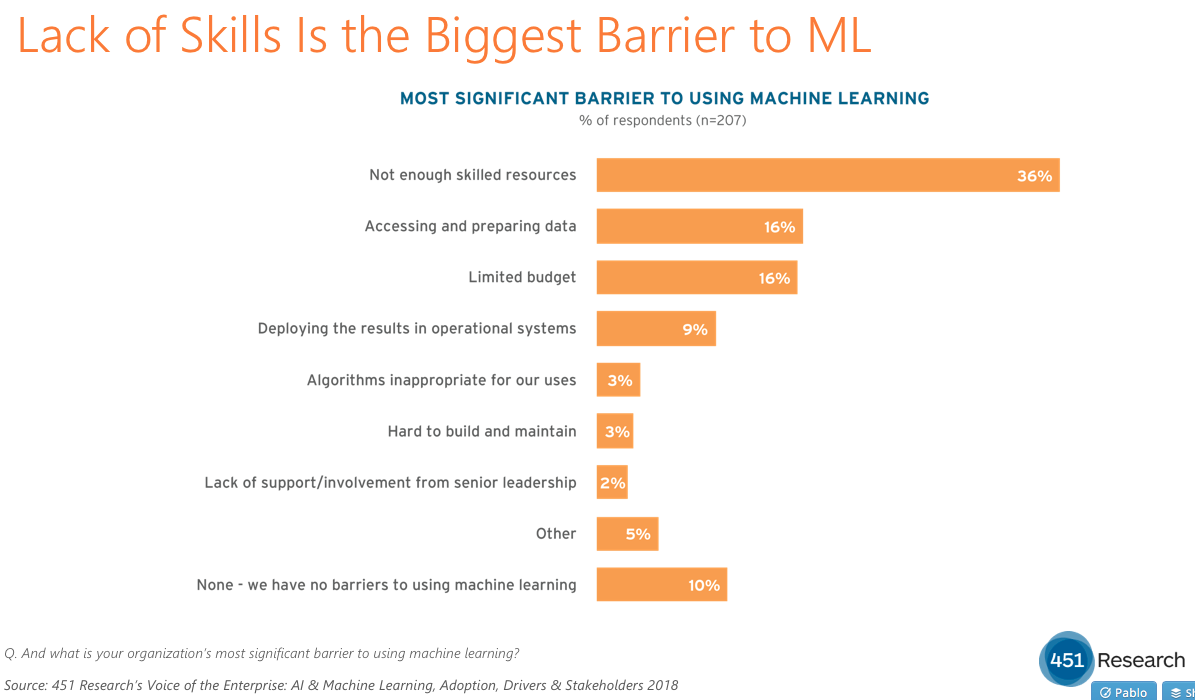
That being said, there are still some major obstacles that inhibit progress. When asked "what is your organisation’s most significant barrier to using machine learning?" most cited a shortage of skilled resources as the top barrier (36 percent).

According to the 451 Research assessment, skilled talent for machine learning projects usually means proven data science skills and experience. And a lack of those capabilities is reinforced further by the finding that data access and preparation is the second biggest barrier cited by survey respondents.

However, 451 Research expects the lack of skills and experience to gradually decline as a barrier when AI tools become easier to use, and the population of users who can leverage machine learning expands.

Outlook for AI and ML application growth

Organisations will need to ensure their machine learning deployment brings the business benefits that matter most to their stakeholders. To learn more about the commercial impact that AI and machine learning might have on your organisation, consider researching the application of 'quick-start solutions' that enable rapid testing and deployment.

Moreover, some forward-thinking vendors are already addressing the bigger challenges that face enterprise developers and data scientists. To help CIOs and CTOs scale projects, smart vendors offer high-performance server platforms and integrated software that will enable organisations to extract better results from their available data and accelerate the reporting of actionable insights.

Interested in finding out more around enterprise AI use cases and how AI and big data will converge? The AI & Big Data Expo World Series is coming to Silicon Valley on November 28-29 2018 – find out more here.

Mark van Rijmenam: On the ‘gestalt shift’ of big data, blockchain and AI convergence

When emerging technologies, such as blockchain, artificial intelligence (AI) and the Internet of Things converge, a ‘gestalt shift’ will occur, according to a new book. “The character of the experience will drastically change,” write Mark van Rijmenam and Dr. Philippa Ryan in Blockchain: Transforming Your Business and Our World. “All of a sudden, we can see the world through a different, more technologically advanced, lens and this opens up a completely new perspective.

“The convergence of multiple disruptive technologies will offer us new possibilities and solutions to improve our lives and create better organisations and societies, as well as build a better world all together.”

Organisations are increasingly taking the approach of exploring these technologies in tandem rather than in silos. Put simply, they all feed into each other. Pat Gelsinger, CEO of VMware, had it nailed down at the recent VMworld event. “Each [technology] is a superpower in [its] own right, but they’re making each other more powerful,” he told attendees. “Cloud enables mobile connectivity; mobile creates more data; more data makes the AI better; AI enables more edge use cases; and more edge requires more cloud to store the data and do the computing.”

For van Rijmenam, already a well-established big data thought leader, it was a natural trend. “The convergence of emerging technologies is the true paradigm shift organisations have to face,” he tells CloudTech. “Big data and blockchain have a lot in common and it will actually make data governance more importance – after all, blockchain makes data immutable, verifiable and traceable, but it does not magically turn low-quality data into high-quality data.”

This feeds into the central problem, that of data – what to do with it and how to utilise it best. But ‘twas ever thus. “When initiating your business intelligence project, you’re likely to be surprised at how bad your raw material – data – really is,” wrote Dan Pratte in TechRepublic. “You’ll discover that if you’re going to be serious about business intelligence, you’re going to have to get very serious (their emphasis) about data quality as well.” The article publication date? May 30 2001.

Today, artificial intelligence is redefining business intelligence at a rapid rate. Take the recent analysis from Work-Bench around the future of enterprise technologies. “Expect all modern BI vendors to release an [automated machine learning] product or buy a startup by [the] end of next year,” the report explained.

This will move down to the rank and file organisations who, ultimately, have to see themselves as a data-centric company going forward. “Organisations need to completely rethink the customer touchpoints and processes to be ready for the convergence of emerging technologies,” says van Rijmenam. “Only those organisations who are capable of seeing themselves as a data company will stand a chance to survive.”

Blockchain: Transforming Your Business and Our World focuses only its last chapter – 14 pages – on convergence. The remaining 180-odd pages explore blockchain’s potential in a variety of scenarios, from poverty, to voting, to climate change. The book describes these throughout as ‘wicked problems.’ Yet the third chapter, on identity, is the ultimate banker.

“We believe that we first and foremost need to solve the identity problem [with blockchain],” says van Rijmenam. “Once we have a self-sovereign identity, it will help make it easier to solve the other issues. That is why we first discussed that problem in our book before discussing the other wicked problems – thus a self-sovereign identity will be the biggest long-term change as it will empower individuals, but also organisations and even connected devices.”

Identity is not the only problem the industry needs to solve before blockchain can make its way truly into the mainstream. While a recent study from Juniper Research found that business leaders’ understanding of the technology is going up solidly, van Rijmenam categorises the issues into three buckets; technological, people, and culture. “Consumers will need to get used to a society where they have to control their own private keys,” he says. “That might be the biggest challenge of them all as it requires a culture shift.”

With this intersection in mind, van Rijmenam is currently working on a new book, focused on ‘the organisation of tomorrow’ and exploring how big data analytics, blockchain and AI will be transformative. “Organisations need to ‘datafy’ their processes, make data available using the cloud, collaborate with industry partners to optimise the supply chain, analyse their data for insights, and automate their business processes using AI,” says van Rijmenam.

Blockchain: Transforming Your Business and Our World is published by Routledge and is available for purchase here.

Main picture credit: https://vanrijmenam.nl/

Ignore multi-cloud today and risk becoming irrelevant in five years, report warns

Multi-cloud initiatives continue to be of great importance to European organisations – and those who aren’t heeding the warning signs today will feel the pinch in five years’ time.

That’s according to a new study from research firm Foresight Factory, alongside application network technology provider F5 Networks. The study, titled ‘The Future of Multi-Cloud’, drew on contributions from Deloitte, CloudSpectator, Ovum and more, having been based on a discussion guide combining publicly available research and Foresight’s proprietary bank of more than 100 trends.

In short – delaying multi-cloud adoption will mean your organisation will become increasingly irrelevant. Yet many organisations will surely be aware of this. Take the study from Virtustream in July, which found the vast majority of organisations (86%) confirming their cloud strategy was a multi-cloud one. Or take how many of the leading cloud vendors are pushing their acquisition and product strategies towards the trend; Cisco acquiring Duo Security, Nutanix buying Netsil, Juniper Networks offering new data centre, campus and branch network offerings.

Everyone is at it. One of the primary drivers for multi-cloud, as the report notes, is fear surrounding vendor lock-in. But the report makes an interesting point: there is a sense of constant change underpinning these initiatives, with the hyperscale vendors more than willing to outspend rivals to keep their market share.

Take machine learning as an example. According to the RightScale 2018 State of the Cloud report, machine learning is the most popular public cloud service with regards to future interest. AWS, Microsoft and Google are all taking big strides in this area, from Google’s pre-packaged AI services, to the various AWS clients citing the technology as key to their success – Major League Baseball, Formula 1, and more. From Microsoft’s perspective, the report notes that its ML focus has led it to invest in new server technologies, with workloads on the edge also contributing.

Yet there are various issues which still need to be overcome. The report cites the well-known skills gap organisations are facing. With multiple cloud services, containers, APIs and more, visibility and management is vital. Plenty of companies have sprung up to help organisations with this – CloudCheckr, CloudHealth Technologies and so on – but ultimately it’s all about service delivery. Consumers may not be interested in the technical intricacies of the multiverse, but they will care if their service becomes inflexible or goes down.

So what can companies do? Their technological landscape is continually changing, driven from the top by initiatives from the largest cloud vendors, and they have more plates spinning than ever. There are a couple of things which can be done, according to the report. Firstly, organisations should focus more on security. Consumers will eventually only be interested in those who have the most watertight systems built in. What’s more, there needs to be an increased focus on nurturing young IT talent – or ‘tapping into the kaleidoscopic potential of youth and promoting industry diversity’, as the report puts it.

In other words, organisations need multi-cloud. With developments in edge computing and artificial intelligence starting to take place driving greater insights and quicker decision making, they need to get on that train as soon as possible. But the skills gap won’t be overcome overnight.

“The multi-cloud ramp-up is one of the ultimate wake-up calls in internal IT to get their act together,” said Eric Marks, VP of cloud consulting at CloudSpectator. “One of the biggest transformative changes is the realisation of what a high performing IT organisation is and how it compares to what they have. Most are finding their IT organisations are sadly underperforming.”

How to make Amazon Web Services highly available for SQL Server

Mission-critical database applications are often the most complex use case in the public cloud for a variety of reasons. They need to keep running 24×7 under all possible failure scenarios. As a result, they require full redundancy, which involves provisioning standby server instances and continuously replicating the data. Configurations that work well in a private cloud may not be possible in the public cloud. And providing high availability can incur considerably higher costs to license more advanced software.

There are, of course, ways to give SQL Server mission-critical high availability and disaster recovery protections on Amazon Web Services. But it is also possible (and all too common) to choose configurations that result in failover provisions failing when needed.

AWS offers two basic choices for running SQL Server applications; a Relational Database Service and the Elastic Compute Cloud. RDS is a managed service that is often suitable for basic applications. While RDS offers a choice of six different database engines, its support for SQL Server requires the more expensive Enterprise Edition to overcome some inherent limitations, such as an inability to detect failovers caused by the application software.

For mission-critical SQL Server applications, the substantially greater capabilities available with EC2 make it the preferred choice when HA and DR are of paramount importance. But EC2 also has a few limitations, especially the lack of shared storage used in traditional HA configurations. And as with RDS, always-on availability groups in the Enterprise Edition might be needed to achieve the desired level of protection.

AWS also offers a choice of running SQL Server on either Windows or Linux. Windows Server Failover Clustering is a powerful and proven capability that is integral to Windows. But because WSFC requires shared storage, the data replication needed for HA/DR protection requires the use of separate commercial or custom-developed software to simulate the sharing of storage across server instances.

For Linux, which lacks a feature like WSFC, the need for additional HA/DR provisions is even greater. Using open source software requires integrating multiple capabilities that, at a minimum, must include data replication, server clustering and heartbeat monitoring with failover/failback provisions. But because getting the full HA stack to work well under all possible failure scenarios can be extraordinarily difficult, only very large organizations have the wherewithal needed to even consider taking on the task.

Failover clustering – purpose-built for the cloud

The growing popularity of private, public and hybrid clouds has been accompanied by increased use of failover clustering solutions designed specifically for a cloud environment. These HA solutions are implemented entirely in software that creates, as their designation implies, a cluster of servers and storage with automatic failover to assure high availability at the application level.

Most of these solutions provide a complete HA/DR solution that includes a combination of real-time block-level data replication, continuous application monitoring and configurable failover/failback recovery policies. Some of the more sophisticated solutions also offer advanced capabilities like support for Always on Failover Clustering in the less expensive Standard Edition of SQL Server for both Windows and Linux, WAN optimisation to maximize multi-region performance, and manual switchover of primary and secondary server assignments to facilitate planned maintenance, including the ability to perform regular backups without disruption to the application.

Although these purpose-built HA/DR solutions are generally storage-agnostic, enabling them to work with shared storage area networks, shared-nothing SANless failover clustering is usually preferred for its ability to eliminate potential single points of failure. Most SANless failover clusters are also application-agnostic, enabling organizations to have a single, universal HA/DR solution. This same capability also affords protection for the entire SQL Server application, including the database, logons, agent jobs, etc., all in an integrated fashion.

The example EC2 configuration in the diagram shows a typical two-node SANless failover cluster that works with either Windows or Linux. The cluster is configured as Virtual Private Cloud with the two SQL Server nodes in different availability zones. The use of synchronous block-level replication across the two availability zones assures both high availability and high performance. The file share witness, which is needed to achieve a quorum, is performed by the domain controller in a separate availability zone. Keeping each server instance of the quorum in a different zone eliminates the possibility of losing more than one vote if any zone goes offline.

Above: SANless failover clustering supports multi-zone and multi-region EC2 configurations with either multiple standby server instances or a single standby server instance, as shown here.

HA and DR configurations involving three or more server instances are also possible with most SANless failover clustering solutions. The server instances can be located entirely within the AWS cloud or in a hybrid cloud. One such three-node configuration is a two-node HA cluster located in an enterprise data center with asynchronous data replication to AWS or another cloud service for DR purposes—or vice versa.

In both two- and three-node clusters, failovers are normally configured to occur automatically, and both failovers and failbacks can be controlled manually (with appropriate authorisation, of course). Three-node clusters can also facilitate planned hardware and software maintenance for all three servers while providing continuous high-availability for the application and its data.

With 44 availability zones spread across 16 geographical regions, the AWS global infrastructure affords tremendous opportunity to maximize availability by configuring SANless failover clusters with multiple, geographically-dispersed redundancies. Such a global footprint also enables SQL Server applications and data to be deployed near end-users to deliver satisfactory performance.

The cloud news categorized.