Introducing Glacier Support for CloudBerry Backup

Amazon Glacier, a secure, reliable and low cost storage service designed for data archiving and backup. In order to keep costs low, Amazon Glacier is optimized for data that is infrequently accessed and for which retrieval times of several hours are suitable. With Amazon Glacier, you can reliably store large or small amounts of data for as little as $0.01 per gigabyte per monthThe latest release of CloudBerry Backup  comes with full support for Amazon Glacier.
Using the product you can move your files to Glacier vaults taking advantage of
the extremely low cost storage .


Register Glacier account


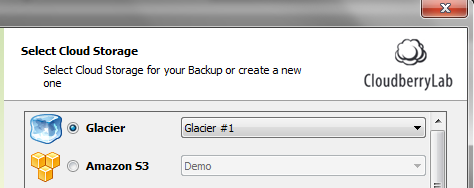
Choose Glacier storage type in the Backup Wizard
Note. Current
version of CloudBerry Backup doesn’t 
allow you: 
1. Restore the files stored in Glacier Vaults and updated version
with the Glacier restore is coming shortly. You should use CloudBerry Explorer to restore the files
2. Doesn’t allows you to encrypt and compress files yet. This is also coming in the future release. 
As always we would be happy to hear your feedback and you
are welcome to post a comment.
+++
Note: this post applies to CloudBerry
Backup 3.0 and later.
CloudBerry
Backup
is a Windows program that leverages Amazon S3 storage. You can download it at http://www.cloudberrylab.com/backup. It comes
with onetime fee of $29.99 (US) per copy.
CloudBerry
Backup for WHS
is a Windows Home Server add-in that leverages Amazon S3 storage. You can download it at
http://www.cloudberrylab.com/whs. It comes
with onetime fee of $29.99 (US) per copy.
CloudBerry
Backup Server Edition.
  is a Windows
program designed to run in server environment that leverages
Amazon S3 storage. You can download it at http://www.cloudberrylab.com/server. It comes
with onetime fee of $79.99 (US) per copy.
Like our products? Please help us spread the word about them.
Learn here how to do
it.
Want to get CloudBerry Backup for FREE? Make a blog post about us!

read more

Microsoft Stiffening Its China Ranks

By next July Microsoft means to hire another thousand people in China where it already has a staff of 4,500, according to what Ralph Haupter, CEO of Microsoft’s Greater China unit, told the press in Beijing.
The hires will be in R&D, sales and marketing and services.
It also means to increase its $500 million-a-year R&D budget there by 15%. That would include a 15% increase in Microsoft’s 3,000 Chinese researchers who mostly work on products for the global market. Microsoft wants to develop more Chinese products.

read more

Cloud Expo: Transforming Cloud Infrastructure to Support Big Data

As companies turn to the cloud to store, manage and access Big Data, it’s clear that its benefits are tempered by technical bottlenecks: transfer performance over WANs, HTTP throughput within remote infrastructures, and size limitations of cloud object stores.
In her session at the 11th International Cloud Expo, Michelle Munson, President, CEO & Co-Founder of Aspera, will discuss principles of cloud object stores, using examples of Amazon S3, Microsoft Azure, and OpenStack Swift, and performance benchmarks of their native HTTP I/O. She will share best practices in orchestrating complex, large-scale Big Data workflows and examine the requirements and challenges of IT infrastructure designs (on-premise, cloud or hybrid), including high-speed transport technologies and high-performance NAS.

read more

Baidu to Spend $1.6 Billion on Cloud Center

Baidu, China’s biggest PC-based search engine, said Monday in Beijing that it’s going to put upwards of $1.6 billion in a new cloud computing center.
It declined to give details but the sum it says it’s willing to spend is a powerful lot of money in any currency.
One report suggests the center will be online in four years and have upwards of three million CPU cores and 4,000PB of storage. It could take Baidu four years to figure out how to pay for such a thing.
Obviously it wants a gateway for mobile services such as the online storage it’s already offering. It released free tools on Monday to encourage developers to build apps using its cloud services.

read more

Big Data Future Spurs Acquisitions

In October 2011, Oracle announced its acquisition of Endeca Technologies, an enterprise search and data management company providing enterprises with non-structured data management, e-commerce and business intelligence technology.

In November 2011, IBM announced its acquisition of Platform Computing, an HPC software company with excellent performance in cloud computing and big data.

In February 2012, Groupon acquired Adku, a startup that uses big data to personalize online shopping experience for people visiting e-commerce sites like eBay and Amazon.

In March 2012, EMC announced its acquisition of Pivotal Labs, a private agile software developer and tool provider headquartered in San Francisco.

In the past two years, international IT giants, including IBM, Oracle, EMC and SAP, have been engaged in an upsurge of acquisition in the big data market, spending more than $1.5 billion in acquiring related data management and analysis companies. Big data becomes a new hot term after “cloud computing” in the IT and financial sectors.

The upsurge of big data results from the integrated development of the new-generation information technology, and the processing and analysis of big data in turn becomes a key support for the said integrated development.

The Internet of Things (IoT), mobile Internet, digital home and social network services are the applications of the new-generation information technology. Big data is continuously increasing together with these applications, whereas cloud computing provides the storage and computing platform for massive and diversified big data. It is estimated that the global data storage volume was 1.8ZB in 2011, and it will hit 2.7ZB in 2012 and exceed 8ZB in 2015. The growth rate of structured data is around 32%, and that of non-structured data 63%.

In the retail sector, analysis on big data enables retailers to master the real-time market trends and promptly take corresponding measures. Walmart has started analyzing the massive sales data of all its chain stores in combination with weather data, economics and demography, so as to select proper products for each chain store and determine the timing of discounts.

In the Internet sector, analysis on big data helps manufacturers develop more precise and effective marketing strategies. Facebook and eBay are analyzing and exploring massive data from social networks and online transaction data, with an aim of providing personalized advertising services.

In the utility sector, big data have begun to play a significant role. Many European cities guide drivers to select the best routes by analyzing real-time traffic flow data, thereby improving traffic conditions. The United Nations also launched “Global Pulse”, a program aiming to accelerate global economic development with big data.

The enormous commercial value of and market demand for big data are driving transformation of the information industry. New big data-oriented products, technologies, services and models are constantly emerging.

On one hand, the challenges such as effective storage, fast read-write and real-time analysis will have significant impacts on the chip and storage industry as well as incubate the integrated data storage & processing server and memory computing markets.

On the other hand, the enormous value of big data will lead to urgent needs for fast data processing and analysis as well as give rise to the unprecedented prosperity of data exploration and business intelligence markets.


How Amazon Glacier Confronts Entropy

Keeping data around — and readable — for a long, long, time is tough. For users Amazon’s Glacier offers freedom from specific hardware issues. We will no longer be stuck with unreadable zip drives or tapes. But that just moves the problem to Amazon. This interview talks about how they are tackling that problem.

The interview also touches on Amazon’s expectation that if they provide the back-end third-party developers will step and provide archiving and indexing tools.


Cloud Approach to IT Service Desk Brings Analysis, Lower Costs

See how a common data architecture and fast SaaS delivery benefits combine to improve the efficiency, cost, and result of IT support of end users.
Our examples are intelligent energy-management solutions provider Comverge and how it’s extended its use of Salesforce.com into a self-service enabled service desk capability using BMC’s Remedyforce.
We’ll also hear the story of how modern furniture and accessories purveyor, Design Within Reach, has made its IT support more responsive — even at a global scale — via cloud-based incident-management capabilities.
Learn from them more about improving the business of delivering IT services, and in moving IT support and change management from a cost center to a proactive IT knowledge asset.

read more

The Self-Driving Car Company

Alexsis Madrigal offers an inside look at what Google is doing with Maps and all those Streetview photos they’ve amassed. It’s jaw-dropping in its scope and audacity — and in its implications for the future:

“…as my friend and sci-fi novelist Robin Sloan put it to me, “I maintain that this is Google’s core asset. In 50 years, Google will be the self-driving car company (powered by this deep map of the world) and, oh, P.S. they still have a search engine somewhere.”

Read the article.


Cloud Computing: Tucci to Run EMC Till February 2015

Well, heck, no wonder Pat Gelsinger took the job running VMware after he was promised he would be made CEO of VMware parent company EMC when Joe Tucci retired, the very reason he bolted Intel.
Tucci just doesn’t want to go.
After saying he would go this year and then saying he would go next year, late Thursday it became clear from an SEC filing that he won’t step down until February of 2015 when he’s just supposed to be chairman of both EMC and VMware.
He’s going to get another $8 million in restricted stock from the remade employment contract tied to performance over the next two years.

read more

Mobile Cloud with Big Data

I worked extensively in the telecommunications area to lead large nationwide mobile application and portal rollouts that included mobile platforms, applications, services and integration mechanisms. With the proliferation of smart phone and tablets, mobile devices are accessing new and innovative applications everyday and the amount of data and processing requirements have exploded. Millions of devices are being added each year. Plug in a Cloud into this situation and you can reap its benefits of on demand access and scalability. Software as a service applications are the most common ones that are being made ready for mobile devices. Vendors are now cloud enabling their applications not just for traditional access but also for mobile access since with 4G services, there is lower latency and better data storage capacity.

read more

The cloud news categorized.