Citrix on Thursday announced it has received the highest possible rating of “Strong Positive” in Gartner Inc.’s “MarketScope for Enterprise File Synchronization & Sharing (EFSS).”¹ The report assesses Citrix ShareFile™, the foundation of the company’s follow-me data strategy. Citrix was evaluated for its corporate viability, product, business and product strategy, innovation and customer experience.
“We’re seeing strong customer adoption of Citrix ShareFile, with 300 percent growth in enterprise licenses over the past six months,” said Jesse Lipson, VP & GM, Data Sharing, Citrix.
According to report authors, Monica Basso, vice president at Gartner and Jeffrey Mann, vice president at Gartner, “File synchronization and sharing is a critical capability for mobile workforces whose organizations have ongoing mobility initiatives with media tablets and BYOD programs. We expect IT organizations will face increasing demand for these capabilities, with deeper focus on security and compliance by regulated or security-conscious enterprises.”
VDI Video: Benefits, Risks, and Predictions
http://www.youtube.com/watch?v=mSZSxzREhxk
What are the benefits of VDI? What are the risks? How do organizations address those risks? Where is VDI headed? DJ Ferarra of LogicsOne hits these points in this new video.
To learn more, we have free webinars available for download on VDI and BYOD!
Overview of the OpenStack Cloud
OpenStack is an Infrastructure as a Service offering. (see my prior post for an explanation of IaaS).
OpenStack is an OpenSource project, founded by RackSpace, NASA and others.
OpenStack can be deployed as a public or private cloud.
Project NOVA, or OpenStack Compute, provisions and manages on-demand virtual machines and associated resources: CPU, Memory, Disk and Network.
Virtual machines can be started, stopped, suspended, created and deleted, while network options for a virtual machine are static, DHCP, or IPv6.
What You Read Says a Lot About You
It is interesting, talking with people about what they read, and seeing how what they read is reflected in their daily lives. Even the occasional reader of this blog would not be surprised to find that I spend some amount of time with my nose buried in epic fantasy books and military history books. It shows in much of how I carry myself, what I do for hobbies, and even the examples I choose in this blog.
But a far greater percentage of my time has been spent reading about computer science. Since I was a young teen, those were avocations, I wanted computers to be my vocation. So it should surprise no one that I devoured what can arguably be called the classics of our field – Norton’s hardware programming books, compiler theory books (used one book in each of my post-secondary degrees, own dozens, literally. Compilers and OS Design fascinate me), some of the Cisco stuff, MicroC/OS, the dragon book (worth mentioning separate from the other compiler books), the J2EE books by BEA, Norton’s security book, the list goes on and on, and gets pretty eclectic. I read “Implementing CIFS with relish, though I may be the only person on the planet that did, and I have several releases of CORBA docs, all read at one time or another in the past…
Need terabytes of cloud storage? No problem…
By Sue Poremba
Sue Poremba is a freelance writer focusing primarily on security and technology issues and occasionally blogs for Rackspace Hosting.
The term “big data” may be a bit of a misnomer. For some companies, big data is actually huge data. Even small companies now find themselves immersed in massive amounts of data of all sorts, which leads to the problem of storing all of it.
Enter the big data cloud storage solutions, which allow companies to store and access media by the terabyte. Storage by the terabyte may have seemed unfathomable just a few years ago, but according to John Griffith of SolidFire, by today’s standards, terabytes of block storage really isn’t all that much.
“Many service providers look at opportunity in hundreds or thousands of terabytes. Between storage hungry database applications and other mission critical systems, terabytes of data can be consumed rather quickly,” Griffith …
Cloud: Impact of DNS on Performance
One of the ramifications of relying on off-premise cloud infrastructure is that you’re necessarily stuck with some of the idiosyncrasies that come with it. For example, it’s not your network, and thus topologically-related identifiers such as host names and IP address are not within your purview. But you certainly aren’t going to ask your customers to visit “host111-east-virginia-zone3-subnet5.cloudproivder.com”. At least not if you want them visit, you won’t.
Luckily, you control your own DNS destiny, so you’ll just CNAME that crazy long host name provided by the provider to be something more catchy and inline with your branding, say, “coolappz.com”.
While certainly more appealing to everyone (easy to remember, fits better on a bumper sticker and on branded swag) it does have a downside: double the latency.
HP Cloud Compute: A Quick Overview
HP has done an amazing job at creating cloud solutions for customers throughout the marketplace. From small to medium-sized businesses through the enterprise and beyond, HP cloud products do the job and do it well.
One product in HP’s portfolio that can provide opportunities for businesses of just about any size is HP Cloud Compute. Cloud Compute allows the organization to:
- Roll out compute instances on an on-demand basis.
- Create customized instances in order to handle unique workloads.
- Add additional instances via the UI or via the RESTful API.
Instances can be configured for many potential uses, including:
- Development and test instances.
- Web-based applications.
- Large-scale, intermittent data processing.
Cloud Compute combines the power of HP’s solid, reliable and highly-functional hardware and software along with some of the most important aspects of HP Converged Infrastructure. Cloud Compute relies on the OpenStack Nova platform and API, which means organizations can still use their OpenStack-compatible applications with Cloud Compute.
HP Cloud Compute provides a number of distinct benefits to organizations, including:
- Help for developers. The developer experience is highly-functional as well as intuitive. This helps developers decrease time in coding.
- Vendor independence. HP Cloud Compute uses open source architecture as well as standards-based APIs to insure that your applications can interoperate the way they need to.
- Secure instance deployment. Instances can be deployed securely on an on-demand basis. They can be scaled up or down quickly, and they can be configured or customized for any number of uses.
- You only pay for what you use. This helps control costs and make sure that service levels can still be maintained.
- Comprehensive support. HP Cloud Services Customer Support gives you life and fully responsive support.
HP Cloud Compute offers instance types in a wide range of sizes. An instance can be as simple as a single virtual core with 1 GB of RAM and 30 GB of local disk space. It can also be as large as 8 virtual cores with 32 GB of RAM and 960 GB of local disk space. The size of the instance matches your implementation’s need.


Government policy-makers should level the playing field for cloud services
Dr Steve Hodgkinson, Research Director, IT, Asia-Pacific
Cloud services policies are being developed and iterated in all jurisdictions. Having reviewed a number of draft policies in recent months, we believe policy-makers need to work harder to create a level playing field for cloud services adoption, mindful of the potential for a type I procurement error (buying a “bad” cloud service) or a type II procurement error (buying a “bad” in-house, shared, or outsourced service, when a cloud service would have been better).
Policies tend to be biased toward avoiding type I errors, so even in policies that are well-intended the playing field is tilted away from cloud services. Type II errors can, however, create worse outcomes, arising from missed or delayed opportunities for productivity improvement and innovation in policy and service delivery.
Innovation-minded governments need to level the playing field
The logic of government cloud computing policy usually starts with …
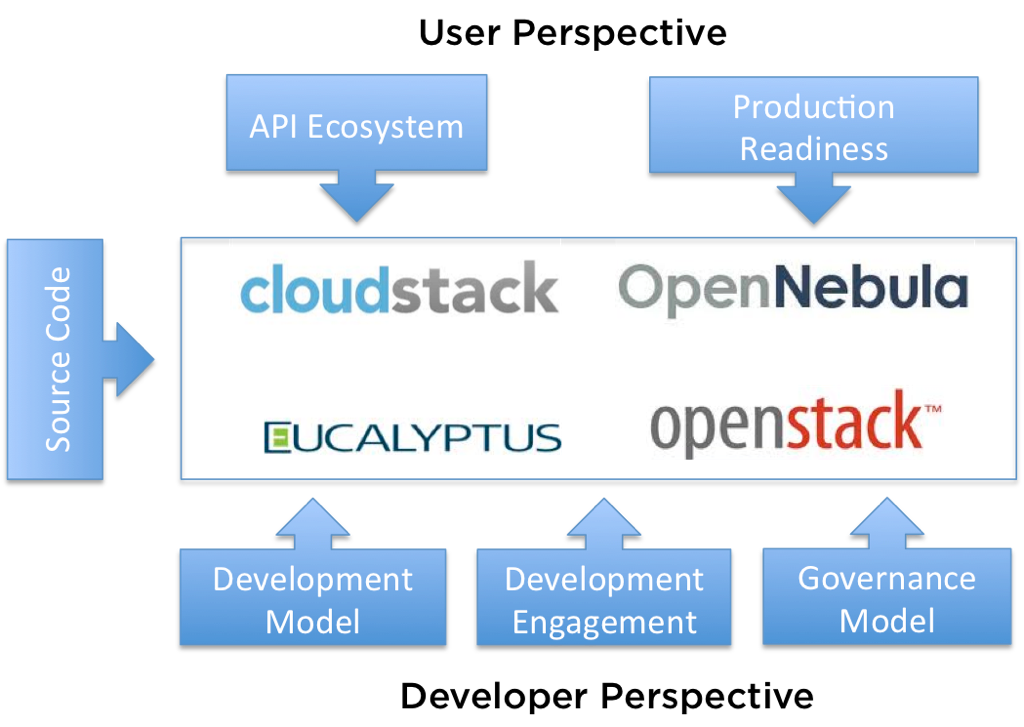
About the Openness of Eucalyptus, CloudStack, OpenStack and OpenNebula
We have just published a post at the OpenNebula blog with our view about the different measures that should be considered to evaluate the openness of the main open-source Cloud Management Platforms (CMPs). Which is the most important measure of openness in cloud computing? Do the cloud users really care about this? Users mainly want a solution that meets their functional needs, and are interested in open-source as a way to enhance flexibility, lower costs and avoid lock-in. However, as discussed in the post, most of these benefits are only available when an open-source software can be used in production environments without the addition of proprietary components.
It is worth reading!.
Move Over SDN – NFV Taking the Spotlight
Energetic debates of what SDN is and the expanding scope of what it can do for our customers continue to race along in a chaotic frenzy. In addition, the overall SDN market is somewhat fragmented in terms of both vendor positioning and marketing. Collectively, the conversation really comes down to improving business agility and the efficiencies gained in bringing new services to market. Essentially, the goal is to enable operators to make their networks and services go much faster.