The COVID-19 coronavirus outbreak is the cloud’s chance to shine


Bobby Hellard

3 Mar, 2020

In one of my favourite episodes of The Simpson, Mr Burns opens a casino in Springfield and locks himself away in a panic room. He watches all the other characters as they gamble on CCTV, zooming in to see the spread of germs. He becomes paranoid, refusing to leave the room and letting his beard and nails grow ridiculously long as he slowly descends into madness. 

Such is the tattered reputation of Facebook, it’s easy to picture Mark Zuckerberg holed up in a panic room watching a crowd of developers cough and spread the outbreak of COVID-19 coronavirus all over San Francisco. Thankfully, the company has put health and safety first and cancelled the F8 conference.

Google has done the same, deciding to “reimagine” Cloud Next 20 as a virtual conference due to the growing concerns over the impact of COVID-19. Currently, the concerns are that it is likely to spread to major cities. The World Health Organisation (WHO) has said it puts the world in “uncharted territory”, but it can be contained with the right measures. 

Cancelling big events is a very good measure, in my opinion, but what’s even better – particularly for technology companies – is that they use the cloud computing they champion to showcase what it can actually do. You don’t need to travel anywhere when you can see it all via the internet – we can all be Monty Burns. 

This is what Google has chosen to do with Cloud Next 20. It’s now a “free, global, digital-first, multi-day event”, the company has announced. This will include streamed keynotes where you won’t have to get dressed and you won’t lose your seat if you go get a cuppa. You can also see the breakout sessions, talk to the experts and check out all the new products and services without leaving your house. 

It probably couldn’t have been set up in such a short time, but this would have also been a perfect opportunity to use virtual and augmented reality technologies. Imagine popping a headset on and your living room turns into one of Google’s breakout sessions. This was done for an Oculus event in 2018, so it is very much possible. There is so much more we can do with cloud computing and it seems that COVID-19 might be the catalyst for us to find out what. 

Anyone who attends the big tech events knows that they are huge. A company usually spreads its keynote and other sessions around a building that’s often too big to see all of it. You need a strict plan to get in, see the whole three hours of what the CEO and their co-presenters have to say and then sprint off to meet with developers, experts or journalists in some far-flung corner. Wouldn’t it be better for all involved if instead, on your laptop in the comfort of your own home, you can just click your way around – or have multiple meetings at once and conserve finger energy. 

This could also be an everyday reality (for some of us) as governments around the world look set to advise people to work from home. People in California have tested positive for COVID-19 and Italy’s Serie A football league has been put on hold as cases have popped up in northern parts of the country. It’s shutdown factories and offices across China and is now wreaking chaos across South Korea. There is a likelihood that it’s coming to a town near you too, with 39 reported cases in the UK, according to Sky. While we can all do our bit and wash our hands and avoid unnecessary travel, working remotely might just be the best solution for containment. 

I would put forward a concern about Wi-Fi speeds, given the UK isn’t exactly leading the way in that area. And, there’s also the likelihood of outages as more and more of us lean on the internet for work, but hey, that probably isn’t as frustrating as spreading a virus that’s potentially deadly to those with existing conditions.

COVID-19 isn’t a pandemic yet – why not log in to the cloud and keep it that way? Open all the platforms and services your laptop can manage, pull-on a VR headset and immerse yourself in work, virtually. You can attend all the technology conferences you want via the internet and, best of all, getting dressed is optional.

How women in cloud are challenging the narrative


Keumars Afifi-Sabet

3 Mar, 2020

It’s no secret the IT industry is heavily male-dominated, with women traditionally struggling to achieve representation for reasons ranging from implicit bias to discouragement from taking up STEM subjects at school

While there are plenty of success stories, important to recognise as we approach International Women’s Day, there are also tales that speak to toxic work cultures, workplace discrimination, and women being overlooked for opportunities.

The last few years have heard a crescendo in the commotion on ‘women in tech’, although it’s hardly translated into concrete improvements. For instance, progress has stalled for the Tech Talent Charter (TTC), an organisation dedicated to raising gender balance in the UK. Women held just 24% of technical roles among TTC signatories last year, a 2% dip against figures from 2018. 

The picture isn’t unified across the entire tech landscape, however. The exciting frontier of cloud computing is challenging the narrative, Ingram Micro Cloud’s Microsoft business manager Violetta Yordanova tells Cloud Pro, with the sector’s rapid expansion opening up new opportunities and roles for women to fill.

“As cloud is a relatively new technology, my experience of being a ‘woman in tech’ may not be typical, as the cloud industry is extremely diverse,” Yordanova says. “In fact, my team has an equal gender split with a real mix of personalities, cultures and strengths from people who grew up with this technology.”

Her experiences are reflected by those of F5 Networks’ principal threat evangelist with the office of the CTO, Lori MacVittie, who feels the cloud industry is more welcoming because there’s less of an ‘establishment’.

“Whether it’s coincidental or not, the rise of cloud was accompanied by a significant drive to recognise and support women ‘in cloud’,” MacVittie explains. “The culture of the cloud industry is very welcoming and cloud as a technology is often credited as democratising the resources needed for women to take their place as entrepreneurs.”

Startups tend to be more progressive because technology has allowed women to more effectively drive their ideas to fruition, she adds. There’s been an explosion of women-led cloud startups, partially fuelled by a rise of flexible working practices.

“The adoption of cloud-based solutions in the workplace has also meant that it’s easier to balance work and life, because the tools you need to work are always accessible from anywhere – even home,” she continues. “I see that accessibility as broadening corporate acceptance of remote work when it’s necessary and alleviates stress on women who struggle with work-life balance.”

While many, including MacVittie and Yordanova, recognise differences, for senior software engineer with Red Hat, Rebecca Simmonds, these are few and far between, despite the fact the growing cloud segment is fed with plenty of resources, she tells Cloud Pro.

“At Red Hat, we have equal opportunities for all of the different sectors in the company, not just cloud. So my experience as I have moved around different companies is that as long as you are willing to work hard then there are similar opportunities in any of the tech sectors,” Simmonds says.

Despite these opportunities, the challenges that women face persist, albeit differing from person-to-person. For Simmonds, as she moved from a startup to a Java EE company, and then to Red Hat, she has felt pressured into always needing to demonstrate her expertise.

“Proving myself and making a great impression when meeting people has been the biggest challenge I had to tackle,” she says. “Women in the tech sector are still stigmatised, and I constantly feel pressured to demonstrate my knowledge. The good thing is that it’s really motivated me to work harder, push my limits, and fight the stereotypes in the industry.”

It’s similar to the experiences of F5 Networks’ MacVittie, meanwhile, who hasn’t come across many roadblocks based on her gender, although there are aspects of workplace relationships with men that have proven frustrating.

“Throughout my career I have experienced male colleagues who wouldn’t take direction from a woman, and also men at conferences who are completely taken aback when they realise I know what I am talking about,” she says. “My question is, what made you assume I didn’t? It’s frustrating but something I try to move past quickly – you can’t let people like that bring you down!”

She also sees wrestling with career progression a major challenge, especially as women become more established in their roles and industries. There are, she adds, fewer options to progress the more established one becomes, with women having to be more strategic about their personal development to ensure they have the skills needed to advance.

“The challenge, in early stages, is to establish yourself in your field of expertise and figure out how to build a reputation that will help you later when you start planning more strategically. Choosing a company that best suits your priorities for your career and life is an important factor in balancing both. If your priority is family, you don’t want to work for a company that doesn’t respect that. If your priority is your career, you want to make sure there are opportunities to [progress] where you work.”

This represents only half of the equation, however, argues head of EMEA and VP of global customer experience with Dropbox, Adrienne Gormley. Effective management plays a critical role in personal development, and women must be empowered to feel at ease with the demands of their work and home lives. 

“I really believe that it’s part of being an effective manager today to help others balance their life at home with work, and to model setting boundaries for your team,” she says. “We can bring empathy for the pressures of home life into the workplace, underlining that we understand the demands on individuals, whether as parents, or carers looking after a relative or other commitments. Looking at how we can make the workplace easier for people is deeply important to me: how we can help alleviate the pressure of trying to do it all.”

Gormley’s biggest piece of advice is for women to set their boundaries early on in their careers, and take an active role in their futures. Moreover, if something isn’t working, take a risk and speak up, or ultimately make a move. 

“Different people will be there for you, but they come and go, ultimately it’s your journey. The sooner you understand that, the sooner you can really be empowered to make choices and changes, and your actions will help shape the workplace at large.”

Q&A: UK Cloud Awards judge Rob Lamb


Cloud Pro

2 Mar, 2020

Please could you tell us a little bit more about who you are and what you do
My role at Dell Technologies is to bring industry expertise and transformation experience to help customers achieve key business outcomes in times of big change. My aim is to counsel them on how they can accelerate their IT transformation while balancing the need for consistent delivery and helping drive the cultural change associated with such initiatives – the magnitude of cultural and operating model change is often underestimated.
How would you describe the UK Cloud Awards in a nutshell?
The opportunity for people to receive industry recognition for their efforts and initiatives.
What appealed to you about becoming a judge for this year’s UK Cloud Awards?
The quality and breadth of the entries last year was fantastic, and I thoroughly enjoyed reading and reviewing them.
What are you most looking forward to about being involved in this year’s awards?
The new categories are exciting and I’m looking forward to reading the entries.
This year’s awards have had a bit of a makeover, with new categories and some other tweaks. Tell us why people should be getting excited about all of that/the awards?
Now in their seventh year, the UK Cloud Awards celebrates the diversity, innovation, excellence, of entries across 20 categories and will provide entrants a showcase for their efforts. The new categories really broaden the appeal of the awards.
Do you have a category/categories you’re most excited about?
I am really looking forward to the new people-centric categories, and especially the Positive Action Award
What are you looking for when you’re reading an entry? How can people make sure theirs stands out?
Make it real – talk about tangible business outcomes – then prove them. It mustn’t be technology for technology’s sake, there must be a positive impact. Don’t play down the challenges, we all know they happen so don’t gloss over them.
Talking about the challenges can bring your story to life. Short, sharp and punchy catches the eye.
What would you say to those thinking about entering but haven’t fully decided to do so as yet?
What are you waiting for? If you’re proud of a project, if it had a real business outcome and made a difference then why aren’t you writing it up and submitting it?
Do you have a standout cloud moment from 2019?
I think for me it has been the realisation by the industry, especially customers/consumers, that a single cloud isn’t the answer and that multi-cloud is going to be of greater importance in the strategies of enterprises in order to address all their workloads.
What are your top three cloud predictions for 2020?
1) 2019 saw the realisation that multi-cloud is industry direction of travel. This and edge computing will continue to be the aspiration for customers in 2020.
2) Security will continue to be a significant focus. Recent breaches have brought attention to the challenge of securing apps and data in a multi-cloud world.
3) Administration of this evolving cloud landscape will see fundamental changes coming in
terms of how it's all administered.

IDC notes IT spending decline – yet sees the upside for private cloud infrastructure

Hyperscale cloud providers are experiencing some market saturation. Vendor revenue from IT infrastructure products (server, enterprise storage, and Ethernet switch) for cloud environments, including public and private cloud, declined in the third quarter of 2019 (3Q19) as the overall IT infrastructure market continues to experience weakening sales following strong growth in 2018.

The decline of 1.8 percent year-over-year was much softer than in 2Q19 as the overall spend on IT infrastructure for cloud environments reached $16.8 billion, according to the latest market study by International Data Corporation (IDC).

As a result, IDC chose to slightly increase its forecast for total spending on cloud IT infrastructure in 2019 to $65.4 billion. This represents a flat performance compared to 2018.

Cloud IT infrastructure market development 

The decline in cloud IT infrastructure spending was driven by the public cloud segment, which was down 3.7 percent year over year, reaching $11.9 billion; sequentially from 2Q19, this represents a 24.4 percent increase.

As the overall segment is generally trending up, it tends to be more volatile quarterly as a significant part of the public cloud IT segment is represented by a few hyperscale service providers. This softness of the public cloud IT segment is aligned with IDC's expectation of a slowdown in this segment in 2019 after a strong performance in 2018.

It is expected to reach $44 billion in sales for the full year 2019, a decline of 3.3 percent from 2018. Despite softness, public cloud continues to account for most of the spending on cloud IT environments.

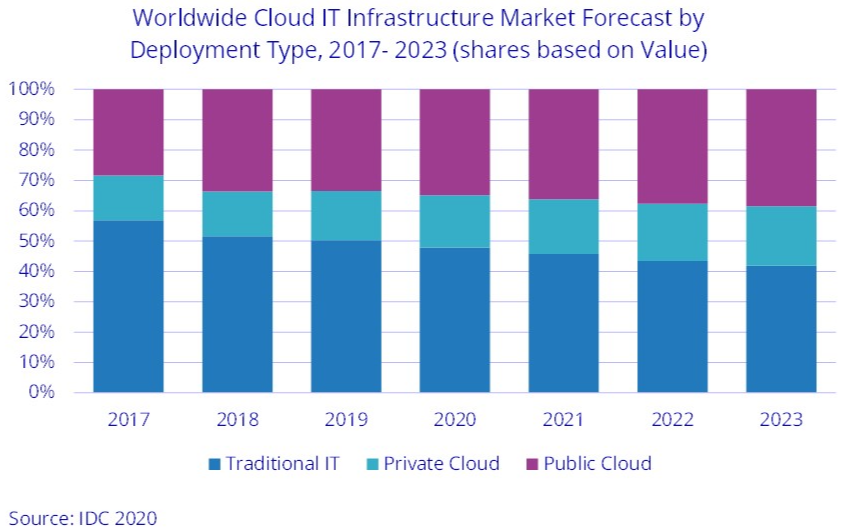
However, as demand for private cloud IT infrastructure is increasing, the share of public cloud IT infrastructure continued to decline in 2019 and will be declining slightly throughout the forecast period.

Spending on private cloud IT infrastructure has shown more stable growth since IDC started tracking sales of IT infrastructure products in various deployment environments. In 3Q19, vendor revenues from private cloud environments increased 3.2 percent year-over-year, reaching nearly $5 billion. IDC expects spending in this segment to grow 7.2 percent year over year in 2019 to $21.4 billion.

As investments in cloud IT infrastructure continue to increase, with some swings up and down in the quarterly intervals, the IT infrastructure industry is approaching the point where spending on cloud IT infrastructure consistently surpasses spending on non-cloud IT infrastructure.

Until 3Q19, it happened only once, in 3Q18, and in 3Q19 it crossed the 50 percent mark for the second time since IDC started tracking IT infrastructure deployments. In 3Q19, cloud IT environments accounted for 53.4 percent of vendor revenues.

However, for the full year 2019, spending on cloud IT infrastructure is expected to stay just below the 50 percent mark at 49.8 percent. This year (2020) is expected to become the tipping point with spending on cloud IT infrastructure staying in the 50+ percent range.

Across the three IT infrastructure domains, Ethernet switches is the only segment expected to deliver visible year-over-year growth in 2019, up 11.2 percent, while spending on compute platforms will decline 3.1 percent and spending on storage will grow just 0.8 percent. Compute will remain the largest category of cloud IT infrastructure spending at $34.1 billion.

Sales of IT infrastructure products into traditional (non-cloud) IT environments declined 7.7 percent from a year ago in 3Q19. For the full year 2019, worldwide spending on traditional non-cloud IT infrastructure is expected to decline by 5.3 percent.

By 2023, IDC expects that traditional non-cloud IT infrastructure will only represent 41.9 percent of total worldwide IT infrastructure spending (down from 51.6 percent in 2018). This share loss and the growing share of cloud environments in overall spending on IT infrastructure is common across all regions.

According to the IDC assessment, while the industry overall is moving toward greater use of cloud, there are certain types of workloads and business practices, and sometimes end user inertia, which keep demand for traditional dedicated IT infrastructure afloat.

Outlook for cloud infrastructure investment growth

Geographically, the cloud IT Infrastructure segment had a mixed performance in 3Q19. Declines in the U.S. market, Western Europe, and Latin America were driven by overall market weakness; in these and some other regions 3Q19 softness in cloud IT infrastructure spending was also affected by comparisons to a strong 3Q18.

In Asia-Pacific (excluding Japan), the second-largest geography after the U.S. market, spending on cloud IT infrastructure increased 1.2 percent year-over-year, which is low for this region. However, it is in comparison with strong double-digit growth in 2018. Other growing regions in 3Q19 included Canada (4.9 percent), Central & Eastern Europe (4.6 percent), and Middle East & Africa (18.1 percent).

Long-term, IDC expects spending on cloud IT infrastructure to grow at a five-year compound annual growth rate (CAGR) of 7 percent, reaching $92 billion in 2023 and accounting for 58.1 percent of total IT infrastructure spend. Public cloud datacenters will account for 66.3 percent of this amount, growing at a 6 percent CAGR. Spending on private cloud infrastructure will grow at a CAGR of 9.2 percent.

https://www.cybersecuritycloudexpo.com/wp-content/uploads/2018/09/cyber-security-world-series-1.pngInterested in hearing industry leaders discuss subjects like this and sharing their experiences and use-cases? Attend the Cyber Security & Cloud Expo World Series with upcoming events in Silicon Valley, London and Amsterdam to learn more.

Four ways to sell more cloud and mobile tools to SMBs


Fleur Doidge

27 Feb, 2020

Only 40% of SMBs have adopted public cloud offerings or plan to in the next 12 months, according to IDC’s European Tech and Industry Pulse Survey 2019-2020Cloud boosts customer profits by supporting productivity-enhancing mobile, collaborative or flexible-working tools; the channel should be in pole position to grow this market.

Yet just 46% of respondents in the IDC survey bought their cloud tools through channel partners. What will persuade the other 54%?

Describe how tools improve employee satisfaction and productivity

Research carried out by analyst house Forrester, sponsored by Lenovo and Intel, highlights flexibility and mobility as drivers for the good employee experience that underpins an effective workplace.

Michael Littler, executive director of global SMB marketing in Lenovo’s Intelligent Devices Group,  says it suggests SMBs aren’t supplying the tools that support how people want to work.

“When we drill into why people don’t feel productive, the tech aspect is a huge piece of it. Only 26% of respondents said ‘my company is providing me with access to cloud-based tools’,” he says.

Of employees in the 2019 survey who indicated feeling productive at work, 81% were satisfied with the devices available. The converse is true among those who said they don’t feel productive: 47% of workers who feel unproductive are satisfied with device provision. Only 23% of the group who feel unproductive felt satisfied with their work overall.

74% said they have no flexibility to choose “suitable” technologies to perform their tasks, and 71% rely on desktops as their main device. Only 49% of SMB buyers said, though, that these desktops would be replaced at refresh time, with only 40% promising to invest in laptops instead, for example.

Yet 87% of buyers within these SMBs cite employee productivity as a high or critical priority over the next 12 months, notes Littler.

Offer SMBs access to dynamism and enterprise-grade offerings

The channel should be asking SMBs if their systems are sufficiently flexible and scalable for future agility or new ways of working. 

Steve Joyner, managing director for UK and Ireland at Avaya, says SMBs need more sophisticated offerings. “Once it was assumed that only enterprises needed the connectivity or higher-end use cases, because they had many employees and really worried about how to collaborate.

“Everyone now expects to be able to collaborate and work together and use systems and applications the same way,” Joyner says.

Meanwhile, younger employees who grew up using mobile tools flexibly and collaboratively expect to do so in the workplace as well. 

In response Avaya, like other vendors, has rejigged its offerings, opening up its platforms as well as researching customer needs, offering a full suite of solutions, education and training to all sizes of customer and channel partner, says Joyner.

Devise specific solutions that deal with questions about cost

SMBs that don’t use cloud often perceive it as expensive or insecure – even though moving non-core tech and systems to the cloud can save money.

Avaya’s Joyner thinks this preconception goes back to the days of on-prem, when sophistication, reliability, redundancy and security came at a premium. Cloud can enable complexity to be delivered per user.

“Smaller firms can enjoy the security and encryption that large enterprises do, because the platforms in the cloud are actually large-enterprise platforms,” he says. “And there’s nothing stopping them taking private cloud – still consuming and not having all those up-front costs.”

Demonstrate benefits concretely via proofs-of-concept

Spinning up a proof-of-concept quickly can enable customers to “kick the tyres” and lay concerns to rest. Avaya’s Joyner notes that customers, large or small, typically ask to review their various cloud offerings live, whether they’re public, private or hybrid.

“Demos are far easier to do with cloud. They used to be just for the enterprise, because it was less cost-effective to do proofs-of-concept for smaller customers – but that’s not the case now,” Joyner adds.

It’s the channel’s role, as trusted advisors on cloud and mobile, to ensure it has the skills to communicate these benefits to more SMB customers.

Google to invest $10bn in US offices & data centres


Bobby Hellard

27 Feb, 2020

Google will build 11 office and data centres across the US as part of a $10 billion investment plan.

The tech giant announced these new buildings will create thousands of jobs and provide opportunities for local businesses.

It follows on from the company’s ambitious 2019 plan to invest $13 billion in rural states such as South Carolina and Nevada. Along with R&D funding, this made Alphabet the largest investor into the US, according to the Progressive Policy Institute.

The new investment will be used to build on that by adding 11 new sites in Colorado, Georgia, Massachusetts, Nebraska, New York, Oklahoma, Ohio, Pennsylvania, Texas, Washington and California.

As an example of the impact Google’s investments could have, CEO Sundar Pichai pointed to the company’s data centre in Mayes County, Oklahoma.

“Last year, I visited Pryor to announce a $600 million investment, our fourth expansion there since 2007,” Pichai said in a blog post. “It felt like the whole community came out to welcome us, from small business owners to teachers to Google employees.

“Pryor Mayor Larry Lees told the crowd that Google’s investments have helped provide local schools with the resources they need – including the latest textbooks and STEM courses – to offer a world-class education. He talked about the small businesses we have helped train and the mentorship Googlers have provided to Pryor’s students.”

The new offices and data centres will create roles with Google, as well as jobs in construction and renewable energy facilities, the company said.

This is also further evidence of Google’s relentless investment into its cloud business. Recently it announced the $2 billion acquisition of Looker, a data analytics firm and also Cornerstone Technology, a mainframe-to-cloud migration firm.

Salesforce acquires Vlocity in $1.33bn all-cash deal amid executive shuffle

Salesforce is to acquire Vlocity, a provider of industry-specific cloud and CRM apps, for $1.33 billion (£1.04bn) in an all-cash deal – amid an action-packed end to the company’s fiscal year.

The news was tucked away at the very end of Salesforce’s fourth quarter update. The company’s financial results were described as ‘phenomenal’ by CEO Marc Benioff – not co-CEO, more on which shortly – with Q4 revenue up 35% year over year to $4.8bn (£3.7bn), and total fiscal 2020 revenue at $17.1bn on a 29% increase.

Vlocity’s acquisition by Salesforce – in terms of the acquiring company – should come as little surprise. The Vlocity solution is built natively on the Salesforce platform, with Salesforce Ventures co-leading its most recent funding, a $60 million series C round in March.

The six primary industries targeted by Vlocity are communications, energy and utilities, government, health, insurance, and media and entertainment, with key customers including T-Mobile, Telus, and Sky. The company placed in the top 25 of the most recent Forbes Cloud 100 ranking, as well as just outside the top 50 on the Inc. 5000 Series earlier this month, representing the fastest growing private companies in California.

Writing to customers following the Salesforce acquisition news, Vlocity CEO David Schmaier noted the growth the company had undertaken to this point. “Every organisation, including the world’s largest customer-centric corporations and industries, must digitally transform,” Schmaier wrote. “It is more important than ever for our customers to have products that speak the language of their industries.

“The best customer experiences are industry-specific,” Schmaier added. “Together, our customers, our partners and our employees have accomplished so much. I am thrilled about our future with Salesforce.”

Speaking to investors following the earnings report, Benioff noted that Vlocity was a ‘relatively small transaction’ – not idle words when you’ve previously spent $15.7bn on Tableau – but that the time was right to invest. “In our relationship with Vlocity and the way that we originally invested in the company, it created a situation for acquisition that we needed to take advantage of and which is why we have acquired it at a very attractive price, because we have been partners with them from the very beginning,” he said.

Alongside this, it was announced that Keith Block has stepped down as co-CEO of Salesforce, with Benioff carrying on alone. Block will remain an advisor to the CEO, with Benioff leading the tributes to an executive who ‘helped position [Salesforce] as a global leader and… the envy of the industry.’ Gavin Patterson, former BT chief, is joining the company as president and CEO of Salesforce International, based in London.

The Vlocity transaction is expected to close during the second quarter.

https://www.cybersecuritycloudexpo.com/wp-content/uploads/2018/09/cyber-security-world-series-1.pngInterested in hearing industry leaders discuss subjects like this and sharing their experiences and use-cases? Attend the Cyber Security & Cloud Expo World Series with upcoming events in Silicon Valley, London and Amsterdam to learn more.

Salesforce co-chief Keith Block steps down


Keumars Afifi-Sabet

26 Feb, 2020

The joint-Salesforce CEO Keith Block has stepped down from his leadership role after just 18 months in-post, leaving founder Marc Benioff as the sole CEO of the software company.

Block’s resignation has come as a surprise, given the former Oracle VP has come on leaps and bounds since joining Salesforce in 2013, and was widely considered to be a potential successor to Benioff in the future.

The co-CEO first joined the customer relationship management (CRM) company in 2013 as head of sales, before being promoted to COO.

He took up the co-CEO role from August 2018, meaning that he’d only been in the role for little more than 18 months before announcing his intent to step down.

The nature of his departure is also somewhat of a mystery, with no explicit reason offered by the company.

Block will stay on with the company for an extra year to serve as an advisor before moving on, and Benioff will now handle the duties the two had previously shared.

The company revealed Block’s decision on a conference call with analysts in which it shared financial results for the fourth quarter of 2019, according to Business Insider.

The firm’s executives, including Benioff, praised Block for his almost seven-year stint at the company, and wished him well for the future.

“I am his biggest supporter,” Benioff said, adding: “I’m his close friend. You’ll always be part of our Ohana [the Hawaiian word for family].”

On the call, the company reported a net loss of $248 million for the fourth quarter of last year, compared with a net income of $362 million for the same quarter in 2018. Moreover, its total revenues rose by 34.6% to $4.85 billion, which beat analyst estimates of $4.75 billion.

The CRM company has made a series of acquisitions over the last year, the most significant of which is its purchase of data management firm Tableau for approximately $16 billion. This was in addition to its purchase of ClickSoftware for $1.35 billion in August.

Already in 2020, the company has acquired data personalisation company Evergage, and industry-specific cloud provider Vlocity.

Firefox activates DNS over HTTPS for US users by default


Keumars Afifi-Sabet

26 Feb, 2020

Mozilla has begun the rollout of encrypted DNS over HTTPS (DoH) by default for all its US-based Firefox users after working for years to upgrade the Domain Name System (DNS) protocol.

Over the next few weeks, Firefox users will be able to use the DoH protocol by default while surfing the web, meaning their web traffic will be fully encrypted. This technology blocks third-party interception and also prevents Internet Service Providers from maintaining visibility over users’ activity.

DNS, which remains unchanged since the 80s, has been long-considered an insecure protocol that, while fundamental to the internet’s structure, allows for threats such as man-in-the-middle attacks.

The archaic database links a URL to an IP address, with browsers able to identify the websites for users by matching the two when a query is made. Because there is no encryption, however, other devices may intercept these queries and potentially collect this data.

DNS lookups are often sent to servers that can allow third-parties to gain access to users search and browsing history without their knowledge. It’s one of the key methods that ISPs deploy when implementing tools like web blockers.

“Today, we know that unencrypted DNS is not only vulnerable to spying but is being exploited, and so we are helping the internet to make the shift to more secure alternatives,” Mozilla said

“We do this by performing DNS lookups in an encrypted HTTPS connection. 

“This helps hide your browsing history from attackers on the network, helps prevent data collection by third parties on the network that ties your computer to websites you visit.”

Mozilla’s DoH implementation involves routing users’ web traffic to a DNS server hosted by either Cloudflare or NextDNS depending on their preference, instead of DNS servers hosted by ISPs and networking companies.

The DoH protocol will be configured by default for US users over the next few weeks, although users outside of the US may activate this level of encryption by accessing the settings menu. This is an option in the connection settings menu.

This privacy-focused move typifies the approach Mozilla has taken in recent years to fine-tuning and differentiating its Firefox browser from a host of competing applications, such as Google Chrome and Microsoft Edge.

Chrome, however, also allows users to adopt DoH, although this will have to be manually configured, unlike for US users in Firefox, and soon across the rest of the world, who will enjoy DoH security by default.

Microsoft, similarly, embraced this protocol in November, announcing it would work to implement more secure technology into its products. This would start with plans to upgrade its servers to use the DoH protocol.

The shift to DoH is expected to anger ISPs, who in the UK previously branded the company an ‘internet villain’ for simply considering implementing the protocol.

Service providers, and regulators like Ofcom, or the FCC in the US, have relied on the DNS protocol for a host of functions, such as implementing content blockers. The mass implementation of DoH would render such tools useless as ISPs would lose all visibility over their customers’ web traffic.

How SaaS, AI and machine learning are boosting sports broadcasting: A guide

The sports broadcasting industry has a problem. Fan bases are growing, as are viewing figures; but it is becoming harder and far more expensive for sports broadcasters and rights holders to manage, package and distribute their content. Obsolete methods of distribution that require expensive software and hardware packages, sold on fix term licenses, are hindering broadcasters from making back-end efficiencies that can ultimately lead to enhanced fan experience.

In short, the traditional linear services used to broadcast sporting events are broken.

This is increasingly true for smaller, more niche sports that are further exposed to the strain on resources and struggle to achieve the fan exposure they require to grow. Where technology is concerned, enhancing fan engagement and increasing audience figures are normally viewed as part of the front-end program, but that should no longer be the case.

By tidying up the backend technology used to manage, package and distribute content, sporting organisations can funnel budget savings – and profits – into frontend production value.

Pay-as-you-grow

This is where a software as a service (SaaS) solution can make a big difference. One of the main benefits of the SaaS model is that it is pay-per-use. This has huge advantages for the sports industry, as it means that they can scale their operations up and down in accordance with peak times. Take the European football season as an example: using a SaaS platform for content management, production and delivery would mean that the broadcasters and rights holders can scale up their operations around the season’s biggest fixtures and busiest weekends.

While this is certainly advantageous for broadcasters and rights holders across all sports, it has particular benefits for smaller sports looking to increase their exposure and break into the mainstream.

They are not fixed to long-term license agreements for their content management platforms, which used to mean having to pay full price near the season’s close. Additionally, the sports broadcasting service industry has traditionally been linear-based and on-premise, meaning that the increasingly complex services required to produce and distribute content require increasingly pricey hardware.

Breaking the strain

In many cases, the traditional methods of editing and distribution are too expensive and require too much staffing for emerging sports, meaning they struggle to keep up and can’t gain the exposure they require to grow their audience. Through utilising a SaaS platform for their content servicing, these sports can overcome the strain on resources by saving money through paying for only what they use, and by decreasing the time it takes for them to package and distribute content. Content, whether that be advertisements to broadcasters, or archive footage to social media, can be accessed and distributed to multiple platforms in a matter of seconds.

In the age of social media, this can pay dividends for smaller sports. A recent study conducted by consumer research organisation Global Web Index found that 22% of social media users cited engaging with sports content as a primary reason for its use in 2019, marking a 37% increase from 2016. Social media provides sporting organisations with the ability to build communities that keep existing fans engaged and help to reach new audiences, providing them with potential new revenue opportunities.

The problem thus far for smaller sporting organisations is that effectively managing and packaging content to distribute to multiple social media channels can be a complicated and arduous process that requires resources these organisations simply don’t have. By using a SaaS platform, social media teams at smaller sports can quickly and efficiently access, edit, and distribute content to multiple platforms. Football teams can have clips of goals posted on their Twitter feed within one minute of the goal being scored. For smaller sports, near to live highlights, analysis and replays creates an element of interactivity, helping to engage larger online audiences.

Boosting fan experience with AI and ML

Once broadcasters and rights holders have developed efficient means of distributing their content, the next question centres upon how they can develop fan experiences to grow their audience figures. Again, the answer for many organisations appears to lie in technology with a number of sports investing heavily in emerging technologies such as artificial intelligence (AI) and machine learning (ML).

Formula 1, for instance, partnered with AWS to boost fan experience by giving them unique insight into the split-second decisions made by racing teams and drivers mid-race. The technology collects data from 120 sensors on the car before using Amazon’s machine learning algorithms to provide fans insights such as real-time race predictions, and car performance. The unique and new analyses that are created by emerging technology inject an additional sense of spectacle. The result is a more immersive experience allowing a sport to build and grow audience numbers.

While these technologies may currently only be accessible to the more mainstream sports, it is clear that the technology being developed for the enterprise can play a significant role in the sports broadcasting industry. With SaaS, developing sports can move on from the traditional linear and legacy systems that are currently holding them back. With SaaS, they can drive back-end efficiencies and feed their fans growing appetite for quick content.

Read more: At the front of the grid: How Formula 1 leads sporting franchises in data and analytics

https://www.cybersecuritycloudexpo.com/wp-content/uploads/2018/09/cyber-security-world-series-1.pngInterested in hearing industry leaders discuss subjects like this and sharing their experiences and use-cases? Attend the Cyber Security & Cloud Expo World Series with upcoming events in Silicon Valley, London and Amsterdam to learn more.

The cloud news categorized.