Digital Services Act: Google asks European Commission to clarify responsibilities


Sabina Weston

4 Sep, 2020

Google has responded to the European Commission’s public consultation regarding the Digital Services Act, submitting a 135-page document which points out the need to clarify the EU’s expectations towards tech companies.

In the submission, Google urged the European Commission to avoid a ‘one-size-fits-all’ approach, as well as elaborate on the responsibilities to which the tech industry will have to adhere if the legislation is passed.

The Digital Services Act, which was first unveiled in 2019, is expected to provide the EU with a raft of legal powers to influence how social media platforms govern hate speech, extremist material, and political advertising. 

The legislation would directly impact Google’s video-hosting service YouTube, which has been criticised in the past for spreading harmful conspiracy theories, fake news, and hate speech.

In the document submitted to the European Commission, Google agreed that tech companies should act fast in order to immediately remove or disable access to harmful or illegal content. However, the tech giant also raised the concern that hosting platforms may be forced to prioritise speed over cautious decision-making.

In a blog post announcing the submission, Google’s SVP of Global Affairs Kent Walker said that the Digital Services Act “should reflect the wide range of services offered by the tech industry”, as opposed to adopting a common approach for every company.

“No two services are the same and the new act should be rooted in objectives and principles that can be applied, as appropriate, across this broad, diverse ecosystem.  This will ensure that everyone – platforms regulators, people and businesses –  are responsible for the parts they play,” he said.

Walker added that Google is “committed to providing greater transparency for our users and governments so that they better understand the content they are seeing and how to notify us of concerns”. 

“The DSA should support these kinds of constructive transparency measures while ensuring that platforms can continue to protect user privacy, ensure commercially sensitive information is not revealed and prevent bad actors from gaming the system,” he said.

The consultation period for the Digital Services Act is set to conclude on 8 September.


Joker fleeceware “thriving” on Google Play Store, researchers claim


Bobby Hellard

3 Sep, 2020

Six apps have been deleted from the Google Play store after it was discovered they were infected with malware that simulates clicks and intercepts SMS messages to commit fraud.

Joker, also known as “Bread”, is a billing-fraud strain of malware that advertises itself as a legitimate app, according to security researchers at Pradeo.

The six apps account for nearly 200,000 installs and, despite confirmation of their removal from Google’s Play Store, researchers have suggested they are still installed on the devices of their users.

The researchers have urged users to immediately delete the apps: Convenient Scanner 2, Separate Doc Scanner, Safety AppLock, Push Message-Texting & SMS, Emoji Wallpaper and Fingertip GameBox.

Often described as ‘fleeceware’, this type of malware is designed to simulate clicks and intercept SMS text messages to trick users into subscribing to unwanted paid premium services. These types of malware generally have a fairly discreet footprint as they tend to use as little code as possible, making their fraudulent activity difficult to spot.

Apps that spread the Joker malware have continued to bypass Google security mechanisms since 2019 as those behind its spread are constantly updating its source code.

“Most apps embedding Joker malware are programmed to load and execute external code after being published on the store,” Pradeo researcher Roxane Suau said, speaking to Threatpost.

“First, these apps are riddled with permission requests and submitted to Google Play by their developers. They get approved, published and installed by users. Once running on users’ devices, they automatically download malicious code. Then, they leverage their numerous permissions to execute the malicious code.”

The malware has “thrived” on Google Play in 2020, according to the team. In January, researchers revealed that Google had removed 17,000 Android apps that had been conduits for the Joker malware, with 11 more removed in July.

New partnership lets users store Facebook data on Dropbox


Sabina Weston

3 Sep, 2020

Dropbox has partnered with Facebook on a digital transfer project which will allow users to import data directly from their social media accounts.

Starting today, the new integration will help users securely transfer photo and video libraries from Facebook, as well as organise the files in any chosen way.

The integration also offers customisable privacy settings, and although the imported files will be set as private by default, users can choose to share the albums with others.

Commenting on the release, Dropbox’s VP of Business Development Jamie Perlman said that the company’s goal was to “provide products and services that make our users’ digital lives easier and less chaotic, so they can really focus on what matters”.

“People no longer accept being locked into one service or product, and want the freedom to use the tools they love. We’ll continue to look for ways to seamlessly integrate with best-in-breed products so that we can serve as the connective platform for all of today’s leading productivity tools and devices,” he added.

The release of the new integration comes weeks after Facebook called for appropriate legislation to be introduced in order to make it easier for users to transfer photos and videos to a competing tech platform.

In comments sent to the US Federal Trade Commission (FTC), Facebook said it planned to improve on its existing data portability tools “in the coming months”. A hearing on the topic is scheduled for 22 September 2020.

Currently, Facebook already allows users in the US and Canada to transfer photos and videos to Google Photos.

Meanwhile, in June, Dropbox unveiled several other features which aim to help users stay organised while they work from home. The updates included a password manager service called ‘Dropbox Passwords‘ and filing system called ‘Dropbox Vault’, as well as an automatic backup service, ‘Computer backup’, which saves Mac and PC folders to Dropbox for secure access on the go.

Oracle loses $10bn JEDI contract appeal


Bobby Hellard

3 Sep, 2020

A US Court of Appeals has rejected Oracle’s challenge over the awarding of a $10 billion Pentagon cloud computing contract to Microsoft in 2019.

The decision affirmed a lower court ruling that Oracle wasn’t harmed by any errors made by the Pentagon while creating the contract proposal as the company qualify as a legitimate bidder, as reported by Bloomberg.

Oracle raised a number of complaints, including that the Pentagon violated its own rules when it set up the contract to be awarded to a single firm, arguing that by calling for extensive data centre capabilities it unfairly excluded Oracle from the process.

The company also filed a lawsuit against the Department of Defence (DoD) in December, arguing that there were conflicts of interest between former Pentagon and AWS employees.

However, before any decision on the contract was made, Oracle was removed from the bidding process in April 2020, as it failed to meet the requirement of having three data centres with FedRAMP Moderate ‘Authorised’ support – which has now been affirmed by the US Court of Appeal.

The panel did suggest that the conflict of interest allegations raised by Oracle were “troubling” but still ruled that it “had no effect on the JEDI Cloud solicitation”.

“Notwithstanding the extensive array of claims raised by Oracle, we find no reversible error,” circuit judge William Bryson wrote regarding the decision by the US Court of Federal Claims.

Although Microsoft was awarded the $10 billion Joint Enterprise Defense Infrastructure (JEDI) contract in November, work has been on hold following a successful appeal from rival bidder AWS. A Federal Claims judge said that the DoD had improperly evaluated a Microsoft storage price scenario and that the process should be reviewed.

AWS also cited other problems with the bidding, including “political influence” resulting from long-running feud between US President Donald Trump and Amazon CEO Jeff Bezos. These claims are still being weighed up by the courts with a 30-day extension put in place at the end of August.

UK global tech exports to grow by a third by 2025


Sabina Weston

3 Sep, 2020

The UK’s global tech exports are predicted to grow by 35% in the next five years to £31.45 billion, according to a new report by Tech Nation.

The latest findings revealed that the value of tech exports is to increase by an additional £8.15 billion by 2025, despite potential inhibitors such as the coronavirus pandemic or Brexit.

According to the organisation, the UK digital tech services sector currently exports a much greater value of goods than they import, which last year led to a trade surplus of 55%, aproximately 7% more than the average trade surplus among the top 57 countries globally.

Last year, the UK was found to be the fifth largest digital tech services exporter in the world, at £23.3 billion, after India, the US, China, and Germany.

Commenting upon the estimates, Tech Nation’s chief executive Gerard Grech said that the UK “is a natural home for many scaling tech businesses”.

“The UK is also third in the world for the number of UK tech unicorns, and number one in Europe. These factors give us a strong conviction that UK founders, government and industry leaders should all be gearing up to double tech exports by 2025, in the aftermath of both the pandemic and Brexit.

“By doubling exports, UK tech could contribute an additional £23bn to the economy per year by 2025 and move up the ranks to become a top global exporter of tech,” he added.

The results mark a steady growth over the last four years, which led to the UK digital tech trade surplus to increase from £8.7bn in 2015 to £12.8bn in 2019 – a growth of 68%. This impressive performance has meant that the industry’s trade surplus is now the third largest in the UK, following Financial Services and the Insurance sector, at £43.4 and £16.9 billion, respectively.

According to Tech Nation’s Global Opportunities Index, a ranking of the best countries in the world for digital tech trading opportunities, the UK takes the second place behind the US – largely the result of the UK’s impressive online retail and e-commerce sales, which are valued at £688.4 billion.

The report argues that UK tech companies should be looking to the US, Israel, Canada, Germany and The Netherlands as the most attractive post-Brexit export markets, while also considering Brazil and Singapore as the fastest rising global opportunities for UK businesses to trade with.

Digital minister Caroline Dinenage described the UK as “Europe’s tech capital”, adding that “these figures reinforce our industry’s reputation as a truly global player”.

“It’s great to see our digital exports booming which will help create more jobs and opportunities for people up and down the country,” she said. “We are investing heavily in the nation’s digital infrastructure as well as in people’s digital skills which puts British firms in an unparalleled position to seize new, global opportunities on the horizon.”

Global Opportunities Index – Top 10

1 US
2 UK
3 Israel
4 Canada
5 Germany
6 The Netherlands
7 Australia
8 Switzerland
9 Spain
10 Sweden

IT Pro 20/20: The learning revolution starts now


Dale Walker

1 Sep, 2020

Welcome to the seventh issue of IT Pro 20/20, our digital magazine that brings all of the previous month’s most important tech issues into clear view.

The A-levels fiasco is by no means the first example of UK leadership woefully misunderstanding technology or viewing it as a panacea. Whether it’s arrogance over the development of a centralised coronavirus contact-tracing app, or senior ministers accidentally leaking Zoom IDs over Twitter, the public sector is not exactly inspiring confidence in its ability to create a tech-savvy society.

As ever with technology, it’s going to be down to the private sector to drive this change. The coronavirus has forced many companies to shrink or close entirely, leaving likely hundreds of thousands of people out of work – although unemployment is notoriously difficult to monitor.

Yet, what we’re also seeing is a surge in the number of schemes offering retraining or courses in highly-sought after skills. In fact, in this month’s issue we argue that the coronavirus pandemic is likely going to create a learning revolution. Whether it’s a surge in the use of coding websites or encouraging veterans into technology, the fractured job market could prove fertile ground for those retraining into STEM-based roles.

DOWNLOAD THE AUGUST ISSUE OF IT PRO 20/20 HERE

The next IT Pro 20/20 will be available on Wednesday 30 September – previous issues can be found here.

If you would like to receive each issue in your inbox as they release, you can subscribe to our mailing list here.

Google-Facebook undersea cable to China cut short by US


Bobby Hellard

1 Sep, 2020

Plans for an underwater data cable between LA and Hong Kong have been scrapped after the US government suggested that China could use it to steal data.

The project is run by the Pacific Light Data Company and includes tech firms like Google and Facebook. 

The issue is that the Hong Kong section would have been managed by China’s Dr Peng Group, a firm the US government believes has a relationship with the Chinese intelligence and security services.

The project was first announced in 2016. At that time, Google said the cable would “provide enough capacity for Hong Kong to have 80 million concurrent HD video conference calls with Los Angeles”. To use the cable, however, companies need permission from the US Federal Communications Commission (FCC).

Around 12,800 km (800 miles) of the cable has already been laid but, according to new plans submitted to the US communication authority, it now only links the US to the Philippines and Taiwan.

“We can confirm that the original application for the PLCN cable system has been withdrawn, and a revised application for the US-Taiwan and US-Philippines portions of the system has been submitted,” a spokeswoman for Google told the BBC. “We continue to work through established channels to obtain cable landing licenses for our undersea cables.”
 
FCC Commissioner Geoffery Stark said in a tweet that he “shared the concerns” of the US Department of Justice, adding that he would “continue to speak out” against China accessing data carried by the cables. 
 
Operation of the cable has been caught in the ongoing US-China trade war, which doesn’t seem to have an end in sight. 
 
A similar fibre-optic cable has been announced between the UK, US and Spain. The ‘Grace Hopper‘ cable will run from New York and split off to Bilbao in Spain and Cornwall in the UK.

Zoom revenues up 355% in second quarter of 2020


Bobby Hellard

1 Sep, 2020

Videoconferencing company Zoom reported strong second-quarter earnings with revenue up 355% year on year.

Shares in the firm rose as much as 25% in extended trading after beating analyst expectations for the three months ending 31 July. 

For the first quarter of 2020, just as the pandemic started to spread, Zoom reported revenue growth of 169%. New customer subscriptions brought in 81% of that growth, according to financial chief Kelly Stechleberg. 

In the following three months, however, Q2 revenue is more than double Q1 at £663.5 million, growing 355% compared to the same period in 2019. As such, the company has raised its full-year guidance.

Zoom is arguably one of the biggest beneficiaries of the global lockdown, capitalising on the sudden need to communicate remotely with work, friends and family. The firm averaged 148.4 million monthly active users in the second quarter, an increase of 4,700% year on year, according to CNBC.

At the same time, the firm was also hit by criticism regarding its security capabilities. A number of high-profile organisations, including the FBI, Google, and even the country of Taiwan, banned its use after multiple reports pointed to a lack of end-to-end encryption. There was also the rise of so-called Zoom bombing where third-parties could hack into meetings by accessing the ID number. 

The company has sought to fix these issues by recruiting security experts and tweaking its platform in various ways, but it looks to have avoided any real damage to its reputation. Zoom’s income neared $186 million, up from a mere $5.5 million a year ago. 

However, the company’s gross profit of 71% is still under the 80% range the firm operated at before free users adopted the service at the start of the pandemic. 

On a conference call with investors, Steckelberg said the company’s gross profits will remain in the same range as the fiscal second quarter for the rest of the fiscal year. She also added the company was experiencing slightly higher rates of customer cancellation than normal, but that these new rates had been factored into its forecast.

Automatically Reclaim Disk Space – a new feature in Parallels Desktop 16


This post is part of a series about new features in Parallels Desktop 16

Parallels Desktop is like having a Windows PC inside your Mac. In some ways, it’s better – after all, can you drag & drop a file from your Mac to a PC? Nope! In other ways, it’s just different, and the virtual hard drive component of a Parallels Desktop virtual machine (VM) is one of those differences. In this blog post, I will outline some of the differentiators between a hard drive and a virtual hard drive, and explain how the new feature, “Automatically Reclaim Disk Space”, assists in reducing wasted space on your Mac hard drive or SSD.

On a Mac, the “Macintosh HD” is the main storage. On a Parallels Desktop VM, the main storage is a file on your Mac where Windows, Windows apps, and your Windows documents (in some cases) are stored. Table 1 lists some of the characteristics of these two kinds of storage. 

  Mac  Windows VM 
Name  “Macintosh HD” (default)  Local Disk (C:) (in Windows)  (VM name)-0.hdd (on Mac) 
File type  Volume  .hdd file in the macOS 
Stores  – macOS  
– Mac applications  
– your documents  
– Windows  
– Windows applications  
– your Windows documents (in some cases)  
Size Characteristics  Fixed  – Maximum size set at creation  
– Maximum size can be increased or decreased  
– Actual size increases or decreases, as needed  
   

The actual amount of space that the virtual hard drive occupies on your Mac main storage grows as you install Windows apps and Windows documents, and in many cases, shrinks as you delete apps or documents. The notable exception to this is a Windows Update. 

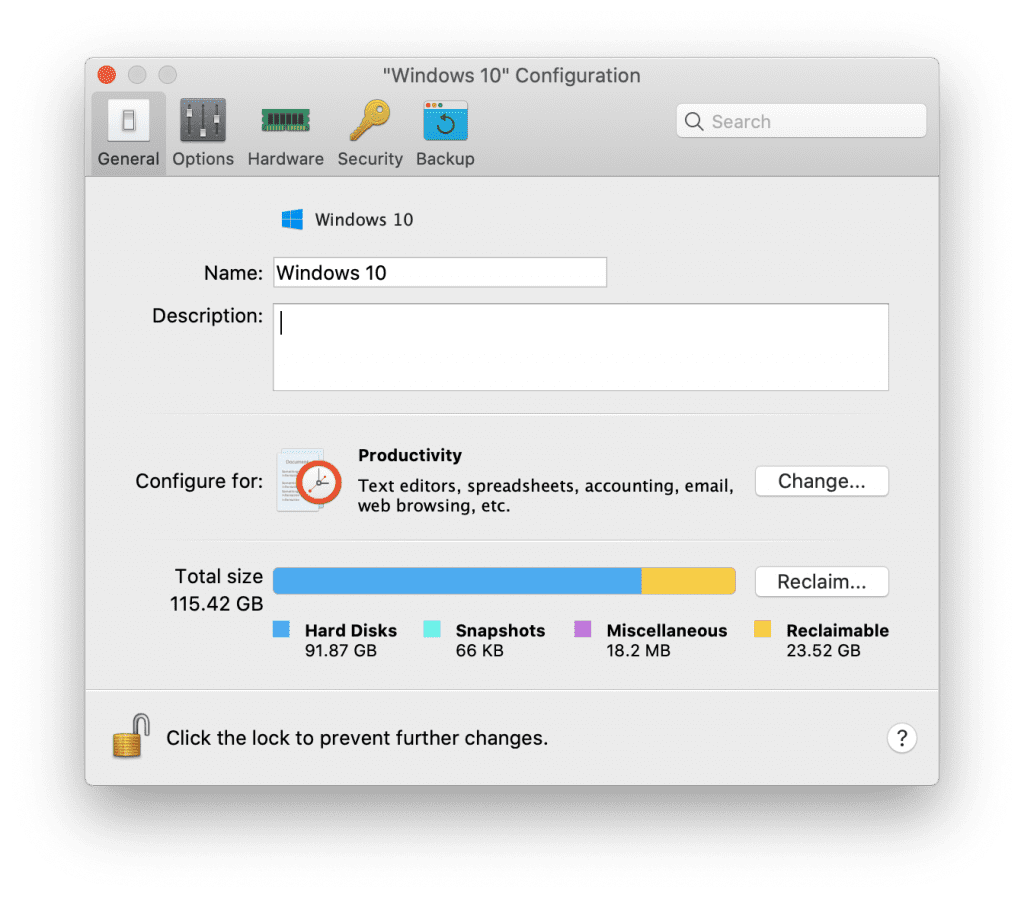
Windows Updates often require extra space for the download and for temporary files needed during the update, so the actual space needed by the virtual hard drive will often grow during the update process. While Windows removes the download and the temporary files at the conclusion of the update, the virtual hard drive doesn’t usually shrink after these are removed. This can lead to a situation in which there is unused space inside the virtual hard drive. Over time, with subsequent Windows Updates, this unused space can grow to many gigabytes. Figure 1 shows the result of one Windows 10 VM in Parallels Desktop 15.

Figure 1_Parallels Desktop 15 Reclaim Button

Now, the Parallels Desktop 15 user in the situation shown in Figure 1, could recover 23.52GB of empty space in the VM if they remember to open the configuration dialog and click on the “Reclaim” button. However, many people forget to do this. I like to think that I am an experienced Parallels Desktop user, but I often forgot to do this.

So, in Parallels Desktop 16, we added an option to do this automatically, as shown in Figure 2. After shutting down this VM, there will be approximately 24GB more space on the Mac main storage.

Figure 2_Parallels Desktop 16. Reclaim at Shutdown option

All that said, there is no free lunch. Reclaiming space takes some time, with the two most important variables being the overall size of the VM and the amount of space to be reclaimed. For the VM in Figures 1 and 2, this reclamation took about 17 minutes on my MacBook Pro. So, if you are the type of person who wants to shut down the VM, close the lid on your laptop, and run to your next meeting, you may not want to use this new option on a busy day filled with many meetings. On the other hand, if you are using a stationary iMac or a Mac Pro, then this option will help you avoid filling up your drive so quickly.

I hope this gives you a useful overview of this new feature in Parallels Desktop 16. Let us know in the comments how this feature is working for you. 

Feel free to test Parallels Desktop 16 for Mac for 14 days for free

The post Automatically Reclaim Disk Space – a new feature in Parallels Desktop 16 appeared first on Parallels Blog.

Dell and VMware revenues boosted by remote working


Bobby Hellard

28 Aug, 2020

Dell Technologies beat profit estimates with strong second-quarter earnings boosted by demand for its notebooks and software products for remote and online learning. 

The firm posted second-quarter revenues of $22.7 billion (£17 billion) and operating income of $1.1 billion (£827 billion), a 119% increase year-on-year. 

While the impact of the coronavirus, and the resulting lockdown, hurt other parts of its business, the rapid shift to the cloud spurred demand for hardware and software to enable remote working.

Orders from the education sector jumped 24% in the second quarter period ending 31 July, according to Dell, while government orders also increased by 16%.

“In Q2, we saw strength in the government sector and in education as parents, teachers and school districts prepare for a new frontier in virtual learning,” said Jeff Clarke, chief operating officer at Dell. 

Revenue in the firms biggest segments was also boosted by consumer sales of notebooks and gaming systems hitting double digits. Data centre sales, were down, however, dropping 4.8% to $8.21 billion (£6.18 billion), which Dell said was due to companies redirecting their spending towards remote working.  

Dell’s software unit, VMware, also benefited from the shift to cloud, posting a 9.7% revenue rise at $2.91 billion (£2.18 billion). 

“In light of these uncertain times, we delivered solid execution and financial performance in Q2 FY21,” said Pat Gelsinger, VMware CEO.

“With our Any Cloud, Any Application, Any Device strategy, we are helping customers solve their hardest technology challenges and meet and exceed their business objectives.”

Dell’s stake in VMware is worth almost $50 billion (around £40 billion), but the company is reportedly exploring a potential spinoff of its equity ownership of the software giant. Any potential deal is likely not to occur before September next year, but Dell has confirmed the plans by submitting a filing with the US Securities and Exchange Commission (SEC).

The cloud news categorized.